Best Wedding Planning Websites for Organized Couples
Integrated planning tools beat scattered apps by keeping guest data in one place.

The worst moment in wedding planning is smaller than a budget blowout or a vendor cancellation: the night before the ceremony, someone finds out a guest's nut allergy was logged in the RSVP tool weeks ago but never made it to the seating chart, because the seating chart lives in a separate app. Nobody transferred it. Nobody was supposed to, because no one owns that handoff. That's the real failure in wedding planning software, and it has nothing to do with how many features a platform offers. Couples end up re-entering the same names, numbers, and dietary notes across three or four separate tools, and every one of those re-entries is a chance for something to fall through.
Revel's 2026 guide states that the issue in 2026 isn't a shortage of wedding apps; it's an excess of overlapping "do everything" tools that generate more browser tabs than actual clarity. Open five tabs, each one promising to be the single source of truth, and none of them talk to each other. A typical stack looks like a checklist app for tasks, a separate tool for RSVPs, a spreadsheet for the budget, and yet another app just for the seating chart. Each piece works fine on its own. None of them know the others exist.
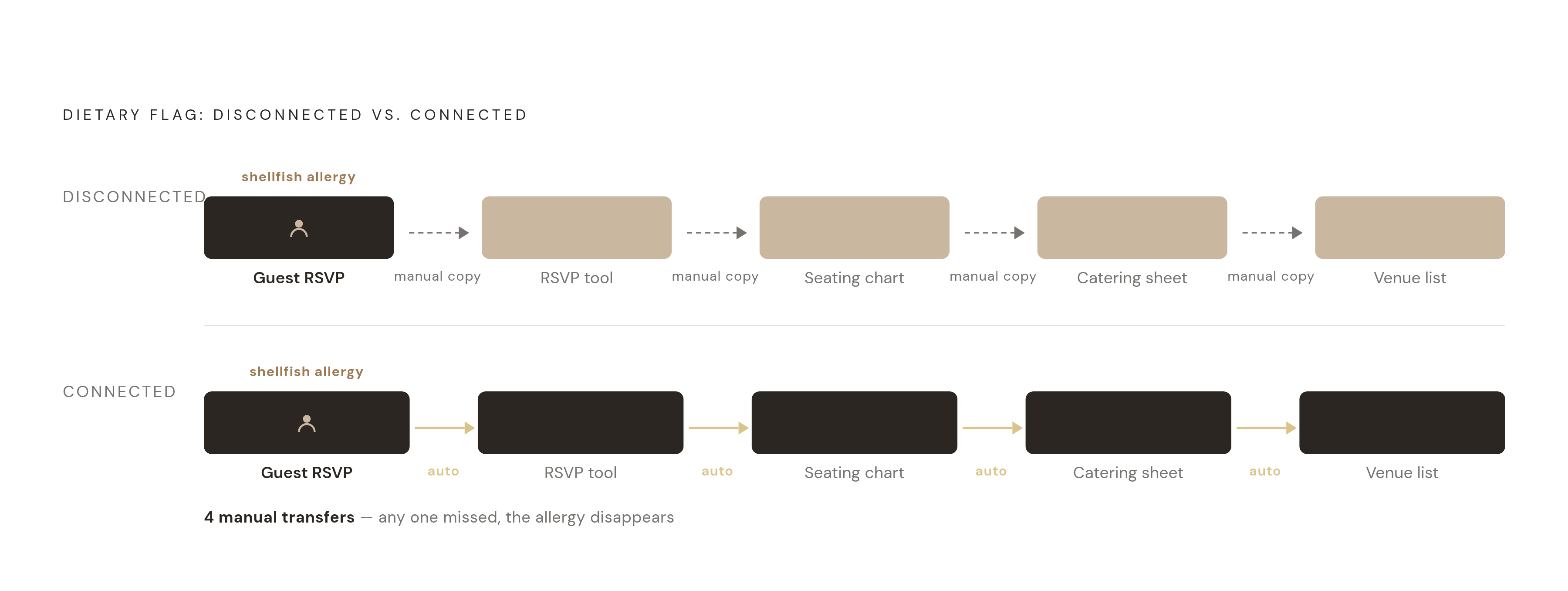
That's where the dietary requirement problem comes from. A guest fills out an RSVP form and notes a shellfish allergy. That information sits inside the RSVP tool, isolated, until someone manually copies it into the seating chart software, the catering spreadsheet, and whatever list gets handed to the venue. Every one of those transfers is manual data entry performed under deadline pressure, usually by two exhausted people a few weeks from their wedding date. It's a data-entry job with a deadline attached, and those jobs get missed.
Building a planning website for organized couples
A wedding planning website earns its place not by how many tools it bundles but by whether those tools actually share information with each other. Online RSVPs need to sync automatically into the master guest list, ideally broken out per event so a rehearsal dinner headcount and a reception headcount don't get tangled together. The wedding website itself needs to be something guests will genuinely visit and use rather than a page that gets built once and ignored. Seating charts should pull straight from the real, live guest list instead of requiring a separate import step that has to be repeated every time someone RSVPs late or changes a plus-one. Budget tools need to track actual invoices and payments as they happen rather than just hold a static estimate typed in back in month one. Checklists and timelines need to be sequenced against the actual wedding date, adjusting automatically instead of sitting as a generic list copied from a template. For Australian couples specifically, pricing needs to show in AUD, and no feature should require a US billing address or a US-based registry to function. And pricing itself needs to be honest: a free tier with clearly stated limits upfront beats a free tier that quietly turns into a paywall three weeks before the wedding, right when the stress is highest.
The single best test of whether a platform is actually connected, rather than just bundled, is to trace one piece of information through it. If someone submits an RSVP, does the guest list update without anyone touching it? Does that guest list feed the seating chart directly? Does a dietary flag entered once travel with that guest's record through every tool in the stack, from RSVP to seating to catering? If the answer to any of those is no, the couple is the integration layer, manually moving data between systems that were never built to talk to each other.
Research collected at rosevow.com points to a useful discipline here: the calmest couples keep their planning stack to three platforms or fewer, give each tool exactly one job, and refuse to add anything that creates friction for guests or locks their data inside a single app. That third point, guest friction, is easy to underweight when comparing platforms, but it matters as much as any internal feature. Guests should be able to RSVP, check the details, and respond without installing an app or creating an account just to confirm they're bringing a plus-one. Every extra step asked of a guest lowers response rates and turns into more phone calls and follow-up texts for the couple to chase down later.
Why the Australian context changes which platform wins
Most wedding planning platforms reviewed online were built for the US market first, and that appears for Australian couples in four specific places: pricing currency, vendor directories, legal requirements, and seasonal planning logic. None of these are cosmetic. Each one can produce a real planning error, not just an annoyance.
Start with the legal requirement almost no US-built platform accounts for. Australian law requires a Notice of Intended Marriage (NOIM) to be lodged with the couple's celebrant a minimum of one calendar month and a maximum of 18 months before the ceremony. Missing that window on either end means the ceremony can't legally proceed on the chosen date. A planning tool that doesn't know this requirement exists can't warn a couple when they're approaching the deadline, and a missed NOIM window isn't a scheduling inconvenience: it's the difference between a legal marriage and a very expensive rescheduling.
Then there's the seasonal mismatch. Australian wedding season runs spring, September through November, and autumn, March through April, which puts it on the opposite calendar from the northern hemisphere's June-heavy wedding season. A planning tool calibrated around a June wedding will sequence every milestone, from venue booking windows to vendor lead times, in the wrong order for an Australian couple getting married in October.
Vendor directories add a third gap. Platforms that claim Australian coverage vary enormously in how real that coverage is. Some have genuinely deep vendor listings, but only in Sydney and Melbourne. Couples planning a wedding anywhere outside those two metros frequently find the directory nearly empty when they search their own region. Ivory Lane's 2026 comparison flags this specifically as a weak point in UK-origin platforms expanding into the Australian market: the expansion brought the app, but not the vendor data to back it up.
How the all-in-one platforms connect and break
No platform currently on the market gets every criterion right. But the distance between the best-connected option and the most fragmented one is wide enough to change how the entire planning process feels, week to week.
One platform worth starting with charges nothing for weddings up to 50 guests, with paid plans available as a one-off A$99 or A$199 for two years of access, and no recurring subscription. The budget planner and seating chart both come included in the free tier, and the paid plans unlock guest-facing extras without locking couples into ongoing payments. Its honest limitation is the absence of a vendor directory: it's built to help couples compare and track vendors they've already found, not to help them find vendors in the first place. It also has no native mobile app, though it's web-based and designed to work fine on a phone browser. Some of its paid extras are still priced in USD. This platform suits Australian couples who want every planning tool connected and who never want to manually reconcile a dietary requirement between two separate systems again.
Ivory Lane, built in Australia and priced at A$99 one-off, is the only Australian wedding planning app offering AI-powered budget forecasting. That forecasting is trained on Australian budget benchmarks by city: roughly $42,000 in Sydney, $38,000 in Melbourne, and $33,000 in Adelaide. It supports real-time collaboration between partners, with assignable tasks, a decisions log, and sync across edits, so both people planning the wedding can own specific categories rather than one partner logging in just to approve the other's choices. It covers AU, NZ, UK, US, and CA, with pricing shown in local currency depending on region. The guest list tracks dietary requirements and meal selections, there's a vendor payment tracker with reminders, and a vision board comes free. Smart RSVP unlocks with the Planner upgrade at A$99, and cinematic invitation videos require the higher Planner + Share tier. Its honest limitations: no vendor marketplace at time of writing, though one is planned for late 2026, a smaller existing user community as a newer platform, and no native mobile app yet, with one expected later in 2026 per Ivory Lane's comparison. This one suits couples who want serious budget forecasting and real structured collaboration as the center of their planning process.
A larger Australian vendor-directory platform takes a different approach entirely, and it's free for couples to use. It claims broad reach across Australian wedding suppliers and offers detailed real wedding galleries with actual budgets attached, alongside a free checklist, budget tracker, and guest list. The trade-off is how it makes its money: it's heavily monetised through vendor advertising, meaning featured listings are paid placements rather than quality rankings, and submitting an enquiry through the platform forwards contact details to multiple paid vendors simultaneously, producing a burst of vendor emails per enquiry. Its planning tools stay basic by design: the budget tracker is a simple list rather than a forecasting tool, there's no AI involved, and the planning experience is manual and spreadsheet-style throughout. This platform earns its place for vendor discovery in Australia specifically. Use it to find and shortlist vendors, then move the actual planning work to a separate, more connected tool.
A UK-origin platform with an Australian expansion rounds out the field, also free. It includes a budget planner, checklist, guest list, and table planner, wrapped in a polished mobile app with AI-powered venue matching and an onboarding flow that personalizes the checklist based on wedding date and location. The Australian vendor directory is thin outside Sydney and Melbourne, and both the budget defaults and planning timelines are calibrated for the UK market, requiring manual adjustment for Australian conditions. It's a solid free planning toolset for staying organized, just not a reliable way to find Australian vendors.
Specialist tools that fill gaps the all-in-one platforms leave
For most couples, one well-connected all-in-one platform covers everything needed. But certain situations genuinely justify adding a single specialist tool on top: multi-event weddings, very large guest counts, or a need for professional-grade floor plans that a general planner can't produce.
Couples running multi-event or multicultural weddings, where a Mehndi night and a reception might each carry a completely separate guest list and headcount, are better served by a tool like Invyt. It gives each event its own guest list and RSVP form while still presenting guests with a single hub page carrying separate RSVP links per sub-event, and the couple sees all of it on one dashboard. It supports WhatsApp and SMS sharing, QR codes for printed invitations, and bilingual invitations, which matters for diaspora families coordinating guests across countries. Its gap: the tool's focus on floor plans means it lacks RSVP functionality, so dietary requirements collected elsewhere don't sync automatically with the seating plan, and someone ends up manually re-entering them by hand, the same way they would at the start of this piece. It makes the most sense for couples working directly with a venue coordinator on complex floor plans, particularly where the venue itself already uses this kind of software.
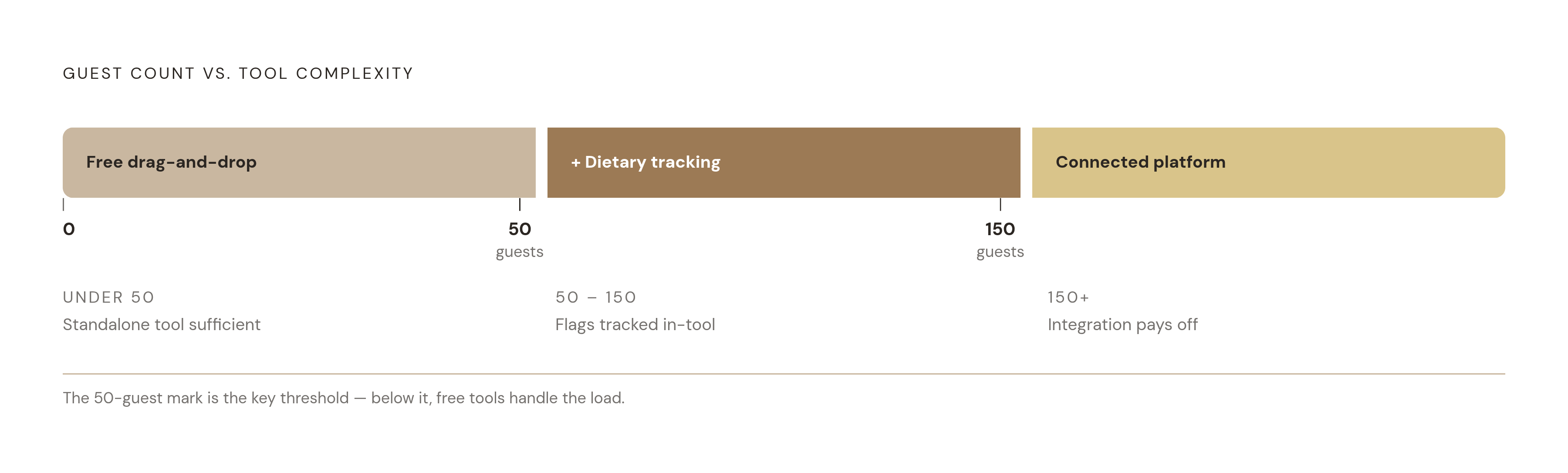
Smaller weddings don't need that complexity. Free standalone seating tools cover the job well below a certain guest count. SeatPlan.io offers free drag-and-drop seating chart creation with no signup required, supports round and rectangular tables, allows guest list import via CSV, and reserves real-time collaboration along with PDF and Excel export for its paid plans. Lovely Seating covers one full wedding seating plan free, with unlimited tables and guests, a drag-and-drop floor plan, guest list management, RSVP tracking, and CSV import. A reasonable rule drawn from this research: under 50 guests, a basic drag-and-drop tool handles the job fine. At a mid-range headcount, dietary flags need tracking directly in the tool. Above that, a fully connected system starts earning its cost back in the time and stress it saves.
Guest photo sharing rounds out the specialist category as its own tool rather than a feature to expect from a planner. Pix Wedding uses QR-code sharing, so guests scan a code and upload photos straight from their phone's browser, with no app install and no account needed. Its free tier covers a limited number of guest uploads, and paid plans are available as a one-time purchase rather than a subscription. None of these specialist tools are meant to replace the core connected platform a couple chooses for budget, guest list, and RSVPs. They exist to cover the specific situations those platforms weren't built to handle, and adding one should be a deliberate choice made for a real need, not a reflex that rebuilds the same fragmented stack this piece opened by describing.
Sources
- Best Wedding Planning Apps in Australia 2026 (Free & Paid)
- Best Wedding Planning Apps in Australia (2026): Honest Comparison
- Best Wedding Planning Software for Australia (2026)
- Best Wedding Planning Apps & Free Tools 2026: 5 + 30 Ranked
- Best Wedding Planning Apps in 2026: What to Use and Skip — Revel
- Best Wedding Planning Apps 2026: Honest Rankings