How to Plan a Deeply Considered Wedding Without a Single Recurring Charge on Your Statement
A free, connected toolkit can carry Australian couples to the day.

A deeply considered Australian wedding can be planned without a single recurring charge. The workable approach is to use free vendor discovery, keep guest details, seating and spending connected, and pay only for extras needed at a one-time cost. The deciding factor is not how many features an app advertises, but whether its free or one-time-payment version covers the work through to the wedding day.
Why so many Australian couples end up paying monthly for tools they barely use
A couple signs up for an app that ranks well, then discovers that part of it needs a US bank account or that its directory has no Australian suppliers. Switching already feels harder than staying. So they subscribe, work around the gaps and gradually stop noticing the monthly charge. The missing jobs still land in spreadsheets and inboxes.
That pattern starts with how much wedding software is built. Vendor directories make money from ads paid for by suppliers, so they build their products to keep couples browsing and clicking. Subscriptions reinforce that ongoing engagement. But a couple needs to finish a finite project. Paying every month does not necessarily buy a better fit for an Australian wedding.
What a fully considered Australian wedding actually requires a planning tool to do
A useful planning system must deal with deadlines before it deals with decoration. The legal deadline for lodging the Notice of Intended Marriage is at least one calendar month and no more than 18 months before the ceremony. A generic checklist that misses it leaves out something more consequential than a late stationery order.
The next requirement is a guest list that does more than store names. Planned and confirmed numbers need to feed into catering, seating and the budget, because per-head costs make attendance a powerful spending lever. Each guest’s dietary requirements must stay with their name all the way through to the caterer’s seating plan. A meal note must move with the guest when they change tables.
Vendor comparison, invoices, deposits, outstanding balances, invitations and the run sheet complete the operational picture. Each needs a clear home. The test is whether information can move through those jobs without being typed again, and whether any gaps are cheap and simple to cover. A screen that looks good is little comfort when a couple finds they must pay to do a key task.
How the planning phases sequence, and which phase each tool is actually built for
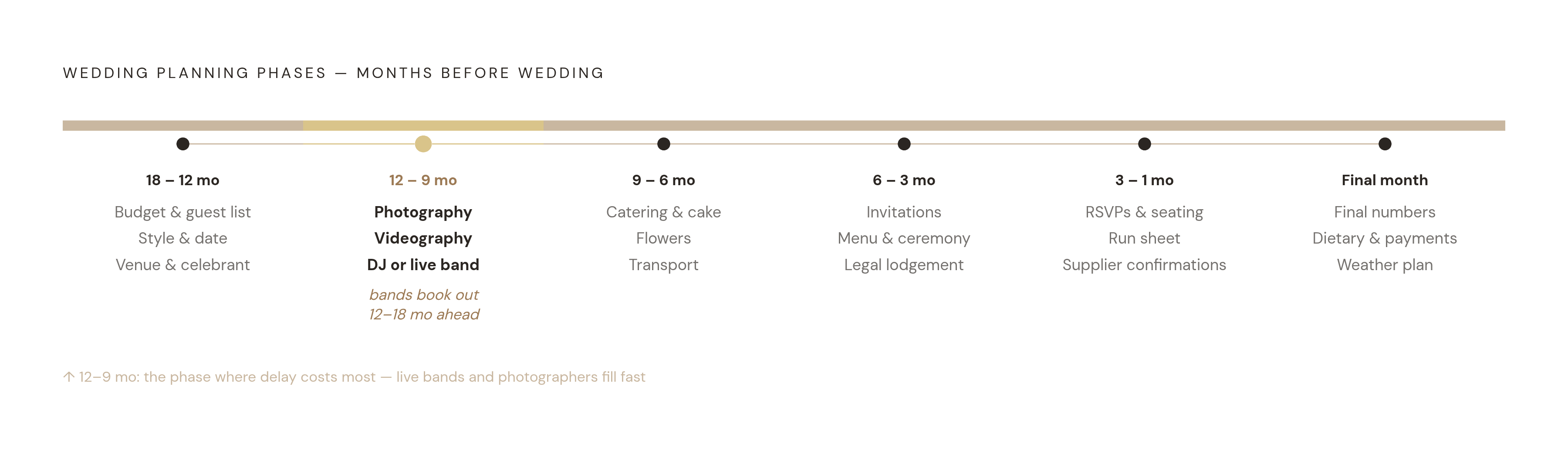
The first phase, 18–12 months out, establishes the budget, guest numbers, style, date, venue and celebrant. Australian couples usually plan over 12–18 months, while destination weddings and peak-season Saturdays can need 18–24 months. Timing changes the available choices. October, November, March and April fill up first, while Fridays and Sundays usually have more dates free and better rates.
At 12–9 months, attention moves to photography, videography and a DJ or band. Music needs an early place in the schedule because in-demand DJs book 6–12 months ahead and live bands up to 12–18 months ahead. At 9–6 months, it is time to arrange catering, flowers, cake and transport. Invitations, the menu and ceremony details follow at 6–3 months, with the legal lodgement window kept visible throughout.
At 3–1 months, the work becomes RSVPs, seating, the run sheet and supplier confirmations. The final month is for settling final numbers, dietary requirements, payments and a weather plan. Vendors need confirming at several points in the final weeks and days, including again close to the day.
A discovery platform may serve the early search well without helping with a caterer’s deadline. The practical choice is one system that follows the work, or two or three tools with clear roles and no duplicated data entry. Rebuilding everything three months out is the avoidable cost.
Where Australian couples actually find vendors, and why discovery tools and planning tools are different jobs
Discovery finds possible suppliers, while planning compares commitments and coordinates delivery. They are different jobs. Once that distinction is clear, there is no reason to keep the whole wedding inside the platform that first surfaced a photographer. Supplier-funded discovery can serve its purpose without becoming the home for guest allergies or payment records.
PickWed offers a shortlist of Australian vendors ranked by style, location, date and budget. Instagram also offers a practical route to regional photographers, florists and other suppliers through hashtags and local wedding accounts. Photography deserves careful attention because its uptake is second only to venues among wedding services, making it effectively non-negotiable for most couples.
The useful next step is to contact three vendors per category with a consistent message. Package inclusions and overtime rates belong in writing, as do prices first seen on a marketplace. Catering needs particular scrutiny because advertised and actual pricing can diverge widely. Moving those quotes into the planning system makes comparison about the same scope of work.
What the budget actually looks like across Australian cities, and why tracking it in real-time changes decisions
Sydney and Melbourne weddings tend to cost considerably more than regional or Queensland weddings. The average cost in NSW and Victoria is also higher than in Queensland, Western Australia, South Australia and Tasmania. Location sets part of the cost context. Yet the number of guests still makes the biggest difference, and per-head costs are much the same across the country, so changes to that number have a big effect on the budget.
Headline venue quotes do not tell the whole story. Cake cutting, corkage, chair cover hire, public liability insurance, ceremony amplification and vendor meals are frequently missed. These costs need somewhere to go before the final bill arrives. Otherwise, a couple can seem to be within budget while comparing estimates that all have costs missing.
A useful tracker keeps estimated costs separate from what the couple has agreed to spend, what they have paid and what they still owe. Deposits and partial payments must stay visible so an invoice that is only partly paid still shows what is owed. The confirmed guest count also needs to update the spending picture. That connection lets couples assess a change while there is still a decision to make, rather than discover its cost during final reconciliation.
A spreadsheet is not automatically the problem. A static one is. If guest numbers and invoices change elsewhere while the budget remains untouched, it stops describing the wedding being planned. The useful distinction is between a live account of commitments and a document that records the original hopes.
How the guest list, RSVPs, dietary requirements, and seating chart collapse into one problem if the data lives in separate places
The same disconnection becomes more serious when meal information is involved. A dietary response collected on paper or in a separate form may pass through a spreadsheet, a seating tool and an emailed document before reaching the caterer. Every handoff needs manual reconciliation. If a guest changes tables but the allergy note does not follow, the caterer has conflicting instructions.
Dietary needs are not one interchangeable category. Halal, kosher and allergy requirements need to remain distinguishable from personal preferences, particularly across the varied guest lists of cities such as Sydney and Melbourne. A single freeform box is insufficient as the whole system for handling those differences. The information needs to be clear enough for the people preparing and serving each meal.
Keeping the meal note on the guest ensures that moving a guest moves the dietary information with them. Gledswood Homestead in NSW needs each guest’s dietary requirements beside their name on the seating chart four weeks before the event. The final handover belongs in the planning schedule ahead of wedding-week admin.
The layout starts with the venue, before any seating software. Many Australian venues provide a scaled floor plan showing table positions, the dance floor, bars and entry points, though inclusions vary and speaker placement may need a separate request. A connected drag-and-drop tool becomes useful for a mid-sized guest list, while a smaller wedding can use a simpler approach. At larger weddings, it is harder to check by hand that records agree, and putting dietary requests into groups can help servers find the right guests.
Assigned seats offer control, while assigned tables leave more flexibility. Fully open seating at a formal reception can leave late arrivals separated from their partners as groups reserve chairs. The seating decision therefore has both a social and a service role. It must work for the guests finding their places and the caterers finding their meals.
Digital invitations and the wedding website as a communications layer, not a separate product
A wedding website should send guest details into the planning system. Otherwise, a beautiful RSVP page simply postpones data entry. The response arrives by email, someone updates the guest list, and someone later checks the seating chart. That is the same reconciliation problem with a nicer front door.
Canva supports wedding websites and invitation design, but a design-first website paired with a disconnected form still leaves responses to be transferred. Paperless Post offers digital invitations, RSVP tracking and real-time delivery monitoring. Those are useful invitation functions. Dietary responses collected outside the planning system, however, still need to be imported into the place where meals and seating are managed.
The connected standard is straightforward. A website RSVP updates the guest list, which already links to dietary tracking and seating, without an export or manual import. Delivery, opens and RSVP status should also be kept in one place. The website itself should be attractive, live and functional within an afternoon, so publishing it does not become a project that competes with planning the wedding.
Which wedding planning tools work without a monthly fee, and where do they stop?
Free, one-time payment and subscription describe cost models, with planning quality assessed separately. A free starting tier is useful only if its limits leave the necessary work accessible. A one-time extra can fit a subscription-free plan, provided it covers something the couple actually needs. The important boundary is where payment begins.
Free Australian vendor directories paid for by ads help couples find suppliers but do not cover all the work of planning. PickWed offers the matching approach described earlier, but the supplied information does not establish its pricing. Neither should be treated as evidence that guest management, payments and seating are included. Finding the right supplier is a substantial job, but it is not the whole job.
Canva has a clear supplementary role in printed materials such as menus, welcome signs and ceremony programs. Its design function does not need to share the planning database. The supplied information does not establish which of those uses are free or require payment, so it does not support a blanket no-cost claim. Keeping design separate is different from separating guest records, because a welcome sign does not need to reconcile a dietary response.
The available product details do not establish a named, fully connected planning app with a verified free or one-time-payment model. That limits any honest product comparison. The selection standard remains specific, however, namely connected RSVPs, guest-level dietary notes, seating, actual payment tracking and Australian deadlines. A tool qualifies for this approach only when those needed functions are available without a recurring charge.
What a subscription-free planning stack actually looks like, end to end
At engagement, the couple sets the budget and working guest count, then uses free vendor discovery to build a shortlist of three suppliers per category. Quotes move into a planning system chosen for its connections and non-recurring terms. Choosing the venue and celebrant sets the date and the schedule for the legal steps. Photography, video and music follow in time to book them, with timing based on how far ahead they fill up.
At 9–6 months, catering, flowers, cake and transport join the commitments being tracked. Deposits, partial payments and balances are each recorded on their own. Dietary fields are ready before invitations go out, so the replies enter the guest record from the start. Optional Canva designs remain outside that system because printed menus and signs have a different job.
As RSVPs arrive, the confirmed numbers feed into the budget and seating work without the couple having to keep a second guest list. The venue’s floor plan guides the layout, and its deadline sets the handover date for meal information. The final month is for confirming numbers, dietary requirements, remaining payments and the weather plan. Supplier confirmations continue through the final weeks and days, while a QR seat finder, if part of the chosen setup, is ready for guest navigation.
On the wedding morning, nobody needs to rebuild a dietary spreadsheet against a seating chart. The meal notes already belong to the people taking those seats. The final payments are accounted for, and suppliers have the agreed plan. The couple can arrive at their own wedding without bringing an unfinished admin job with them.