Vendor Management Best Practices for Wedding Coordinators
Centralize vendor details in one master document to stop searching and start solving.

One document. Every vendor detail flows through it and back to it. That's the whole principle, and it sounds almost too simple until you're standing in a venue at 9am on a Saturday trying to remember if the DJ's emergency contact is in your texts or the couple's email.
Here's the pattern I've watched play out more times than I can count: the catering contract lives in an email thread, the DJ quote is a PDF buried in someone's Downloads folder, and the sound engineer's number is in a WhatsApp message from three weeks ago. Something needs resolving fast, and you spend twenty minutes searching instead of solving. That's not a vendor problem. That's a structure problem.
The average couple hires 13 vendors (per The Knot's 2026 Real Weddings Study). Thirteen separate professionals, each carrying their own contracts, contact details, timelines, and requirements. None of them can see the whole picture unless someone builds it for them. That someone is you.
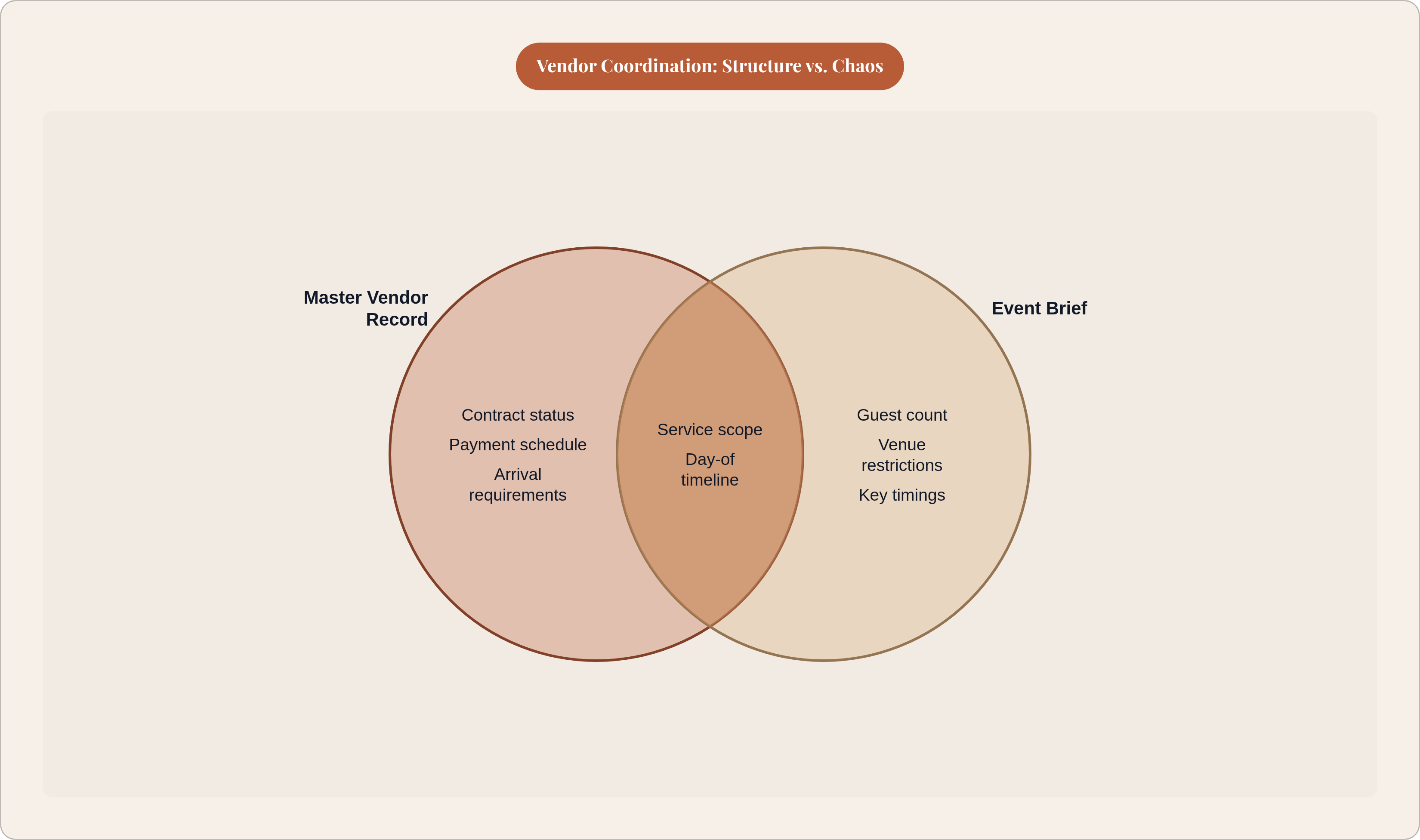
The minimum contents of a vendor master record:
Contact details. Primary and secondary. Day-of mobile numbers specifically.
Contract status and key terms. What's locked, what's pending.
Payment schedule. Deposit paid, balance due, payment method.
Service scope. Exactly what is and isn't included. Scope creep needs a paper trail.
Arrival window and setup requirements. Power needs, loading dock access, sound or candle restrictions.
Interaction notes. Not just decisions. Context too. Why you went in a certain direction, what the couple was worried about, what the vendor flagged.
Alongside the vendor record, you need an event brief. One document: event date, venue, key timings, guest count, service expectations, technical requirements, venue restrictions. It lives next to the vendor record, and both stay current.
One practical move that takes five minutes: set up a shared email address for the wedding (smithwedding2026@gmail.com, whatever). Vendor correspondence stays visible to both partners and out of anyone's personal inbox. Contracts and invoices go into a structured cloud folder the moment they arrive. Not later. Right then, before you move on to the next thing.
On which tool to use: honestly, it matters less than people think. Google Sheets is flexible and easy to share. Notion lets you link your vendor list directly to your budget and contract storage, which is genuinely useful once you've set it up. Trello visualizes progress well but gets shaky when you need relational data. Dedicated wedding planning platforms build those connections in from the start and cut out the manual linking that general tools require. Wedbuild, for instance, is a self-serve wedding organizer for couples that brings RSVPs, guest lists, seating charts, and budget tracking into one place rather than across separate tools. Pick the one you'll actually maintain. The tool is not the point. One place, accessible to every decision-maker, is the point.
Building the Master Checklist Template That Scales Across Every Wedding
Here's the mistake coordinators make early: they build a checklist for the wedding in front of them. The checklist that actually saves you time is a template first and a wedding-specific document second. I learned this the hard way, somewhere around my eighth or ninth wedding, when I realized I was rebuilding the same list from memory every single time and occasionally forgetting the same things.
Build one master template per service type. Full-service coordination gets one. Day-of gets another. Partial planning gets its own. The wedding-specific version is a customized copy of that template. You are not building from scratch each time.
Structure the checklist around milestones, not just tasks:
12 months out: Vendor category decisions locked. Venue, catering, photography.
6 months out: Contracts signed, deposit schedules active.
8 to 12 weeks out: Final guest count confirmed, dietary data collected.
2 weeks out: Final timeline distributed, vendor arrival sequence confirmed in writing.
1 week out: Tip envelopes prepared, vendor meal timing confirmed with caterer.
About 52% of couples begin planning 12 months out (per The Knot). If you're working with couples from the start, your checklist needs to pace the workload across that whole span. Front-loading everything or leaving it all to the last few weeks are both coordination failures. They just happen at different points in the calendar.
Two rules for every checklist item. First, assign an owner: coordinator, couple, or a specific vendor. Unassigned tasks are tasks nobody does. Second, give it a hard due date. "Before the wedding" is not a due date.
One more thing the checklist does that's easy to overlook: it works as a communication tool with the couple. Sharing milestone status reduces their anxiety because they can see progress instead of just feeling uncertain about it. That's real service, and it costs nothing extra.
Structuring Vendor-Specific Information So the Right Details Reach the Right People
Vendor coordination breaks down in two ways. Information goes missing entirely, or the wrong version reaches someone too late to act on it. Both cause the same kind of chaos on the day. They just have different paper trails.
Each vendor category needs its own information profile:
Venue: Setup details, floor plan, access times, power requirements, sound limits, candle policy, loading dock rules.
Caterer: Confirmed guest count, service style, full dietary breakdown by guest (not a summary count), dinner timing, vendor meal requirements and timing.
Photographer and videographer: Shot list, family groupings with pronunciation notes, must-capture moments, ceremony order.
Florist: Delivery timing, exact placement instructions, pickup schedule for rented items.
Transportation: All addresses, a named contact at each stop, buffer time built in.
Officiant: Ceremony order, name pronunciations, microphone logistics.
DJ or band: Reception run of show, song restrictions, must-plays and do-not-plays, expected dinner service end time.
Dietary requirements deserve their own attention because the handoff is exactly where they break down. Raw dietary data collected through RSVPs needs to be translated into whatever format the catering team can actually use. You don't forward a spreadsheet dump and call it done. The caterer is standing in a kitchen at 5pm, not at a desk with time to cross-reference.
If seating is assigned, dietary data must travel with each guest as they're placed at a table. The caterer needs a document that links guest name, table number, and dietary requirement together. A separate headcount summary isn't enough at service time.
Last-minute dietary changes will happen in the week before the wedding. They always do. You need a named process for them before they happen: who updates the caterer, by what method, by what deadline. Without that, you're reconciling dietary changes at 7am on the wedding morning, and nobody wants to be doing that.
The rule for every handoff: confirm receipt in writing. Not just that you sent it. That they got it.
The Vendor Timeline as the Document That Holds the Day Together
A single, definitive timeline is what converts a good plan into coordinated execution. It is not a suggestion. It is the mechanism by which everyone operates on the same version of reality.
One of the most damaging things you can do is update the timeline in pieces. The photographer hears one version. The caterer gets another. The DJ gets a text with a later change. None of them know they're working from different documents. This is how the cascade problem starts, except instead of starting with a late vendor, it starts with your own paperwork.
The protocol: one updated final timeline distributed to all vendors simultaneously, one to two weeks before the wedding. Any change after that goes to all vendors at once. Never selectively. I cannot overstate how much grief this saves.
Build the timeline backwards from the ceremony. Ceremony start is fixed. Work backwards to determine when photos must begin, when hair and makeup must finish, when transportation must depart. Buffer time is not a luxury. It's the margin where small problems get absorbed before anyone else notices them.
On staggered arrivals: a typical venue access window of three hours before guests arrive needs to accommodate four to six vendor crews loading in, setting up, sound-checking, and clearing the dock. The most common day-of complaint vendors file against coordinators isn't about pay or scope. It's about arrival overlap. The florist and caterer showing up at the same time. The DJ and photographer competing for the same hallway. Everyone losing time because nobody staggered the schedule. The stagger assigns each vendor a specific arrival time, a setup window, and a load-out path.
Vendor meals belong on the timeline too. A photographer, videographer, DJ, or planner working eight-plus hours needs a meal. That window cannot overlap with first dance, cake cutting, or any other moment you can't miss. Confirm this with the caterer in advance. It's a small thing that vendors remember.
Managing the Budget Across Vendor Categories Without Losing Track of the Total
Per Zola's 2025 First Look Report, 74% of couples went over their wedding budget. One in five overshot by more than $10,000. That's not a discipline problem. It's a structure problem.
Thirteen vendors, each with deposits, balance due dates, and potential add-ons, is a genuinely complex payment schedule to manage manually. The average U.S. wedding cost $34,200 in 2025 (per The Knot's survey of over 10,000 couples). That average hides an enormous range depending on which vendors are hired and at what tier, which is exactly why couples need category-level anchors, not just a single total number.
Rough category benchmarks:
Venue: 30 to 40% of the total budget.
Catering: 20 to 25%. Full-service catering costs rose $10 to $20 per guest in 2025 as food costs increased.
Photography: Average package price around $5,800 in 2025, but average couple spend was $2,900. That gap reflects the range between entry-level and premium photographers. Clients need to understand which end they're actually budgeting for.
Florals: Facing the sharpest cost pressure of any category right now. About 80% of U.S. cut flowers are imported, and tariffs have pushed floral design costs up 15 to 25%, with many florists now requiring $3,000 to $5,000 or more in minimums for full-service work.
Real-time budget tracking is the single most effective prevention against overspending. Not budget size. Not self-control. Real-time tracking.
Set aside a contingency reserve before any vendor is booked. The floor is 10 to 15% of the total budget. The 5% figure that sometimes circulates as a recommendation is a minimum, not a target, and actual cost surprises in vendor contracts tend to exceed it.
One more thing worth flagging to couples: many venue catering contracts include a service charge of 18 to 22%. That charge may or may not reach the staff. Couples who also prepare tip envelopes may effectively be tipping twice. Confirm in writing with the venue catering manager whether the service charge is a gratuity or an administrative fee. I've had couples genuinely surprised to find out the answer.
Per a 2025 vendor survey, 83% of vendors reported higher operational costs in 2025 and 77% raised their rates. If your cost benchmarks haven't been updated since 2023, you're giving clients numbers that no longer hold.
How Dietary Data and Seating Connect Vendor Information Into a Single Logistics Chain
Nearly 45% of couples identify guest list and seating logistics as the most anxiety-inducing task in planning (per Zola survey data). That's worth sitting with, because the anxiety isn't inherent to the task. It's structural.
The anxiety comes from two data streams that should be connected but usually aren't: who is coming, where they sit, and what they're eating. When those streams are disconnected, someone reconciles them manually. Usually the week before the wedding. Under time pressure. Across multiple spreadsheets that don't talk to each other.
What assigned seating above 100 guests actually requires:
Structured RSVP collection that captures dietary requirements in a usable format. Not free-text notes in an email chain.
A seating chart that carries each guest's dietary data as they're placed at a table.
A caterer handoff document that links guest name, table number, and dietary requirement. Not a separate headcount summary.
A day-of system (QR codes, place cards, or whatever works for the venue and service style) so staff can identify requirements at the seat without stopping to ask guests.
Last-minute changes need a closed-loop process defined before they happen. Who updates the seating chart. Who notifies the caterer. By what method. By what deadline. Without that process established in advance, you are reconciling it at 7am on the wedding morning and hoping nothing falls through.
When RSVP data, seating, and dietary information live in one connected system, the caterer handoff becomes a report you run, not a manual exercise you build from scratch. That's where the coordination infrastructure pays its clearest dividend, and it's the kind of thing a caterer notices and remembers.
Building the Vendor Relationships That Generate Referrals After the Wedding
Vendor referrals are the primary lead source for most coordinators after year two. The pattern holds across the industry pretty consistently.
The way it works: couples ask their florist, their photographer, or their caterer who they like working with. The coordinators those vendors recommend are the ones who made their job easier on the day. Not just the ones who were pleasant to be around, though that helps. The ones whose information was complete, whose timeline was accurate, whose arrival sequence didn't create a traffic jam in the loading dock.
What makes a coordinator easy to work with, from a vendor's perspective:
Clear, complete information delivered in advance.
A staggered arrival schedule that respects their setup time.
A timeline built around the realistic logistics of their service, not just the couple's ideal scenario.
One contact point and one up-to-date version of every shared document.
Vendors talk to each other constantly. They compare notes on which coordinators run tight ships and which ones create chaos that rolls downhill onto their crews. The reputation you build with vendors is a marketing asset that compounds quietly over time. You don't have to advertise it. It just shows up in who gets recommended.
The best coordinators aren't the ones with the most elaborate systems. They're the ones whose systems are simple enough to actually maintain, comprehensive enough to catch the gaps, and shared openly enough that every vendor is working from the same map. That's it. That's the whole job.