Wedding Planning Tools Designed for Professional Planners
Professional planners and couples need completely different wedding software.

Most couples hit the same wall early in planning. They search for "wedding planning software," find something that looks comprehensive, maybe even impressive, and only later realise the tool was built for a professional planner to run their business, not for a couple to run their wedding. That confusion is a product category problem, not an accident of marketing. Professional wedding planners and engaged couples are looking at the same event, but they have almost nothing in common as software users. A planner runs dozens of weddings at once, bills clients, and manages vendor contracts across a whole portfolio, so they need workflows built from templates that repeat cleanly from one job to the next. A couple plans exactly one wedding, one time, usually with no prior experience doing anything like it. The tools built for planners reflect the planner's reality: multi-client dashboards, agency branding, templated contracts, built-in invoicing. All of that is genuinely useful, for the person running the business. None of it helps the two people trying to plan their own day.
For professional wedding planners in 2025, Aisle Planner remains the clearest industry pick: its Contacts section lets planners build detailed profiles for every vendor across their entire client portfolio, including proposals, contracts, invoices, and payment schedules with automatic reminders, making it genuinely efficient for anyone running dozens of weddings at once. HoneyBook sits in an adjacent category, built for wedding vendors such as photographers, florists, and videographers who need to manage a pipeline of leads, proposals, and client payments across a full season. Both tools are structured around multi-client workflows, templated contracts, and business billing, which is exactly what a planner running a portfolio needs. Couples planning their own wedding are a different user entirely and are systematically underserved by both products.
What a Pro-Planner Tool Is Built to Do
Aisle Planner is the clearest case study in this mismatch, built to do a specific job well. It's considered the industry pick for professional wedding planners, and for good reason: its most valuable feature is the Contacts section, where planners build detailed profiles for every vendor they work with, including proposals, visual inspiration, contracts, invoices, and a payment schedule with automatic reminders built in. For a planner juggling several weddings and dozens of vendor relationships at once, that structure is a genuine time-saver. It's considered one of the most collaborative and efficient tools currently available for running a wedding planning business.
The pricing makes the audience obvious. The starter plan runs $59 USD a month with a 12-month minimum; a couple using it for a single wedding would commit to roughly $700 USD, or about $1,050 AUD, for one event they'll never plan again. If you're a business amortising this cost across a full client roster, it's reasonable. It's a strange cost for two people planning one wedding.
The features that make Aisle Planner valuable to a planner are also the features that do nothing for a couple. The seating tools are limited compared to dedicated seating planners built specifically for that job. The registry function skews toward US retailers, which matters little to an Australian couple registering at stores their guests can actually shop at. Paid extras, including custom domains, are priced in USD, and that's a small sign the product was built for a different market and a different user. None of this makes Aisle Planner a bad product. It makes it the wrong product for a couple, a different claim entirely, worth understanding before spending money based on a planner's recommendation.
How HoneyBook serves vendors, not couples
The mismatch isn't limited to planner-facing software. Couples also run into an adjacent category: CRMs built for wedding vendors themselves, and these are just as misaligned with what a couple actually needs. HoneyBook is a good example. It's excellent software for service-based wedding businesses, photographers, planners, florists, videographers, who need to manage a pipeline of clients. It handles leads, proposals, contracts, and payments for the vendor's business, which is what a photographer juggling twenty inquiries a season needs.
A planner has to repeat the same process across fifty weddings a year. A couple needs to get through one wedding, once, without the emotional weight and financial stakes of the day turning into a logistics failure. Reusing a workflow isn't the goal; getting through a single, high-stakes, deeply personal project is, which raises the real question: if pro-facing tools solve the wrong problem, what does a tool built for a couple actually need to solve?
What couples need from a planning tool, and why the criteria differ so sharply
A couple's planning situation is structurally different from a planner's in ways that should shape every feature a tool offers them. They're planning one wedding, not fifty. They usually have no prior experience to draw on. Their budget is fixed, often tightly, and the process of spending it is genuinely anxiety-producing in a way a planner's client billing never is. Decision-making is shared between two people, not centralised in a single operator's dashboard. And the entire project has a hard, permanent endpoint: once the wedding day happens, the coordination need ends completely, with no next client and no repeat use for the system.
Those differences translate into a concrete list of what a tool actually has to deliver. Online RSVPs need to work per-event where a couple is hosting multiple functions, and they need to sync automatically into the guest list rather than requiring manual re-entry. A wedding website needs to be something guests will actually open and use. Seating charts need to connect to the real, current guest list. Budget tools need to track actual invoices and payments as they're paid, so early estimates don't go stale the moment a vendor is booked. Checklists and a planning timeline need to reflect how Australian weddings actually get planned, step by step. And the tool itself needs to be built for Australia: pricing in AUD, and no features that quietly assume a US address or a US retailer.
Pricing has to be honest too. Free tiers need limits a couple can actually understand.
None of these criteria matter in isolation nearly as much as they matter connected. When an RSVP updates the guest list automatically, it feeds directly into the seating chart, so table cards come out with dietary legends already attached. That chain matters because caterers need meal choices and dietary requirements recorded per person, not per household: kitchens route meals by seat, not by family. A tool that handles each of these steps separately, with no connection between them, forces a couple to manually reconcile RSVP responses against a seating chart against a catering order, by hand, at the exact moment they have the least bandwidth to do it. That's where day-of errors come from.
Shared access between partners matters for the same structural reason. When family members are contributing significantly to the budget, as they often are, multi-party collaboration becomes a financial-coordination requirement, not just a convenience. Two people, and sometimes two sets of parents, need visibility into the same numbers in real time.
The real cost stakes that make choosing the wrong tool consequential for Australian couples
The financial scale of an Australian wedding is why getting the tool choice wrong carries real consequences, not just mild inconvenience. Couples routinely spend more than they initially budgeted, and the gap between what they planned to spend and what they actually spend is substantial. A tool that tracks estimates instead of real invoices, or that uses the wrong cost categories entirely, sends a couple into their planning with worse financial information than they'd have with a plain spreadsheet.
That's why a guest-list tool that connects directly to budget tracking is core financial infrastructure, not just a nice add-on. Every RSVP that comes in should shift the budget forecast in real time, because every confirmed guest changes what the day actually costs.
Per-head catering costs also vary significantly by city. Sydney costs more than Melbourne, which in turn costs more than Brisbane and Perth. A budget tool built around US-market averages, or around generic international templates, will systematically mislead an Australian couple about what they can actually afford, because it's answering a cost question for the wrong country. If a couple plans in Adelaide using benchmarks built for an American city, they don't get a rough approximation. They're getting a wrong number, at the exact moment they most need an accurate one.
What Are the Best Wedding Planning Tools for Professional Planners in 2025?
A small number of tools in the Australian market are genuinely built for couples, as opposed to businesses or vendor directories, and they differ enough that the right pick depends on what a couple needs most.
Ivory Lane, built in Melbourne and launched for the Australian market in May 2026, is the most complete option for couples who want to replace spreadsheets with a single system. Its standout feature is AI-powered budget forecasting grounded in real Australian pricing benchmarks by city, rather than generic templates: Sydney is around $42,000, with Melbourne and Adelaide running progressively lower. It also offers real-time partner collaboration, with edit sync, a shared decisions log, and tasks either partner can take ownership of, so planning doesn't default to one person managing everything alone. The guest list has dietary requirements and meal selections built in, you also get a vendor payment tracker with reminders and a vision board, all free to start. A one-off payment, not a subscription, unlocks Smart RSVP, cinematic invitation videos, unlimited guests, and more, and every new couple can try the paid features free for seven days before deciding. If you want AI-assisted budget forecasting and structured partner collaboration instead of a shared spreadsheet, Ivory Lane suits you; if you want to find and compare vendors from scratch, look elsewhere, since it helps you evaluate vendors you've already found rather than discover new ones, and it's a web-based tool designed for phones, not a native app.
Managing Matrimony, also built in Australia, takes a broader approach: guest list, RSVPs, invitations, wedding website, seating chart, budget, runsheet, checklist, and vendor directory, all inside one connected platform. The free plan supports a limited guest count, and paid plans are available as one-time purchases rather than subscriptions. If you want every planning function in a single environment without stitching several apps together, it suits you.
SeatPlan.io covers one job and covers it in depth: seating charts. It turns any floor plan into a workable seating chart, couples can upload a photo or a PDF and the tool's AI builds a layout for review. It supports round and rectangular tables, guest list import via CSV, real-time collaboration between partners, drag-and-drop table arrangement, ready-made templates, export to PDF and Excel, and works as a progressive web app on any device. If you have a large or complex guest list, 100 or more, and want dedicated seating capability layered alongside a broader planning tool, this suits you best. It isn't built to be an all-in-one solution, and it doesn't need to be: the earlier point about integration chains still applies, and a couple using a dedicated seating tool for seating should still want that chart connected back to a real-time guest list elsewhere.
Applying the right tool to the right stage of planning, using the Australian planning timeline
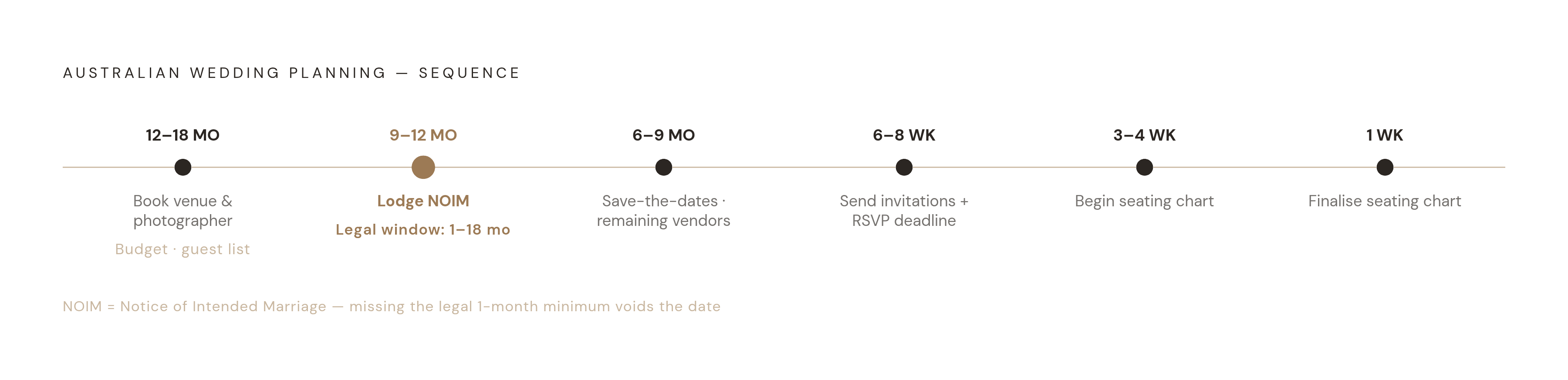
Choosing the right tool only pays off if it's used at the right point in the process, because Australian wedding planning follows a sequence where each decision constrains the next one. The order isn't arbitrary, and a good tool should reinforce that order rather than hand a couple an undifferentiated list of tasks to tackle in any sequence they like.
At 12 to 18 months out, budget and guest list need to be settled first, before anything else, because those two decisions determine venue, date, and every per-head cost that follows. Venue and photographer bookings follow once those numbers are fixed. At 9 to 12 months out, couples need to lodge the Notice of Intended Marriage with a celebrant, a legal requirement in Australia that must be filed a minimum of one calendar month and a maximum of 18 months before the ceremony. Missing that one-month window means the couple legally cannot marry on the date they've planned around, making this the one step in the entire timeline with no flexibility. Celebrant and caterer bookings typically happen around this stage too. At 6 to 9 months out, save-the-dates go out and remaining vendors get booked. At 6 to 8 weeks out, formal invitations go out with an RSVP deadline attached, stretched to 10 to 12 weeks for destination weddings or in cases where no save-the-date was sent earlier. At 3 to 4 weeks out, seating chart work begins in earnest, once the RSVP deadline has closed and the guest list is final, which is exactly the point where a dedicated seating tool earns its place in the process. At 1 week out, you finalise the seating chart using confirmed RSVP data, and that closes the loop that started months earlier with the guest list.
Season matters here too. Peak season in Australia runs spring, September through November, and autumn, March through April, when the best venues and photographers get booked out 12 to 18 months ahead. A summer or winter date often unlocks meaningfully better pricing and availability. A planning tool built around Australian seasons, rather than Northern Hemisphere norms baked in from an overseas template, reflects that reality instead of working against it: the same test separates every tool in this piece, built for how Australian couples actually plan, or built for someone else's calendar.