Wedding Venue Shortlisting Workflow for Couples
Lock down your guest count, budget, and must-haves before touring anywhere.
Most couples pick a venue backwards. They fall for the string lights on Instagram, save forty photos to a folder, and only ask about price once they're already picturing their first dance in that exact spot. Venue eats up roughly 40% of a typical wedding budget, so whatever you spend there sets the ceiling for everything else. Keeping that ceiling visible alongside everything else is exactly what a self-serve wedding organizer like Wedbuild, a free-to-start planning app that tracks a couple's budget, guest list, RSVPs, and seating in one connected place, is built to help with. Research from recent wedding industry reports shows 74% of couples went over budget, and one in five blew past it by more than $10,000. Venue is where that drift usually starts, and the fix is picking your constraints before you open a single tab, rather than more scrolling.
Setting the three constraints that define your real search
Three things need locking down before you look at a single venue website: guest count, budget, and your non-negotiables. Skip this step and you'll tour six beautiful spaces that were never actually options.
Guest count needs to be a real number, not a vibe. A 150-guest dinner in round tables eats up around 1,800 square feet of seating alone, closer to 2,200 to 2,400 once you add the bar, dance floor, and walkways so people aren't climbing over each other's chairs. The average U.S. wedding in 2025 runs 122 to 132 guests, but micro-weddings (50 or fewer) now make up 18% of all weddings, nearly double their share from 2013. Nobody hands you your guest count. You decide it, and then you live with the math.
Budget needs to be a hard ceiling, not a range. A range invites you to talk yourself into things later, while a firm number holds its ground even at 11pm after a second glass of wine and a really nice tour.
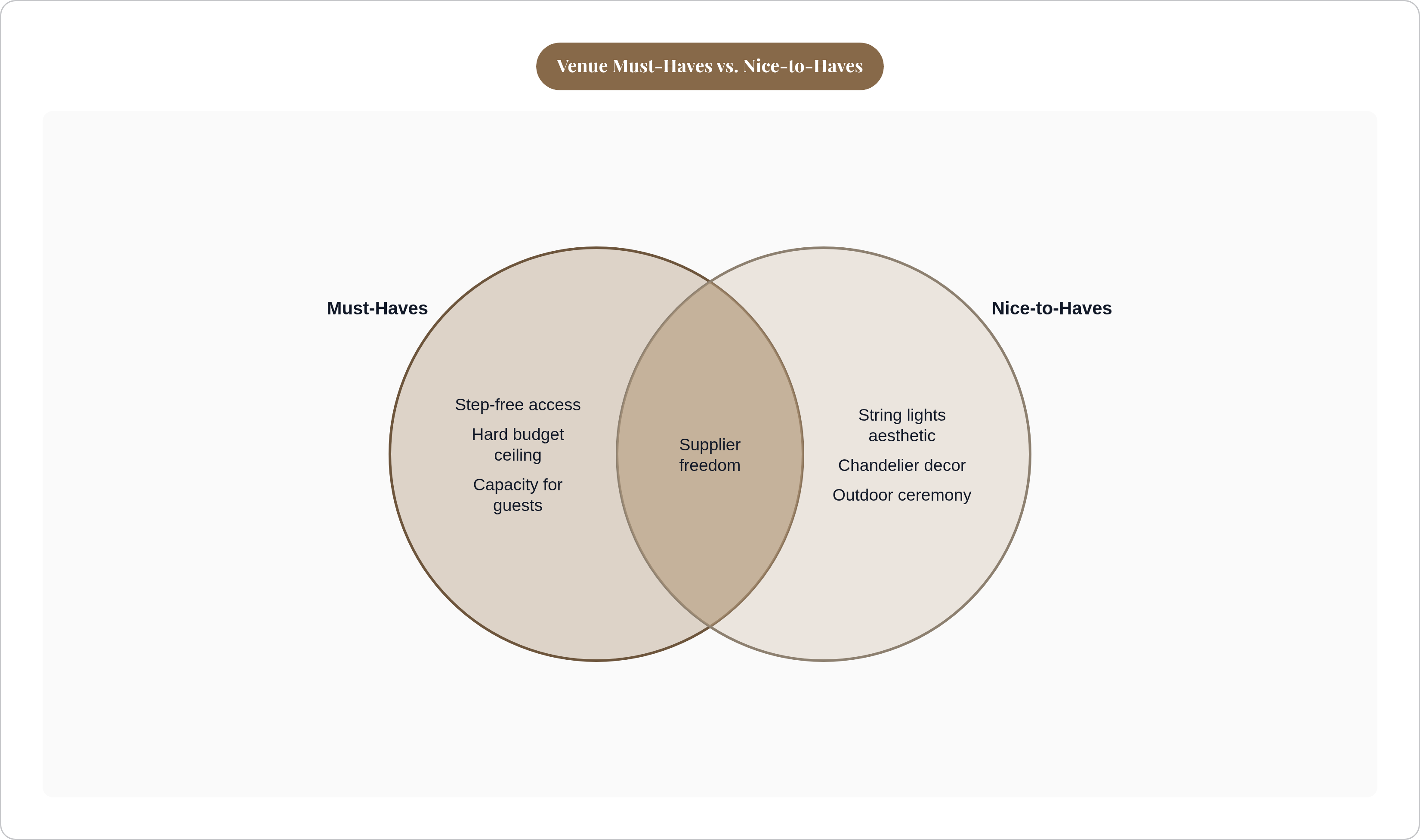
Then write down the non-negotiables: how far you'll drive, which dates are actually on the table, indoor or outdoor, whether one space can hold ceremony and reception both. Separate must-haves from nice-to-haves, because must-haves kill a venue on sight and preferences only get to vote once the survivors are lined up. Do this before you tour anything. Tours have a way of turning "we need 150 seats" into "well, we could cut twenty people, right?" Put accessibility on the must-have list too, step-free access, accessible bathrooms, parking that isn't a quarter-mile hike, and check it while you're filtering, not after you've already fallen for the place.
How to build a longlist that is wide enough to be useful
A longlist and a shortlist do different jobs, and mixing them up is how people end up "settling" for the third venue they ever looked at. The longlist exists to be wide, giving your filter something to chew on.
Pull from more than one channel. Venue directories help and can list tens of thousands of vendors with photos and virtual walkthroughs, but a local wedding planner will know about pricing quirks and last-minute openings no directory will ever show you. Recent couples in a local Facebook group will tell you the truth a venue's own marketing team never will. And scroll the venue's actual social feed, not the one styled shoot they paid a photographer to stage under perfect lighting for four hours.
Get enough entries on the list to filter through meaningfully, but don't let it balloon into something unmanageable. No emotional attachment yet, this is a working document, not a ranking. Run everything against your must-haves and cut fast; anything that fails goes before you've even sent an email, not after a tour where you got attached to the chandelier. Start early, too. Most couples book 12 months out or more, and destination weddings need even more runway. If you want a popular Saturday, early booking is the only way in.
What to ask every venue so you can compare them on the same terms
Here's the annoying part: venues don't quote the same way. Some price per head, some do flat-fee hire, some bundle everything into one number that means something different at every single property. Ask the same questions of everyone or you're comparing apples to, well, whatever a barn charges for overtime. Per WedInspire's research, 88% of couples said knowing all the costs upfront mattered most, and slow responses plus confusing pricing were the top two complaints once venues actually wrote back.
Send every venue on your longlist the same short inquiry, covering capacity (seated and standing, minimum and maximum), available dates and what the hire fee actually includes (tables, chairs, linens, AV, staff), catering rules (in-house only, a preferred list, or wide open), and everything excluded that you'll have to rent separately, plus service charges, taxes, bar minimums, overtime rates, and cancellation terms.
Supplier restrictions deserve extra attention, and I mean that. A lot of venues require in-house or approved-list catering, which quietly takes your biggest vendor decision out of your hands before you've even picked a venue.
Keep every response in one place, a shared doc or a vendor tracker, instead of scattered across nine different email threads you'll never find again. And pay attention to how a venue answers, not just what they say. A venue that's slow or vague at the inquiry stage stays slow and vague after you've signed the contract. That's a pattern worth trusting.
Decoding venue pricing so raw quotes become real numbers
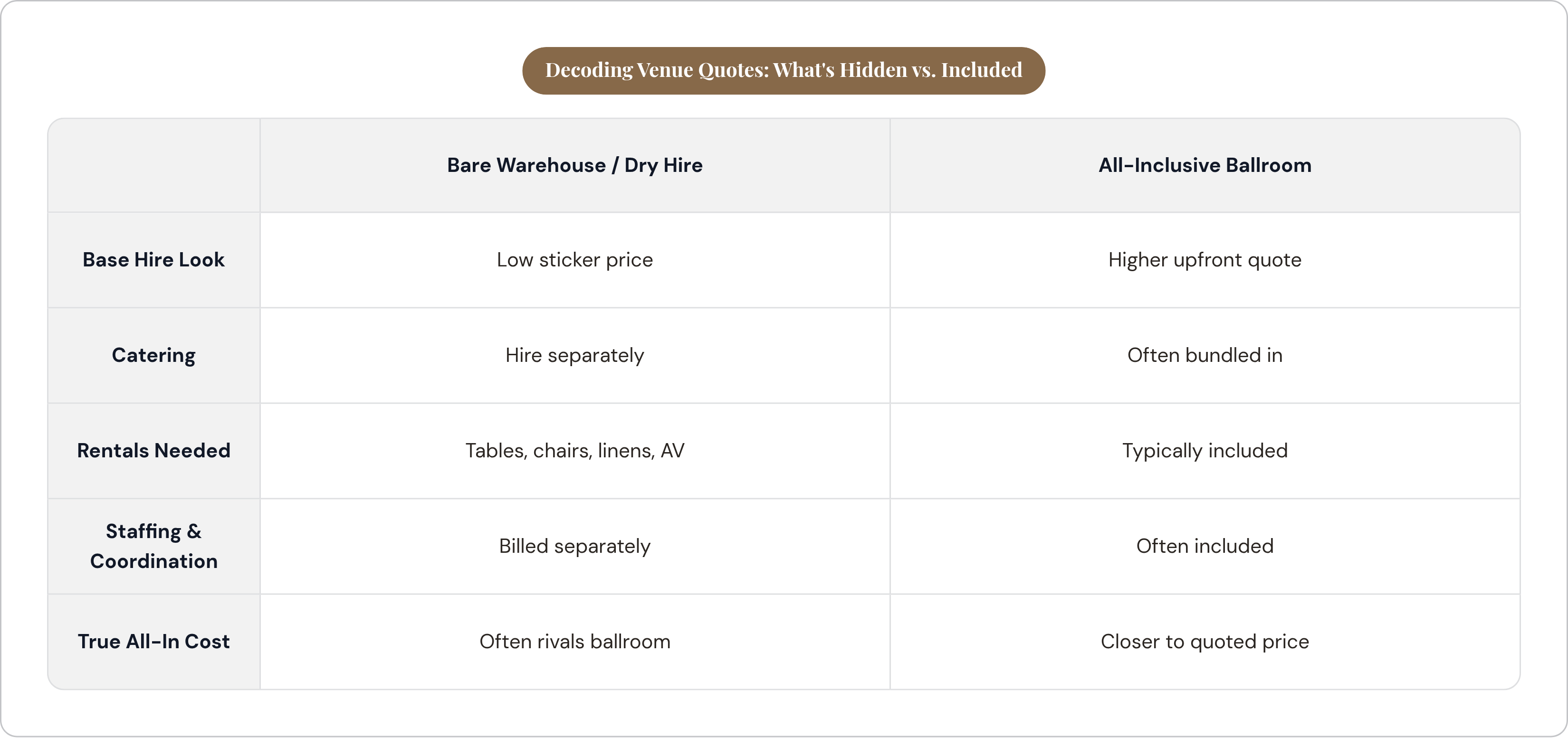
The number on the quote sheet is rarely the number you pay. The gap comes from the same handful of places every time: service charges (a cut of your food and drink bill), taxes and gratuities that sometimes get itemized and sometimes just vanish into a lump sum, overtime fees if your night runs long, rental add-ons for whatever the base hire doesn't cover, bar minimums that charge you whether your guests drink or not, and staffing or coordinator fees billed separately from the room itself.
A bare warehouse space looks like the budget option on paper. Add rentals, catering, staff, and a coordinator, and it can land more expensive than the hotel ballroom that included all of it from the start. Funny how that works.
So do the math for real: convert every quote into an all-in cost per guest, using your actual headcount, not the guess you had three months ago. That's the only way to put a barn and a ballroom on the same scale without lying to yourself.
Season matters too. Summer carries the highest rates and the earliest booking windows, Saturdays cost more than any other day of the week, and a Friday or an off-season date can move the total by a real amount. A contingency buffer is widely recommended by planning resources, and it's usually venue surprises found after the contract's signed that eat into it. No quote counts as comparable until the hidden costs are sitting right there next to the sticker price.
Running a structured site visit that gives you usable information
A site visit without a checklist leaves you with feelings; a site visit with one leaves you with data.
Build a standard visit brief and use it everywhere: how guests move from arrival to ceremony to reception, where the bar sits relative to the dance floor, what the light actually looks like at the time your ceremony would run (not noon, if your wedding's at six), and what noise bleeds in from the street or the venue next door. Check kitchen access, loading areas, and the wet-weather backup if any part of this happens outside. And check accessibility again: step-free routes, restroom access, how far parking sits from the door, for every guest, not just the ones who can take the stairs.
Visit at the time your wedding will actually happen, if you can manage it. A room that glows at noon can go completely flat by six. Ask to see it set up for a wedding close to your size, because a room's capacity on paper and its capacity with 130 people and a dance floor crammed into it are two different rooms entirely.
Take photos and video every time, and file them next to your financial notes so the feeling and the numbers live in the same place. Write your impressions down the second you leave the parking lot, before your next two tours turn every venue into the same beige blur.
Scoring venues side-by-side so the decision is legible
By the time you've reached this point, every venue has answered the same questions, every quote is converted to an all-in per-head number, and you've got notes from every visit. Now you score them.
A simple matrix does three things: forces the trade-offs into the open, takes the pressure off holding six criteria in your head at once, and gives you and your partner shared language for the disagreement you're definitely going to have.
Score each venue on must-haves (pass or fail, no partial credit for "almost"), budget fit against your ceiling, freedom on suppliers, how well they communicated when you first reached out, logistics like parking and noise rules, and atmosphere. Weight that last one if you want, but keep it to one line item among six rather than letting it swallow the scoreboard. A shared tracker beats three spreadsheets and an inbox you're both scrolling through at midnight.
If two venues land in a near-tie, go back to the must-haves and the supplier question first. Those settle it more often than the room's vibe does, even when the vibe is the thing screaming the loudest.
What to confirm before signing and how to protect yourself after
Scoring gets you to a decision. Signing turns it into a legal document, so read it like one.
Before you sign anything, get it all in writing: exactly what's included at the price you agreed to, the supplier restrictions and whether exceptions are negotiable, the full payment schedule (deposit, installments, final balance date), cancellation and postponement terms including what happens to money already paid, how overtime gets triggered and priced, and the deadline for your final guest count. A contract that doesn't match what the sales rep told you on the phone is still the contract you're stuck with when something goes sideways.
Once you've booked, set calendar reminders for every payment date and the guest-count deadline. Venues hold you to their dates whether you remember them or not, and "I forgot" has never once un-charged a late fee. Keep one folder, physical or digital, with the signed contract, every email, and every receipt. The morning of the wedding is not when you want to be digging through your inbox for a message from four months ago.
Booking the venue is what unlocks everything else. Once the date and space are locked, the photographer, the band, and the caterer come next, and for summer Saturdays, those vendors often book 12 to 18 months out. Staying organized after you sign is what carries the calm you built during the search through the chaos that shows up the second everything else starts moving at once.