Why Australian Vendors Disappear From Your Wedding Website When the Platform Is Built for the US Market
US-built wedding tools often fail Australian couples on vendors, budgets and legal deadlines.

A wedding website builder built for Australia needs more than a price in AUD. It needs local budget benchmarks, guest and seating data that stay linked, and a way to keep track of Australian vendors. US-built platforms can have good planning tools, but the way their directories make money often leaves Australian couples doing the local work elsewhere.
How US wedding platforms make money, and why that model leaves Australian vendors out
US wedding directories usually make money from paid listings or paid leads. Vendors pay to appear where couples are searching, or to receive enquiries that might become bookings. That model depends on competition for visibility. Where enough photographers, florists and caterers serve the same area, a directory can turn that competition into revenue. Per-lead costs on major US wedding directories grew 18–22% year over year as of 2025, showing the commercial pressure within that model.
Australia has a substantial wedding market, but it is spread across a continent. Its vendor density differs from the US metropolitan markets around which these directories were built, weakening the commercial case for populating a local directory. The software can travel more easily than the marketplace. A website builder can work for an Australian couple without a network of local suppliers, but a directory needs that network to help couples find suppliers. The resulting gap is structural and requires more than a software update alone to fix.
What an Australian couple actually encounters when they open a US-built planning tool
Imagine you’re an engaged couple in Melbourne opening a tool to plan your wedding. The website builder works, the guest list looks useful, and the checklist gives the planning some shape. Those tools have genuine value across borders. A seating chart does not become useless simply because the software was built overseas, and a wedding website can still give guests the information they need.
The problem appears when you try to find suppliers. A search for a Sydney photographer or a Margaret River venue may return nothing local, or sponsored US results that cannot help with the wedding. The directory looks like part of the service, but it cannot do its job for you. So the supplier search moves outside the platform, while the guest list, website and budget stay inside it. What appeared to be one planning system becomes two.
The couple must bring the results of that outside search back into their planning. The platform still helps with some tasks, but it no longer provides the complete workflow its collection of features suggests.
Why Australian wedding costs make a US-calibrated budget tool actively misleading
The directory gap is visible when a search returns nothing. A budget mismatch is harder to spot. A calculator can give Australian couples a tidy spending plan that looks sound even when the averages it uses come from the wrong market and do not match local quotes. Showing the result in AUD does not change the assumptions it is based on.
Australian wedding costs vary sharply by state and city. Venue and catering consume a substantial share of the total budget, so errors in those categories can distort the whole plan. A single US-derived average flattens differences that affect what a couple can afford.
Seasonality creates another mismatch between the estimate and the market. Australian peak wedding season runs September through April, and venues and suppliers charge more for Saturdays in that season. Northern Hemisphere assumptions do not capture that pattern. If the budget and checklist use those assumptions, the couple can be working with the wrong expectations about both price and timing.
The Australian legal and logistical requirements that US checklists omit entirely
A checklist built around US requirements can leave out steps that an Australian ceremony needs. The Notice of Intended Marriage is a concrete example. Australian marriage law requires it to be lodged at least one calendar month and no more than 18 months before the ceremony. Missing the required window can prevent the wedding from legally proceeding as planned. A generic reminder to organise the ceremony is not a substitute for that deadline.
Local booking timelines can also exceed the checklist’s horizon. Sydney Harbour and waterfront venues require booking 20–24 months ahead for peak season, which does not fit neatly into a 12-month US planning schedule. A checklist needs to tell couples when to book a local venue as well as remind them to book it.
Other omissions affect how the event is organised. Quality Australian venues use per-guest menu cards labelling each dish as standard practice, so the caterer needs the right dietary details for each guest. Multicultural weddings in Melbourne and Sydney may also need bilingual RSVPs, something US-built tools do not address by default. These examples cover part of the legal and logistical checklist. These local requirements need to be part of the workflow so the couple can avoid keeping a separate set of reminders.
Why the RSVP-to-seating-chart chain breaks on platforms not built for Australian venue standards
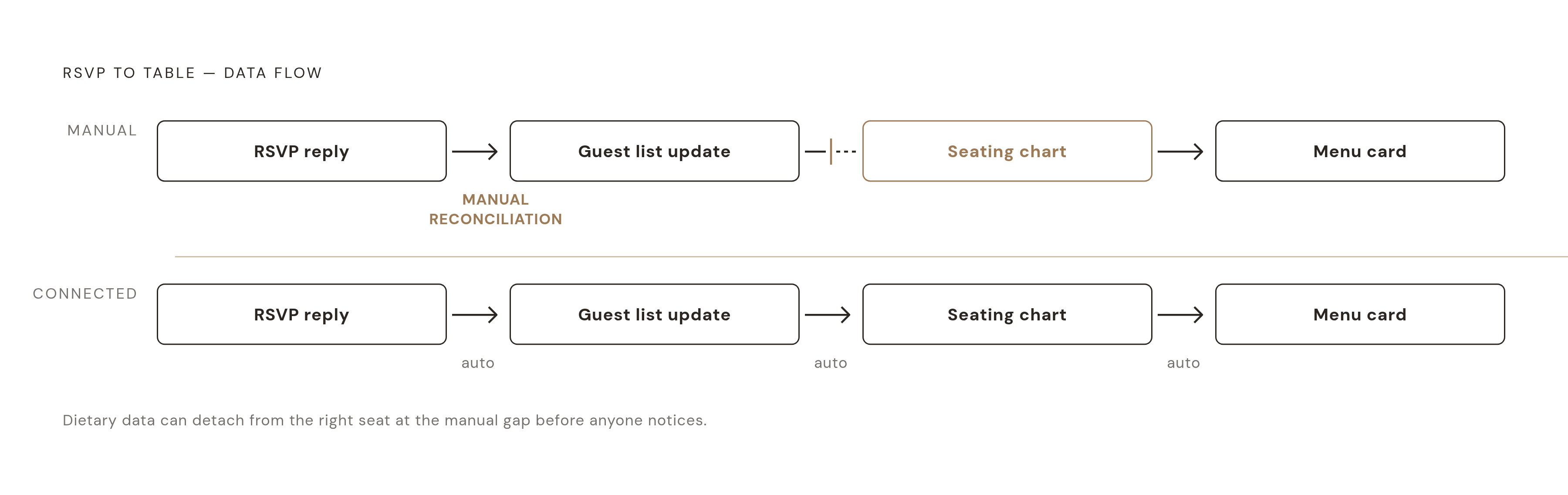
Collecting a dietary requirement is only the beginning. That information needs to reach the caterer as an instruction attached to the right guest’s seat. When RSVPs and seating charts are separate datasets, someone must match the replies to the seating plan manually. Days before the wedding, that can mean a couple or a patient parent reconciling two lists that were never designed to match.
The venue needs more than a total count of dietary requests. A menu card at each guest’s place requires the information to be mapped correctly to that place, including the dishes being served. Manual reconciliation introduces a point where errors can enter the handoff. Those errors may only become visible when guests are seated, rather than while the couple is reviewing the RSVP dashboard.
More varied dietary requirements make the matching harder. That is particularly relevant to multicultural guest lists in Sydney and Melbourne, where the task can involve more than a small number of identical exceptions. A US-built platform may handle replies competently in isolation while still lacking the per-seat dietary mapping expected by an Australian venue.
What should a wedding website builder purpose-built for Australia include?
For couples choosing a tool, the first test is what sits beneath the local label. Does it price in AUD, and does its budget calculator use Australian cost benchmarks or converted US averages? Those are separate questions.
The next test is whether guest information moves without re-entry. An RSVP should feed the guest list and seating chart so that dietary requirements remain attached to the correct person and seat. The checklist should also include the Notice of Intended Marriage and local lead times for peak-season venues. These checks distinguish a locally useful workflow from a website with a few Australian settings.
Vendor support needs the same scrutiny. If a platform has a directory, a search for an Australian city should find real suppliers in that city. A different approach is to let couples track and compare vendors they find themselves, without promising a marketplace. Either way, the useful question is what happens after a couple finds someone they want to book.
The payment model is another practical test. Couples should establish whether the tool charges once or runs on a subscription, and how that arrangement fits a planning timeline of 12–18 months. Fees that keep coming can add up over a long planning period, even when the price at the start looks low. The comparison needs to cover the whole period of use.
How the main options compare for Australian couples
Wedbuild is an Australian-made option that connects the wedding website, digital invitations, RSVPs, guest list, seating, dietary requirements, budget and vendor tracking in one app. It prices in AUD and uses a vendor comparison tool rather than relying on a paid directory, so Australian suppliers can be managed without an empty local search becoming a dead end.
Its strongest fit with Australian venue needs is the guest-data flow. An RSVP updates the guest list, which feeds the seating chart and produces table cards with dietary legends. Guests can use a QR-code seat finder on the day. Digital invitations and RSVP tracking share a system, so couples do not have to enter guest data again as they move from one task to the other.
The budget planner was designed by an accountant and uses Australian cost benchmarks in place of US averages. Vendor comparison gives couples a structured way to assess the suppliers they have found, although it is not a discovery directory. The product supports local vendor management without claiming that a marketplace will find every supplier for the couple.
It is free to start, with optional one-off paid upgrades. That arrangement fits an 18-month planning period without recurring fees, and the free tier covers the core flow for smaller weddings. Henry and Elise, an accountant and an engineer, built it after planning their own Australian wedding. The described features address currency, budgeting, vendor tracking and guest-data handoffs, but do not establish whether its checklist includes the Notice of Intended Marriage or whether bilingual RSVPs are supported. Those criteria still need checking before a couple commits.
Mamahinga serves AU/US/UK users and has no advertising or vendor marketplace. It is free during beta in 2026, with a one-time fee planned after beta as its revenue model. There is no empty directory promise to work around, but vendor discovery remains entirely the couple’s task. Feature completeness is unconfirmed during beta, so couples with complex requirements should check its current capability before committing.
US-built platforms remain a reasonable option for geography-agnostic tasks such as building a website, organising a basic guest list and providing checklist structure. Familiarity may also reduce friction when many guests are scattered internationally and already know those tools. Alongside that benefit, Australian couples would still need to account for absent local directory results, US-calibrated budget estimates and checklists missing Australian legal requirements.
How to start planning with a tool that fits the Australian market
Choose the tool before building the plan inside it. Switching halfway through can mean re-entering information that a connected system would have moved forward automatically. The cost includes another subscription or upgrade and the work of reconciling RSVPs with seats, seats with catering instructions, and budget estimates with actual quotes.
For couples with a significant guest count, those handoffs are a good reason to use connected software. The starting step is to set up the wedding website and RSVP form before paper invitations or other communication goes out. That gives guest information one place to enter from the beginning.
The payment decision can then follow the workflow decision. A one-off purchase and a subscription have different implications over a long planning period, but neither is useful if the couple must rebuild every handoff outside the tool. Less time matching lists leaves more room to enjoy the wedding being planned.