AI Budget Forecasting Tools for Wedding Cost Estimation
AI wedding forecasts trained on US data miss Australian-specific costs entirely.

A couple gets engaged, searches "wedding budget calculator," and types their details into the first AI tool that comes up. The forecast looks clean and confident. There's just no way to tell, from the output alone, whether it was built on local wedding data or another country's wedding data, and that gap is the whole subject of this piece.
Why Australian Couples Face a Different Cost Reality
Australian wedding costs run well above what most AI tools assume by default, and the spread between cities is so wide that a single national average fails nearly everyone who relies on it. Sydney is the most expensive, Hobart the least, and Melbourne, Brisbane, Perth, and Adelaide each cost somewhere in between. From top to bottom, that spread covers tens of thousands of dollars, which makes the city a couple marries in one of the strongest single predictors of what the wedding will cost.
A tool trained on US wedding data carries its own country's averages into every calculation, no matter what city you type into the form. The output isn't just in the wrong currency; it's built from a different market, so converting it to Australian dollars leaves the underlying numbers mismatched to the Australian cost structure.
The mismatch goes deeper than currency, too. US wedding data has no concept of BYO venues and the corkage fees that come with them. It doesn't know what dry-hire means, and it doesn't know that you need to lodge a Notice of Intended Marriage before you can legally marry in Australia; lodgement fees vary depending on whether a registry office or a private celebrant handles the paperwork, and celebrant travel costs come on top. It has no sense of how tax-inclusive pricing changes a quoted figure, or how a long weekend in one state can push venue pricing up in a way that simply doesn't exist in the American calendar. None of this appears in a US dataset, because none of it happens in the US. If you use a US-calibrated tool, you don't just get a slightly-off number. You get a number built from a different set of cost rules.
How AI Budget Forecasting Works
AI budgeting tools earn their usefulness from data, not intelligence. The underlying mechanism is straightforward: the tool analyses thousands of real wedding cost data points, then compares those against a specific couple's guest count, location, season, and vendor preferences to build a personalised forecast. So this is a meaningfully different process from a generic spreadsheet that multiplies a fixed per-head cost by the guest count and calls it a budget.
The payoff appears early in the planning process, at the point where it matters most. Many couples start reaching out to vendors with a number in their head that has nothing to do with current market pricing. A well-trained AI tool closes that gap before the first quote lands in their inbox, so the first real conversation with a venue or photographer starts from a number that's actually in the neighborhood of what they'll be quoted, rather than a number that causes the couple to flinch.
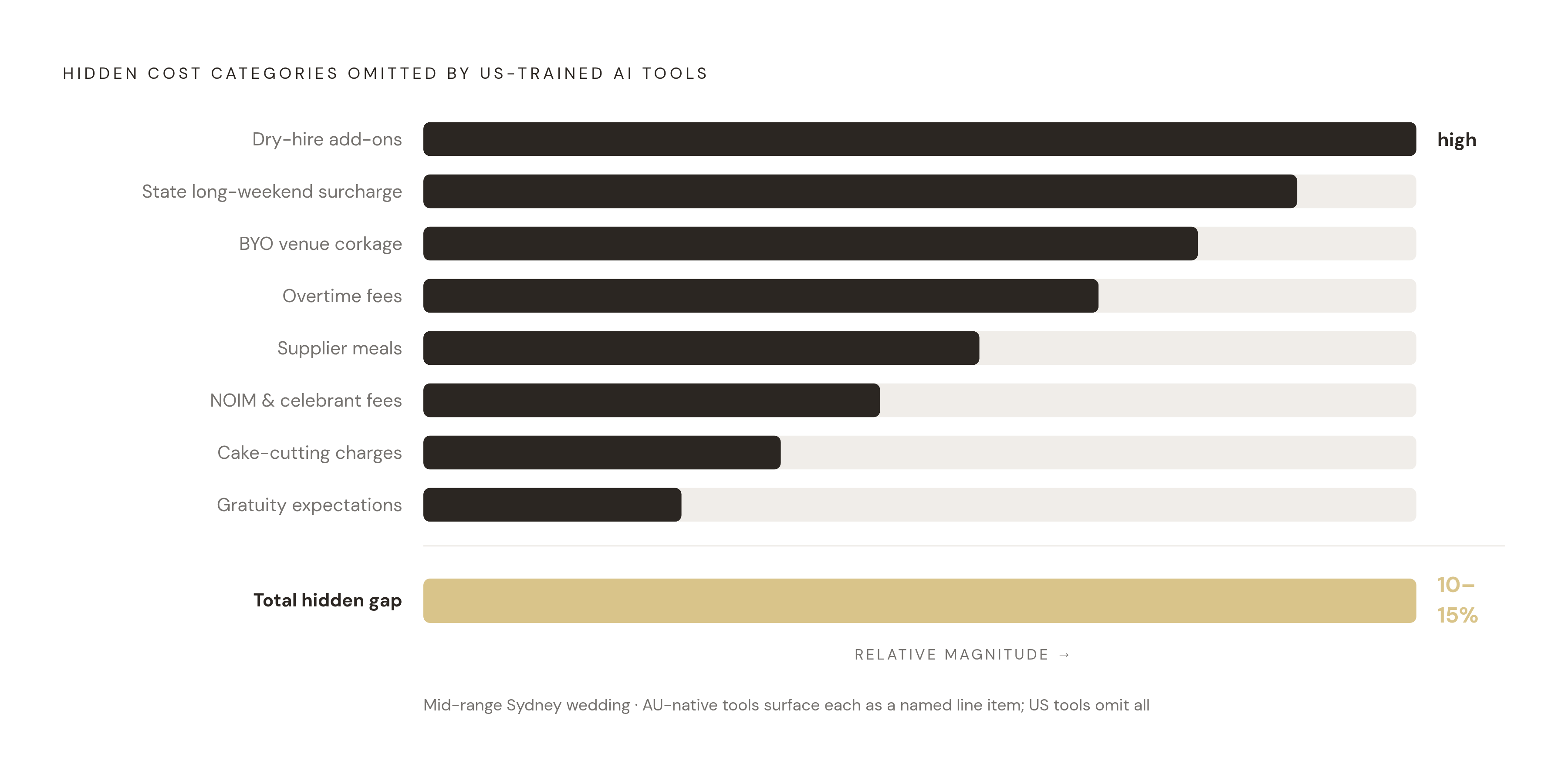
That value depends entirely on what the tool was trained on. If you enter an Australian city into a tool trained on US wedding transactions, you still get a US-shaped forecast. It will miss NOIM paperwork and its associated fees. It will miss corkage at BYO venues, state-specific surcharges tied to long weekends, the add-on costs that come with dry-hire arrangements, and the way local sales tax gets baked into Australian vendor quotes. None of these are small rounding errors. They're entire categories of cost that simply don't exist in the data the tool was built from.
The more serious risk sits on top of that gap: general-purpose AI tools will confidently invent Australian vendor names, pricing, and venues that don't exist, stated with the same tone of certainty as a real fact. That's the single biggest risk in using AI for wedding planning: trusting a tool for local factual data it was never trained on. A forecast that's off by a few percent is a nuisance. A tool that names a venue or a vendor that doesn't exist, and does so with total confidence, can send a couple down a genuinely wasted path.
The overspend problem AI forecasting is specifically designed to solve
The average Australian couple starts planning with a budget that sits well below what they eventually spend, and the gap isn't the product of carelessness or poor discipline. It comes from a predictable set of categories that a good forecasting tool can name before a single contract gets signed. That distinction matters, because couples who go over budget often did everything right by the numbers they were given. The numbers they were given were just incomplete.
Sticking to budget is the top source of stress for engaged couples, which tells you the financial pressure doesn't arrive once, at the final invoice. It runs through the entire planning process, from the first venue tour to the week before the wedding. Taken together, AU-native planning tools catch hidden-cost items that add 10 to 15% to most weddings, and on a mid-range Sydney wedding, you can be looking at several thousand dollars. Corkage, overtime fees, supplier meals, cake-cutting charges: individually small, collectively enough to move a budget from comfortable to tight.
A large share of couples say they increased their budget, or shifted money between categories, just to recreate something they saw online, and Gen Z couples do this more than older cohorts do. So a couple can follow their budget exactly and still end up spending more than planned, simply because the budget itself kept moving.
One consequence of all this is visible in the guest list. Couples are inviting significantly fewer guests than they originally planned, trimming the list to protect the budget rather than the other way around. That's a real cost to the day itself, and it's one that earlier, more accurate forecasting could prevent, because a couple who sees the true cost early can plan their guest list around an honest number instead of discovering too late that the number was wrong.
There's a fair objection to all of this: even the best forecast only works if a couple actually acts on it. That's true, but forecasting changes when the decision happens. If you see a hidden-cost itemisation before you sign a venue contract, you can negotiate the corkage fee, ask about overtime charges, or choose a different package. A couple who discovers the same costs on the final invoice has no leverage left. The forecast doesn't remove the need for a couple to engage with their budget. It gives them a moment, before the contract, when engaging with it still changes the outcome.
What Separates a Trustworthy AI Wedding Budget Forecast
A trustworthy AI forecast relies on local data, a cost model that updates as real numbers come in, hidden-cost categories named rather than buried, and honesty about what it doesn't know.
Local data comes first, because everything downstream depends on it. The tool needs to have been built on, or calibrated against, real Australian wedding transactions, not US figures run through a currency converter. A simple test separates the two: does the tool know that Sydney venue hire runs materially higher than the national average, and that a Hobart wedding with the same guest count costs structurally less, or does it hand back one flat national figure regardless of where the wedding happens?
The cost model needs to move with the couple's actual bookings, not sit frozen at the number it produced on day one. A forecast generated once, at engagement, and never touched again, gets less useful every month, because real vendor prices start replacing the tool's original guesses the moment contracts get signed. A forecast that updates as those bookings happen stays accurate. One that doesn't slowly turns into a historical document.
Named hidden-cost categories are what separates a genuinely useful tool from one that just looks tidy. A trustworthy tool itemises corkage, cake-cutting, overtime, supplier meals, NOIM costs, and gratuity expectations as their own line items, instead of folding them into a vague rounding buffer at the bottom of the spreadsheet. Couples can't plan around a cost they were never told about, so naming it is most of the value.
Factual restraint matters as much as the data itself. If a tool confidently states Australian venue names, celebrant details, or vendor pricing it was never trained on, it does more damage than a tool that simply says it doesn't know. A single invented fact, stated with full confidence, can undo the value of an otherwise accurate forecast.
Venue pricing transparency plays into all of this too. Some venues bundle their services into opaque all-in packages that make it nearly impossible for any tool, however well built, to break the cost down accurately. So if a trustworthy AI can't model those packages cleanly, it says so, instead of quietly smoothing over the gap with an estimate that looks precise but isn't.
The AI Tools Australian Couples Are Using in 2026
Most AI tools marketed to couples in 2026 fail at least one of those four conditions. The ones worth using are built for a specific, narrow job, not general-purpose AI dressed up in wedding branding.
ChatGPT Plus works well for wording: speeches, vows, RSVP copy, and reviewing the fine print of a vendor contract. It costs A$30 a month. Its limitation is exactly the hallucination risk described earlier: it will confidently invent Australian vendor names, pricing, and venues that don't exist, so it should never be treated as a source of local factual data. It also has no budget tracking, no guest management, and no timeline features. It's a writing tool, not a planning tool.
Canva, through its Magic Studio features, handles the visual side: save-the-dates, programs, signage, and menu cards. Its free tier covers most of what a couple needs, with a Pro plan available for more advanced design work. It has no wedding planning features beyond design, and it isn't trying to.
If you want an answer with a source attached, such as what photographers in a given city typically charge, Perplexity AI suits that kind of research question. It has a free tier and a paid Pro plan. It isn't a planner: no budget tool, no guest list, no timeline, no vendor management.
For seating, two tools cover different scales of wedding. SeatPlan.io takes a photo or PDF of a venue layout and builds an editable, to-scale floor plan from it. It's free to design, with a one-time £8 charge for 90 days of save and export access. PerfectTablePlan suits larger or more complex receptions, handling 4,000-plus guests for a one-time purchase of $29.95, backed by a 14-day money-back guarantee.
Two categories are worth skipping. Generic wedding-branded ChatGPT wrappers charge a subscription for functionality the base ChatGPT already does for free. Most AI wedding website builders produce templates that look no better than what existing website tools already offer, just with an AI label on the price.
For a small, simple wedding, stitching together free tiers of these tools covers the basics well. For a mid-size wedding with dietary requirements to track, complex seating arrangements, and several vendors to compare side by side, a connected platform, where guest data, RSVPs, dietary needs, and budget all live in one place, does more real work than piecing together separate free accounts.
Using AI Forecasting to Stay Ahead of Costs
The couples who get real value from AI forecasting treat it as a living document, updated at each stage of planning, rather than a single estimate typed in at engagement and forgotten until the invoices start arriving.
The first step happens before any vendor gets contacted. You put guest count, city, and preferred season into an AU-native tool, and it gives you a cost range grounded in actual Australian wedding data.
The second step happens before any venue contract gets signed. The hidden-cost itemisation, corkage, cake-cutting, overtime, supplier meals, needs to be reviewed while those costs are still negotiable. They're negotiable before the signature and fixed after it. An AU-native tool that surfaces these line items ahead of time gives a couple real leverage in the venue conversation, rather than a list of complaints after the fact.
The third step runs continuously through the planning process. Each time you book a vendor, you should update the forecast with the real number and replace the earlier projection. As more real figures come in, the remaining forecast narrows and gets more accurate. The three-month mark before the wedding, when RSVP tracking and seating charts start becoming active, is the key moment to sit down and reconcile the running budget against what's actually been booked.
The fourth step is about matching the tool to the task. ChatGPT and similar general-purpose AI tools belong in the writing column: vows, speeches, RSVP messages, contract review. They don't belong in the local-facts column, because that's where an AU-native budgeting tool, built and calibrated on real Australian wedding transactions, needs to do the job. Used this way, each tool does the one thing it was built for, and the couple ends up with a budget that reflects the wedding they're actually planning, in the city they're actually planning it in.