AI Style Recommendation Tools for Wedding Aesthetics
AI tools let couples visualize decor in their actual venue before spending thousands.
Walking into an empty ballroom or a bare garden marquee, a couple is often asked to sign a contract worth thousands of dollars based on nothing but a mental picture. The real shortage in wedding planning is a way to prove, before the money moves, that the picture in your head will actually survive contact with the real room.
The visualisation gap: why couples can't make confident decor decisions from inspiration alone
Most couples don't struggle to find beautiful ideas. Pinterest boards fill up fast, and Instagram saves pile into the hundreds within a few weeks of getting engaged. The struggle starts the moment someone asks: will this work here, in this specific room, with these specific walls and this specific light?
That question is hard to answer from a saved image alone. A photo of a reception pulled from a destination resort doesn't tell you anything about how its colors will read against the beige walls of a hotel ballroom, or how a lighting scheme will hold up once the sun moves across a garden marquee in the afternoon. The venue has its own architecture, its own proportions, its own existing fixtures that no mood board accounts for. A couple can love a look and still have no way to know if it will survive the transfer from someone else's wedding to their own.
That uncertainty has a cost, and it isn't just emotional. Couples who can't validate a decor decision tend to stall on it, and that stall compounds. A delayed decor decision pushes back the floral order, which pushes back the final headcount conversation with the caterer, which compresses everything else into the final few months before the date. Planning timelines get shorter right as stress is climbing.
For years, there wasn't a good way around this. Couples who wanted certainty before signing a contract could pay for a physical mockup: a sample table setting, a staged corner of the venue, a rented arch set up for an afternoon. That costs money most couples don't have room for in a budget already stretched across a dozen vendors. The other option was simpler and worse: book the venue, pick the colors, and hope it comes together. Neither of those is a real answer for a couple trying to make a financial decision with confidence.
What AI Style Tools Can Do for Decor Decisions
AI tools built for wedding aesthetics now work across several distinct stages of a decision, and the stage a tool is built for determines what it can actually be used for.
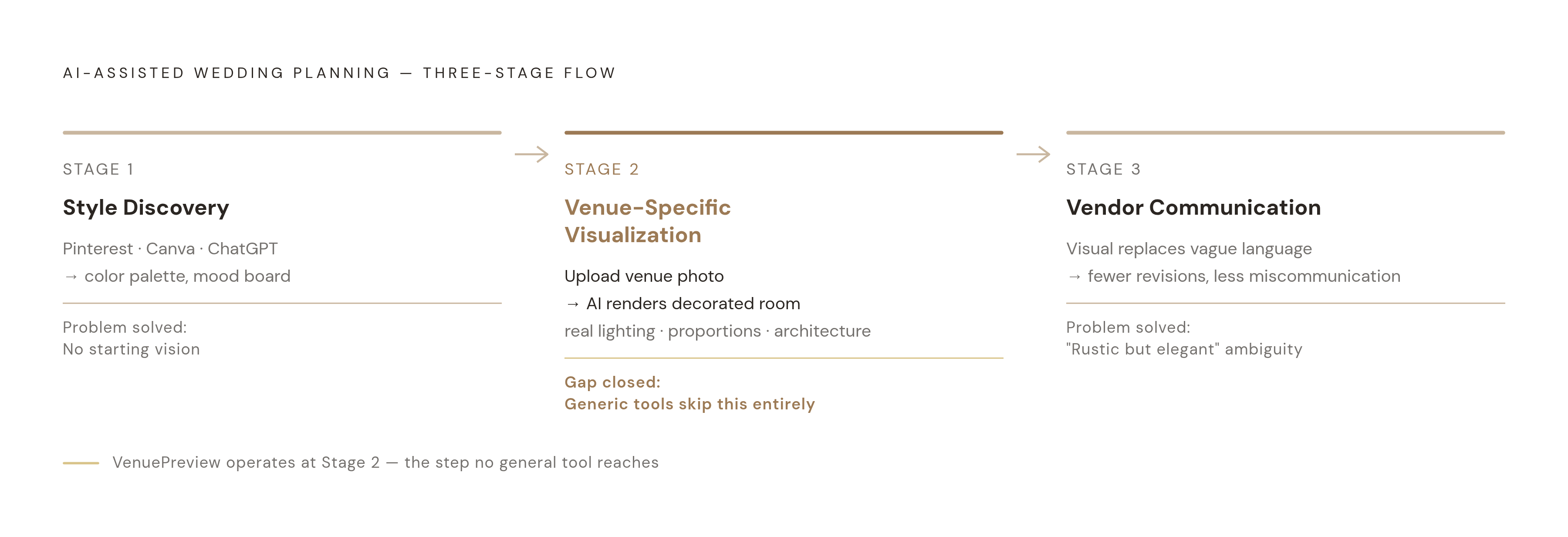
At the earliest stage, the job is style discovery. A couple feeds their scattered references into an AI tool and gets back a mood board that pulls those ideas into one coherent direction. This step solves a problem that has nothing to do with venues at all: two partners often use the same word to mean different things. "Rustic" to one person means reclaimed wood and mason jars; to the other it means a barn with exposed beams and nothing else. An AI-generated mood board forces that disagreement into the open early, before either partner has spent money assuming the other meant something different.
The middle stage is where the real stakes sit: venue-specific visualization. Here, a couple uploads an actual photo of their actual venue, empty, and the AI generates a decorated version of that same room, respecting its real lighting, its real proportions, its real architecture. VenuePreview describes this as the step generic tools miss. A gorgeous AI-rendered table setting means very little if it was never tested against the room it's supposed to go in. It won't tell a couple whether the arrangement fights the beige walls of their hotel ballroom, or whether it reads differently under the natural light flooding into a garden marquee at 4 p.m. versus 7 p.m.
Venue-specific visualization answers the questions that actually matter: does the head table fit inside that alcove without crowding the aisle? Do floral arches sitting against the room's existing columns look intentional, or do they visually compete with them? Those are logistics questions wearing an aesthetic costume, and no amount of inspiration browsing answers them.
The most useful trick available at this stage is direct A/B comparison: generating two contradictory looks inside the same real room; a "Minimalist Industrial" render next to a "Lush Romantic Garden" render, both placed in the couple's actual venue. Seeing both side by side lets a couple reject an option quickly, before any money or emotional attachment is on the line, rather than living with quiet regret after a florist contract is already signed.
VenuePreview frames this as a "pre-visualization" layer sitting ahead of every financial commitment, and the practical gains are specific. Feedback that used to take weeks, waiting on a vendor's hand sketch, now takes minutes. A couple can look at twenty different color palettes in less time than it takes to describe one idea out loud to a florist. And testing a new idea costs nothing, since moving pixels around a render carries none of the cost of renting physical furniture or booking a stylist for a trial setup.
Venue visualisation tools: how the leading platforms work
A handful of distinct tool types have emerged to serve these different stages, and the right one depends entirely on where a couple sits in the decision, not on which tool is objectively "best."
VenuePreview sits specifically at the venue-specific visualization stage. The platform takes a photo of an empty venue and turns it into a fully decorated visualization of that same space, built around a clear goal: removing the anxiety of not knowing how a space will look before a couple commits financially. That's a narrower, more technical job than general mood-boarding, and the platform is built around solving that one problem.
General-purpose tools like Pinterest, Canva, and ChatGPT do real work, but only at the top of the funnel. They're strong for the broad-strokes phase: generating a color palette, assembling a mood board, narrowing a vague idea into a clearer direction. What none of them can do is take a specific photo of a specific room and map decor onto it while respecting that room's actual structure. A Canva mood board can tell a couple they like sage green and ivory. It can't tell them how sage green and ivory will look against the exposed brick in their actual reception hall.
They're useful for producing a concept image of a centerpiece or a lighting arrangement, something a couple can hand to a vendor to communicate a feeling or a direction. What they don't do is anchor that concept to the couple's actual venue. A Midjourney render of a candlelit tablescape is a strong communication tool. It isn't a test of whether that tablescape will actually work in the room the couple has booked.
None of these tool types replaces the others. A couple moving through planning in order typically runs through all three: general tools to settle on a direction, mid-tier generators to sharpen a concept into something vendors can react to, and venue-specific visualization to confirm the concept actually survives contact with the real room.
Virtual try-on for wedding attire: a parallel visualisation problem
The same gap appears in the attire decision: a couple has to imagine a result instead of seeing it, just as in decor planning. AI-powered virtual try-on tools solve it with the same basic logic: upload an image, and let the AI render the real result.
Weddie's virtual stylist works this way. A bride uploads a personal photo along with an image of a dress, either pulled from an online store or chosen from the app's own library, and the AI renders how that specific dress looks on her specific body. That's a meaningfully different output than a photo of a model wearing the same dress, since the model's proportions are not the bride's proportions, and a dress that looks one way on a 5'9" model with a long torso can look entirely different on a 5'4" frame with a shorter one.
The rendering isn't a flat image pasted over a photo. The AI accounts for shoulder-to-hip ratio, torso length, where the waist actually sits, body pose, and lighting conditions, producing something closer to a realistic drape than a sticker overlay. That lets a bride compare a wide range of dress styles side by side, save her favorites, and share them with family or a wedding party before ever setting foot in a boutique.
Weddie is upfront about the limits of this. The AI version is available any hour of the day, carries no sales incentive pushing toward one dress over another, and can render a dress from any store rather than only the inventory a particular boutique happens to carry. What it can't replace is a human consultant's read on how a fabric actually feels and moves, or hands-on help getting the sizing right. The sensible approach, in Weddie's own framing, is to use the AI tool to cut a list of thousands of dress options down to a real shortlist, then bring that shortlist into boutique appointments where fit and fabric get decided in person.
What ties this back to decor is the identical underlying decision problem. In both cases, a couple is being asked to commit real money to something they can currently only imagine, and in both cases, AI closes that gap by rendering the actual, specific outcome.
Why AI style tools change the conversation with vendors
Bringing an AI-generated venue visualization into a first vendor meeting changes what that meeting is actually for, and the change saves real time.
Without a visual, a couple's only tool is language, and language is a poor way to transmit a design brief. "Romantic but not fussy" and "rustic but elegant" sound specific to the person saying them, but a florist and a lighting designer will each build their own private image of what those words mean, and those private images rarely match each other or what the couple actually pictured. A first concept sketch misses the brief, a second round follows, sometimes a third, each one costing time and often money.
A venue-specific AI render replaces that guessing with something a vendor can look at directly. A florist looking at a render can see immediately that a proposed arch design is going to visually compete with the room's existing columns, rather than discovering that problem on the wedding day. A lighting designer can see that a space is darker than photos suggested and needs warm uplighting to compensate, a detail that's obvious in a render and easy to miss in a conversation. VenuePreview describes the payoff in plain terms: these visuals let a couple communicate their vision with real clarity, rather than hoping a vendor interprets their words the way they intended.
The A/B testing capability carries its own vendor benefit. A couple who has already rejected three competing styles on their own time arrives at the vendor meeting with one direction, not five. That shortens the meeting, cuts down the number of paid revision rounds a florist or decorator has to run, and reduces the odds of a miscommunication making it all the way to the wedding day.
The earlier-stage tools matter here too. A palette generated through ChatGPT or a mood board built in Canva isn't venue-specific, but it still gives a vendor something concrete to react to. A Midjourney concept of a lighting arrangement does the same job: it won't show how that arrangement looks in the couple's actual room, but it communicates intent far better than adjectives alone.
AI style tools inside a connected planning system
A decor concept that gets validated inside a visualization tool and then sits disconnected from everything else, the budget spreadsheet, the vendor tracker, the seating chart, creates a new kind of friction even after the original gap has closed.
The decor vision a couple locks in through a venue visualizer needs to carry forward into how they evaluate vendor quotes, so each quote gets judged against a brief that's already settled rather than re-argued from scratch at every single meeting. Without that connection, a couple ends up re-explaining the same vision five separate times to five separate vendors, with room for drift each time.
A locked style has downstream effects that ripple through the rest of the plan. The color palette shapes what a florist quotes for centerpieces. The floral choices affect how much space each table needs, which affects how many tables fit in the room. Table spacing feeds directly into the seating chart. When these steps live in five disconnected tools, a couple ends up typing the same information into each one by hand, at every stage, with every update.
The planning systems that hold up best are the ones where these steps talk to each other automatically. The aesthetic brief feeds into vendor evaluation. Vendor selection updates the running budget. The budget connects to the final guest count. The guest count drives the seating chart. And the seating chart carries dietary requirements straight through to the day of the event, so no server is left guessing table by table who ordered what.