Risks of Using AI for Wedding Contract Review
AI tools can miss or misstate the exact contract clauses that protect you.
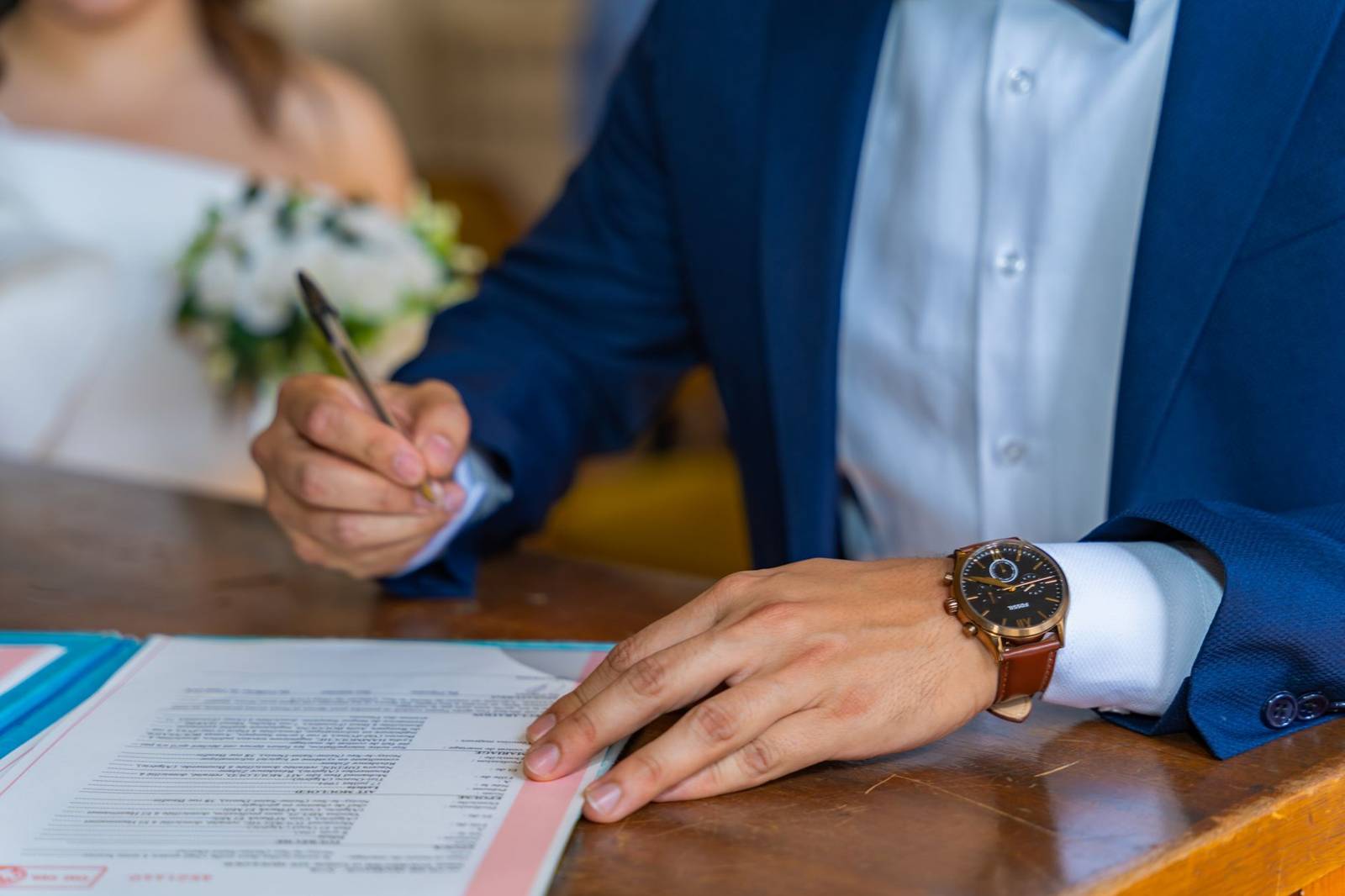
A wedding vendor contract is the document that decides what happens when something goes wrong with one of the biggest purchases a couple will ever make. It is not paperwork to skim before the payment screen. A venue agreement, a photography package, a catering deal: each one commits a couple to thousands of dollars, often tens of thousands combined, much of it non-refundable or refundable only under conditions written by the vendor's lawyer, not the couple's.
These contracts tend to favor the vendor, because the vendor wrote them and has handled the clauses before. Broad cancellation rights for the business, deposits that vanish the moment they're paid, and caps on how much the vendor owes if something goes badly are standard contract terms. If a photographer cancels two weeks out, or a reception runs long and the venue starts charging by the hour, the contract decides what happens next, not the goodwill built up over a year of planning calls.
Australian Consumer Law sits underneath all of this as a backup. It guarantees certain rights regardless of what the contract says. But that guarantee only helps a couple who knows it exists and can recognize when a clause is quietly trying to override it. Most people signing a venue or photography contract have never read one before and never will again. That is the gap you need to close before AI enters the conversation.
What AI contract review tools can do
AI contract review tools do real work: purpose-built software made for this job reads a document, flags risk by severity, calls out language that doesn't match standard wording, and suggests edits in minutes, not the hours a manual read would take.
The people using these tools day to day are mostly in-house legal teams and law firms, working through high volumes of similar paperwork: NDAs, software contracts, employment agreements. The value in that setting comes from consistency across hundreds of documents that look alike, fast risk flagging, and quick suggested edits at scale. Tested tools on the market differ in what they actually do under the hood: some catch risky language, some spot missing clauses, some produce a risk score, and some go further and suggest fixes. Those are different skills, and not every tool does all four well.
None of that is the same as asking ChatGPT or Claude, in an ordinary chat window, to look over a photography contract. A general-purpose chatbot wasn't built or trained the way purpose-made legal software was. It has no fixed playbook to check the document against, and critically, it has no way of telling the user when it isn't sure. Because of this, the tool most couples are actually reaching for is a general-purpose chatbot, not purpose-built legal software, and that choice shapes everything else in this piece.
Why accuracy drops on the contracts couples are reviewing
The accuracy numbers vendors advertise for AI contract review come from testing on standardized paperwork. Wedding vendor contracts are close to the opposite of standardized, which is exactly where that accuracy tends to fall apart.
A venue contract or photography agreement is built by hand, often by a sole trader or a small studio, with its own cancellation schedule, its own force majeure wording, its own substitution clause, its own overtime trigger. Tools that do well on NDAs were tested against thousands of NDAs that resemble each other closely. A boutique Australian photography contract doesn't look like anything in that training pile, so when these tools meet it, they have far less to work with than they do on familiar documents.
The number that would actually tell a couple how much to trust a result, the F1 score (a measure of how well a tool catches real problems without also raising false alarms), is rarely published by the companies selling these tools. Without it, there's no way to know how reliable a given report really is. A report can come back clean and the contract can still have problems. It may mean the tool didn't catch what was there. A couple who reads a green light and signs is in a worse spot than a couple who got no review at all, because the first couple now believes a problem has been ruled out when it may simply have been missed.
The clause types AI consistently fails to handle in wedding vendor agreements
The weak points in AI contract review don't scatter at random across a document. They cluster around the exact clauses that decide who pays when a wedding goes sideways: force majeure, cancellation schedules, liability limits, and hidden cost triggers.
Start with force majeure. When AI runs a review, it tends to leave vague, vendor-favoring wording untouched, without a comment, because the tool isn't built to catch the kind of judgment call that language requires. Wedding vendors routinely write broad force majeure clauses that let them cancel with little or no penalty, and AI tools pass straight over that kind of fuzzy wording.
Cancellation ladders are the next trap. Most vendor contracts spell out what percentage of the total fee they keep at different points leading up to the wedding date. An AI tool can usually tell you that a cancellation clause exists. It has a much harder time judging whether the percentages are fair, or whether the timeline for losing a deposit lines up properly with the services the vendor is supposed to deliver before the day.
Liability caps carry a legal trap of their own. Under Australian law, a limitation-of-liability clause has to be drafted carefully to hold up, and Australian Consumer Law guarantees can't be excluded no matter how the contract is worded. A tool that's only checking whether a liability clause is present, rather than whether it's lawful, will miss an exclusion that conflicts with the ACL.
Overtime fees for running past the contracted end time typically run $300 to $800 an hour at Australian weddings, and per-head vendor meal charges are standard in venue and catering contracts. A tool built to check for named clause types has no reason to flag a cost trigger buried in a schedule rather than labeled as a clause.
AI also struggles to read clauses against each other. An indemnity clause might look ordinary on its own, but when you read it alongside a liability cap and a force majeure carve-out, the three together can leave a couple with no real remedy at all, even though each clause passed inspection individually. And because these tools learn from documents across many countries, a contract reviewed without a clear local frame can come back with an assessment that reflects another jurisdiction's standards rather than what a local tribunal would actually enforce.
AI hallucination as a contract review liability
AI missing something is one failure mode, and AI stating something false with total confidence is another, more dangerous one. Generative AI tools have no built-in way to flag their own uncertainty. When one invents a legal reference or misstates what the Australian Consumer Law actually covers, the output reads just like a correct answer. That gives a couple false confidence, and false confidence is harder to undo than simply not knowing.
In a wedding contract, hallucination could look like an AI citing a section of the Australian Consumer Law that doesn't exist, describing a consumer guarantee incorrectly, or declaring a clause unenforceable when it holds up fine, or the reverse.
This isn't a hypothetical risk invented for this piece. In Moore (Scheme Administrator) v Ochkit Pty Ltd (No. 3) QSC 15, the Supreme Court of Queensland found that AI-generated submissions contained "references which were incorrect, and cases which did not exist." Those submissions came from self-represented parties, people doing their best without legal training, not from lawyers who should have caught the errors.
That detail matters directly for couples. A couple reading an AI-generated summary of their vendor contract has no way to check whether a cited ACL provision is real or whether the AI has correctly described their rights. The risk of acting on a made-up summary is at least as high for a couple with no legal background as it was for the self-represented litigants in that Queensland case, and arguably higher, since a contract review often happens with no court and no judge checking the work afterward.
The data privacy risk couples overlook when they upload a vendor contract
Uploading a signed or draft contract to a consumer AI tool raises a separate question that has nothing to do with how well the AI reads legal language: where does that file go, which country's laws apply to it once it's there, and does it get used to train the next version of the model. Most couples never think to ask.
The two questions that actually matter are where the file is stored and whether it feeds into training data, because a vendor contract contains pricing, payment terms, and business details that the vendor reasonably expects to stay private. Consumer AI tools differ widely on data retention and training policies, and many don't make those terms easy to find. Defaults often allow broad use of whatever gets uploaded.
For a couple, the practical risk is straightforward: uploading a vendor's contract to a general AI tool could expose that vendor's pricing structure or proprietary terms to a system outside either party's control, and that alone could create a dispute with the vendor or sour the relationship before the wedding even happens.
The strongest case for using AI
The fairest case for using AI on a wedding contract starts with the alternative: most couples, without any tool, would sign without reading the document closely. An imperfect AI pass can still catch glaring one-sided terms that a first-time reader would miss. How to use AI without treating a partial check as a finished one.
Purpose-built legal AI tools do measurably better than an experienced lawyer reading manually at the same speed, at least on standardized paperwork. For pattern-based problems, a missing dispute resolution clause, inconsistent defined terms, dates that don't line up, AI is a genuine step up from no review.
The right way to use it is as a prompt for questions, not as a verdict. AI can reliably flag that a force majeure clause exists and that it's written broadly. It can't tell a couple whether the vendor's reputation makes that risk worth accepting, and it can't say whether that clause would hold up to ACL scrutiny in a Victorian tribunal. That judgment call still belongs to a person, ideally one with legal training, not the tool. Even within that narrower role, which tool gets used still counts: a general-purpose chatbot used casually carries every hallucination risk already described, with none of the safeguards built into purpose-made legal review software.
What to do before signing a wedding vendor contract
The right approach treats anything AI produces as a first list of questions, then brings in a human, ideally a lawyer for anything high-value, to settle the points that actually decide the money at stake.
Start by knowing which clauses carry the financial weight before any tool gets involved: force majeure scope, the percentages and trigger dates in the cancellation ladder, the size of any liability cap, overtime rates, whether the deposit is refundable, and substitution rights. You should give these a close, deliberate read regardless of what any AI tool does or doesn't flag. Alongside that, it helps to know the baseline Australian Consumer Law already provides: those guarantees apply no matter what the contract says, and a vendor cannot write around the right to a remedy when the contracted service isn't delivered. If you know that baseline, you can spot a clause that's quietly trying to exclude it, with or without any AI involved.
A clean AI report should be read as a starting point, not a verdict. If a tool doesn't flag anything wrong with the force majeure clause or the cancellation schedule, that silence might just mean the tool lacked the context to judge those terms, not that the terms are fair. For anything high-value, a venue contract worth thousands, a multi-service package from a sole trader, any agreement where the deposit is more than the couple could afford to lose, a short conversation with a lawyer is worth far more than a chatbot's summary.
Where a clause is genuinely unclear, the vendor is a better source of an answer than any AI tool. No AI can say what a vendor actually means by a vague force majeure clause, or whether "reasonable cancellation" refers to some internal policy the vendor has in mind but never wrote down. The vendor can answer that directly, and if the answer never makes it into the written contract, that alone says something about how much that vendor's word can be relied on later. Finally, the details that surface in a contract, deposit due dates, final headcount deadlines, payment milestones, vendor meal counts, need to end up somewhere that connects them to the budget and the guest list. A contract review that only checks the wording but never links those dates and numbers back to the rest of the planning catches the language and still misses the consequences.
Sources
- The Insurability Frontier of AI Risk: Mapping Threats to Affirmative Coverage, Silent Exposures, and Exclusions
- The AI risk repository: A meta-review, database, and taxonomy of risks from artificial intelligence
- AI Hallucination Legal Cases: A Sanctions Tracker (2026) — GC AI
- Legal LLM Hallucination Should Be Evaluated as Failure of Legal Warrant