FAQ Section on a Wedding Website
Answers to the logistics questions guests actually ask before the wedding.

A wedding FAQ page exists for one reason: so you're not answering "is there parking?" for the sixth time while trying to taste cake. I've watched couples skip this step and pay for it in group texts at 11pm the week of the wedding, and this piece covers what to put on that page, how to lay it out, and the stuff people forget until a guest asks them in the middle of a fitting.
The logistics questions guests ask most — and how to answer them clearly
Start with the venue address. The full thing, street and postcode, not "The Barn at Willow Creek," since your Aunt Denise is typing that into GPS, and GPS has never heard of Willow Creek in its life. If the ceremony and reception happen at different spots, list both, and say whether guests drive themselves or there's transport arranged. Left with no information, guests assume the worst case: they're on their own to figure it out.
Parking gets its own line, too, and it deserves specifics. Small lot, nearby garage, weekend street parking rules that make no sense, write it down, because nobody wants to circle the block twice in heels.
Ceremony timing needs a blunt answer, not a vibe. "Ceremony begins promptly at 3:00 pm, doors close at 2:55 pm" tells a late guest exactly what they're walking into, which beats finding out at a locked door. If there's a gap between ceremony and reception, say where people should go and what there is to do. An hour with nowhere to be is how you end up with six guests standing in a parking lot, unsure if they read the invite wrong.
Accessibility gets skipped more than anything else on this list, and it shouldn't. Wheelchair access, step-free paths, accessible bathrooms, answer it directly, even if the honest answer is "reach out and we'll sort it together." Guests with mobility needs rarely ask outright, since they'd rather stay quiet than make a fuss, and they just don't come, or they show up anxious and say nothing. One proactive sentence fixes that.
Round it out with the boring-but-essential stuff: public transport options, where to get dropped off by taxi or rideshare, and shuttle times if you've got one running.
Dress code — the question couples most often under-explain
"Cocktail attire" means five different outfits to five different people, and "black tie" has ruined at least one evening for a guy convinced chinos counted as formal. The label alone does nothing, so translate it: "Cocktail attire, knee-length or midi dress, or a suit, no jeans" ends the argument in one sentence.
Push past the label while you're at it. Name any color guests should avoid (white, ivory, champagne, you know the list). If the ceremony's on grass, say so, because nothing humbles a guest faster than watching her heel vanish into the lawn mid-processional. If the venue runs warm at 3pm and cold by 9, or the reception spills outside after dinner, mention it so people bring a jacket instead of shivering through the toasts.
This is also the one section guests actually read word for word, so use it. "We want you comfortable enough to dance, come in something you love" tells people more about the tone of your wedding than any dress code label ever could.
Children and plus-ones — setting clear expectations without awkwardness
Say it straight: are kids invited or not? Don't bury the answer in the wording of the invitation and hope people decode it correctly, because invitation etiquette is a dead language most guests never studied. If kids are staying home, soften it with a line like "We love your kids, this one's just for the grown-ups." If it's immediate family only, name that, and if you've booked a babysitter or set up a kids' table, that detail belongs here too.
Plus-ones follow the same logic. If they're not automatic, spell it out: "If your invitation includes a guest, you'll see their name on the envelope or the RSVP form." One sentence, and you've dodged a dozen slightly painful "can I bring someone" conversations before they start.
Most guests would rather read the rule than guess wrong or corner you at the RSVP deadline to ask directly. Write it once, and you never have to say it out loud.
Dietary requirements and how guests should flag them
The FAQ has one job here: tell guests where to put the information, not just that you want it. "Let us know if you have dietary needs" sounds thoughtful, but it actually creates more questions, because now people are wondering if they should email you, text you, or bring it up at the engagement party.
Send everyone to one place, the RSVP form. "Please note dietary requirements when you RSVP, there's a field for it on the form" closes that loop for good. If your RSVP form doesn't have a dietary field yet, add it before the FAQ goes live, not after.
This isn't just tidiness for its own sake. Dietary answers gathered through the RSVP can feed straight into your seating chart and catering headcount, but only if they land in one structured spot instead of scattered across texts and half-remembered chats at your cousin's baby shower. Some wedding platforms sync those RSVP answers directly into the seating chart, so nobody's retyping allergy notes from a group text at midnight the week of the wedding.
Say plainly what your caterer can and can't handle, too. Nut-free, gluten-free, vegan, or just the standard vegetarian plate, whatever the answer is, spell it out, since guests with real allergies need that answer early, not as a surprise on the night.
The gift question — registry, cash funds, and what to do if guests ask
Most guests want to bring something and want an easy way to do it. Leaving the registry off your site doesn't read as modest, it just sends people to Google, or to your mother, asking what you actually want. Put a registry link, a cash fund, or both, either right in the FAQ or on a page it links to.
Keep the tone warm, not transactional. "If you'd like to give a gift, we have a registry at [link], your presence is the real gift" lands well for most couples. For cash funds, say what it's going toward, a house, a honeymoon, whatever's true, since people give more freely when they know where the money's headed instead of wiring it into the void.
Cover the physical logistics, too, since guests need to know whether there's a gift table at the venue or if they should ship ahead of time. If you'd rather skip gifts entirely, say so clearly, and note that guests will bring something anyway unless you tell them not to.
Phone and photography etiquette during the ceremony
An unplugged ceremony means phones stay in pockets while you're saying your vows, and guests won't know that's the rule unless the FAQ says so. Sure, the celebrant can announce it on the day, but the guest who already knew isn't the one fumbling for her phone mid-vow.
Frame it as a gift to guests, not a scolding. "We've hired a photographer to capture the ceremony, we'd love for you to be fully present, please keep phones away until after we exchange rings" turns the ask into something guests get, not something they give up. Add the why: clear aisle shots, no phone screens in the background, everyone actually watching instead of filming through a 6-inch screen.
Then tell guests when they'll actually see the photos. Knowing good ones are coming makes it a lot easier to leave the phone alone for twenty minutes. If there's a hashtag for the reception, once phones are back in play, that's the spot to drop it.
What couples most often forget to include in their FAQ
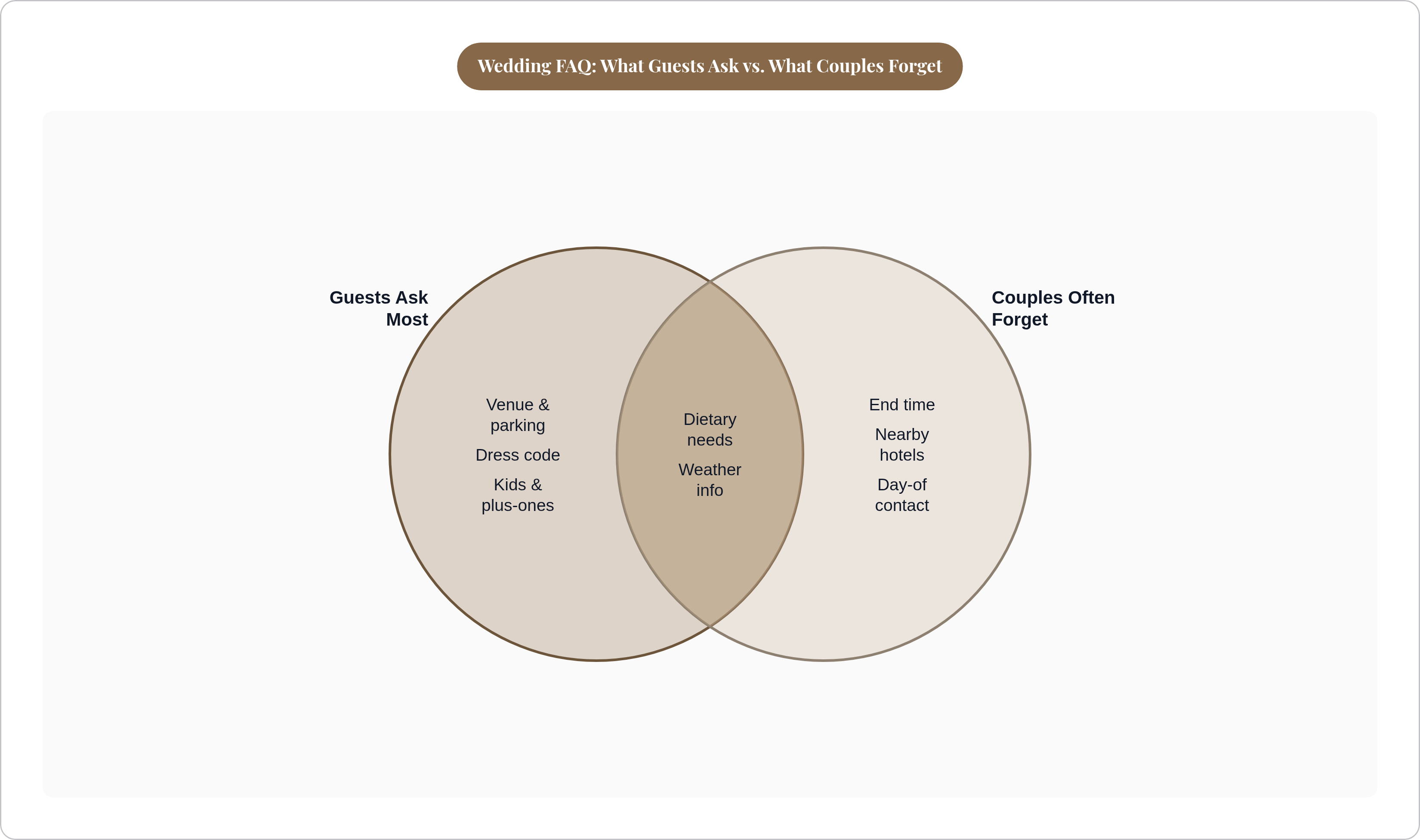
The end time is a detail everyone asks about, yet almost nobody answers it outright. Guests with a babysitter on the clock, a long drive, or a 6am flight need a number to plan around, plus a heads-up if there's a send-off moment they shouldn't miss.
Nearby hotels are the other big gap, especially outside a city center. A short list, or a room block code, saves a dozen guests from independently googling "hotels near [venue]" at 11pm on a Tuesday.
Weather is worth a sentence, too, especially for anything outdoor or half-outdoor. What happens if it rains, and does the site turn into a wind tunnel by sunset? One line here heads off a week of nervous messages.
Name a day-of contact who isn't the couple, a sister, a groomsman, whoever stays calm under pressure, and list their number. Also spell out what guests should do if they've blown past the RSVP deadline instead of just going quiet. Set that deadline two to three weeks out so catering and seating numbers actually have time to settle.
How to organise and write the FAQ so guests actually use it
Group questions by topic, not by the order they occurred to you at 1am. Buckets like Getting There, On the Day, Gifts, and Photos let guests jump straight to their question instead of reading top to bottom. Put your highest-traffic answers, dress code, location, kids, near the top of each group.
Write it like yourselves, whether that's formal or goofy, so it sounds like the two of you and not a terms-and-conditions page nobody asked to read. Keep the answers short, one to three sentences handles almost everything, and use the real question as the heading ("Is there parking at the venue?") instead of a one-word label, since people scan for their own phrasing, not yours.
Treat it as something you update, not something you publish once and forget. If the shuttle time changes, update the page and tell people to check there instead of sending another mass text, and give it a real home on the site, its own page or a clearly labeled link off the main menu, because buried under "About Us," it might as well not exist.
Building the FAQ as part of a connected wedding
The FAQ works best when it's not off on its own. RSVP answers, dietary notes, hotel info, they all trace back to the same guest, and a page that actually talks to the rest of the site saves you from typing the same detail twice. That's the case for building the FAQ alongside the wedding website from the start instead of bolting it on later: less duplicate work, no mismatched versions floating around, and one place guests learn to check before they ever pick up the phone to call you.