Formal Wedding Invitation Wording for Australian Couples
The right structure tells guests how formal your day is before they even read the details.
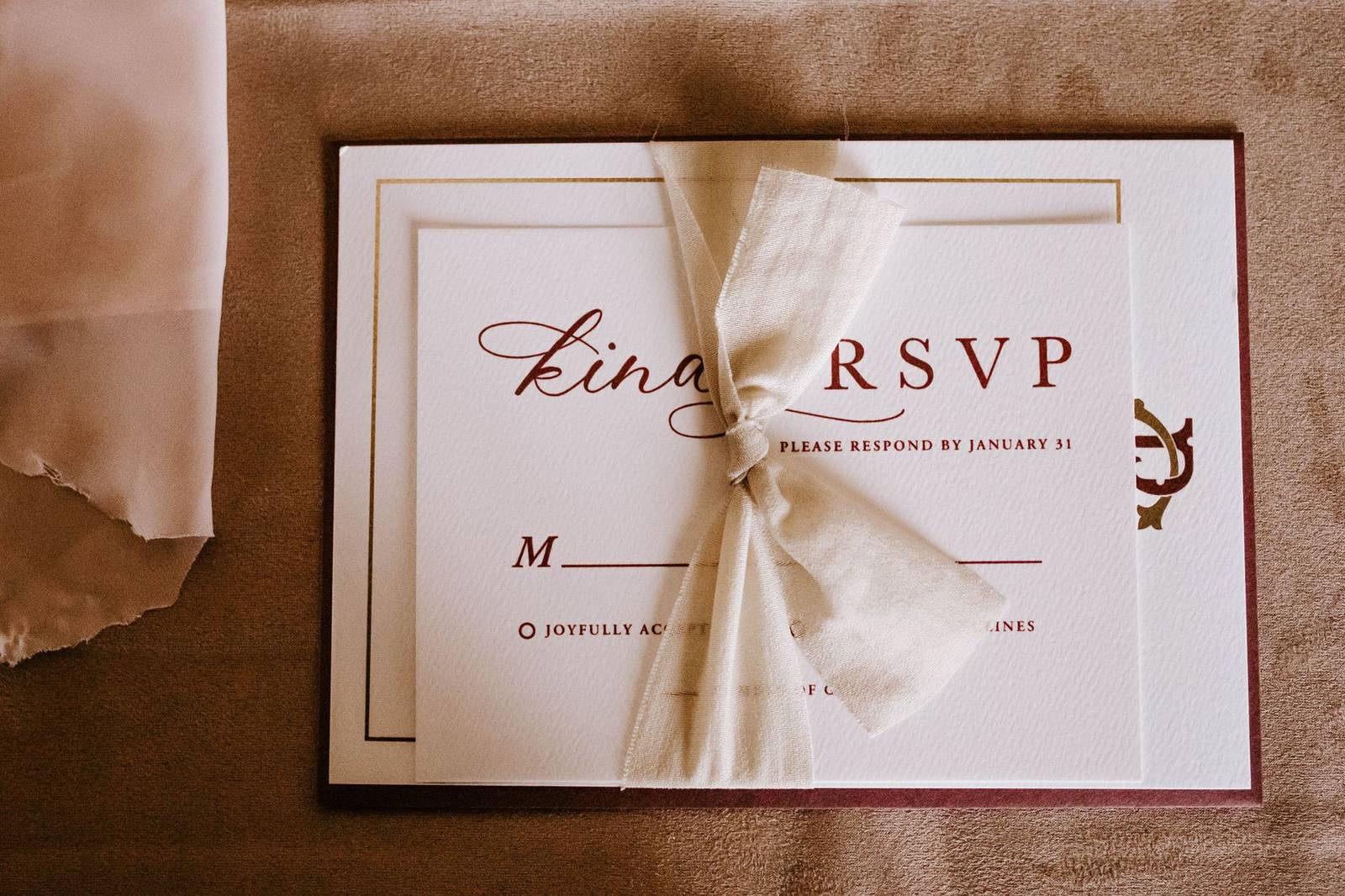
The host line, the request phrase, the name order, every piece of it carries meaning, and a couple who treats these as decorative swaps the message without meaning to. The wording alone tells guests the dress code, how urgent the RSVP is, and how formal the day will be, long before any of that gets spelled out. Getting the structure right is what makes the rest of the invitation land the way it's meant to.
The line-by-line structure every formal Australian invitation follows
Formal Australian wedding invitations follow a set sequence: the host line comes first, naming who is giving the wedding, followed by the request phrase, which signals the formality of the occasion. Each of these pieces sits on its own line, and that's not a styling choice; it's a structural signal. Line breaks work as structural markers: they tell the reader where one piece of information ends and the next begins, and they signal hierarchy among the names and roles listed. When a couple runs two lines together, or reorders the sequence without knowing why it exists, guests can feel something is off even if they can't say what.
How the host line signals who owns the occasion
The host line does more than credit whoever paid for the wedding. It tells guests whose occasion this is, and that ownership sets the register for everything that follows. If the bride's surname differs from her parents', that detail doesn't need to appear in the host line. It appears later, in the couple's name line.
Wording the host line when families are divorced, remarried, or blended
The host line adapts cleanly to divorced, remarried, and blended families, and the governing principle stays the same throughout: the wording should reflect who is actually hosting, not imply a joint household that doesn't exist. Where one parent has remarried, that parent and their new spouse share a line, while the other parent keeps their own: "Mr. and Mrs. John and Eliza Jones / Ms. Janet Jones / request the pleasure…"
When both sets of parents are divorced, each parent gets a separate line, and the bride's family is listed above the groom's. The phrase "their parents" can simply be dropped where step-relationships make it inaccurate.
A deceased parent can still be named on the invitation, and doing so is both accepted practice and a meaningful acknowledgment: the surviving parent hosts, while the late parent is noted with a construction like "the late Mr. John Jones." Where only one parent survives and is hosting alone, listing that parent by themselves is equally correct.
For same-sex couples, "together with their families" removes the need to default to the bride's-parents-first convention and gives both families equal footing on the page. The classic request phrasing works without any need to adapt its gendered history.
Choosing between "honour of your presence" and "pleasure of your company"
The request phrase isn't a stylistic flourish. It tells guests whether the ceremony is taking place in a place of worship, and using the wrong one in either direction sends a false signal about the day. "Request the honour of your presence" belongs exclusively to ceremonies held in a church, synagogue, or other religious venue. The word "honour" carries the weight of entering a sacred space, and that weight is lost if the phrase is used anywhere else.
"Request the pleasure of your company" is the correct phrase for secular venues: gardens, wineries, barns, heritage buildings, waterfront sites. Using "honour of your presence" to dress up a secular venue is a recognisable etiquette mistake, and it tells guests the couple isn't familiar with the convention they're using. Couples wanting other formal options for secular ceremonies can reach for "cordially invite you to celebrate the wedding of" or "invite you to witness the union between." For a warmer, slightly less formal tone that still holds its structure, "invite you to celebrate their marriage" or "would love you to join them" both work, though they sit better on semi-formal invitations than strictly formal ones.
One detail trips up more couples than it should: the Australian and UK spelling is "honour," not "honor."
Name order, titles, and presenting the couple on a formal invitation
How the couple's names appear encodes both the hosting arrangement and the formality of the day, and it's where a lot of the precision built up in the host line and request phrase can unravel if the conventions aren't followed. In the traditional format, where the bride's parents are the sole hosts, the bride appears by her first and middle name only, no surname, since her surname already matches her parents' and has been established in the host line. The groom is introduced with his title and full name, followed by his parents' names: "their daughter / Emily Grace / to / Mr. Thomas William Chen / son of Mr. and Mrs. David Chen." That structure introduces the groom and his family in the same line, so it does double duty.
Where both families are hosting jointly, or where the couple are hosting themselves, both partners appear with their full names, and either name can lead, whether by alphabetical order or personal preference. The traditional "bride first" rule only applies when the bride's parents are the sole hosts, not automatically across every format. Same-sex couples have no inherited convention to dictate order, so you can put the names in whatever sequence suits you, whether that's alphabetical or just the rhythm you prefer on the page.
Middle names are optional, but using the full middle name raises the formality of the invitation. The formal register calls for full given names throughout.
Writing the date, time, and venue in formal style
If you spell everything out in words instead of switching to digits, the invitation keeps its formal register. A date written as "Saturday, the fourteenth of March two thousand and twenty-six" carries the register the rest of the invitation has built, while "Sat 14/03/26" or even "Saturday, 14th March 2026" breaks it. Spelling out the year in words marks the highest level of formality; many semi-formal invitations use the digit year instead, which is acceptable but drops the register slightly.
Time follows the same logic. "At half past five in the afternoon" replaces "5:30pm," and "at three o'clock in the afternoon" covers on-the-hour times. "In the afternoon" or "in the evening" takes the place of AM and PM throughout.
Venue listings need the venue name and suburb, plus city and state, and you can skip the full street address if a details card or wedding website carries it instead. Formal invitations leave off the postcode, a convention drawn from some US etiquette sources, but UK authorities like Debrett's recommend including it so guests can enter it directly into a map. Where the ceremony and reception happen at different venues, both addresses need to appear, either on the invitation itself or on a separate enclosure card, so guests can arrange transport without guessing.
Reception lines, dress code, dietary notes, and the wedding website URL
The lines that follow the venue details aren't filler. Each one answers a practical question before a guest has to ask it, which saves the couple from fielding the same questions by phone or text for weeks. Reception lines at the most formal register stay contained: "Reception to follow" is the cleanest version, with "and afterwards at a reception" or "reception immediately following" as close alternatives. Where the tone of the day is warmer, phrases like "dinner and dancing to follow" or "please join us for a cocktail reception afterward" still sit comfortably on a formal invitation.
Dress code should be brief and specific, placed at the bottom of the invitation or on a details card. Established terms, "black tie," "black tie optional," "cocktail attire," "smart casual," work better than invented descriptions, because guests can look an established term up and know what it means.
The dietary line deserves particular attention, because what it sets in motion matters more than its two lines of text suggest. A single standard line does the job: "Please let us know of any dietary requirements when you RSVP." The earlier dietary data comes in, the more useful it is to caterers and to whoever is building the seating chart. This is exactly the point where a lot of couples run into trouble: dietary responses arrive through RSVPs, but seating charts get built separately, and reconciling the two by hand, often the morning of the wedding, is where mistakes happen and stress spikes. Wedbuild's RSVP-to-seating-chart sync is one example: when a guest notes a dietary requirement in their RSVP, that response updates their seat record automatically, with no manual cross-referencing required between a spreadsheet and a floor plan.
Where children are concerned, clear and polite language removes any ambiguity: "adults-only celebration" or "we respectfully request no children under 16" both state the policy so no one needs to ask.
You'll now find the wedding website URL as standard on formal and casual invitations alike. A QR code next to the URL makes access easier, especially for older guests who may not want to type out a web address.
Worked examples: four hosting situations as complete formal invitations
The following examples show the rules working together in four different hosting situations, so you can find the one closest to your own and adapt it directly.
A bride's-parents-hosted invitation for a religious venue follows the traditional format throughout: parents' full names, "request the honour of your presence," the bride by first and middle name only, the groom with full title and name followed by his parents, and the formal church name in the venue line. This version is the most traditional of the four, built entirely on inherited convention.
Where both families host a secular venue, the invitation reads: "Mr. and Mrs. John and Janet Jones / Mr. and Mrs. Samuel and Sally Smith / request the pleasure of your company / at the wedding of their children / Charlotte Jones and Oliver Smith / Saturday, the fourteenth of March / two thousand and twenty-six / at half past five in the afternoon / Factory 51, Coorparoo, Brisbane / Reception to follow / RSVP by 14 February 2026."
For a couple hosting their own secular wedding, the wording shifts to put them first: "Together with their families / Anna Marie Jenkins and Thomas James Reynolds / request the honour of your presence / at their wedding celebration / Saturday, the twelfth of October / two thousand and twenty-six / at three o'clock in the afternoon / The Royal Botanic Garden, Sydney / Dinner and dancing to follow."
The fourth example covers divorced parents on the bride's side, one remarried, at a secular venue: "Mr. and Mrs. John and Eliza Jones / Ms. Janet Jones / request the pleasure of your company / at the wedding of their daughter / Charlotte Jones / to / Mr. Oliver Smith / son of Mr. and Mrs. Samuel and Sally Smith / Saturday, the fifth of April / two thousand and twenty-six / at four o'clock in the afternoon / [Venue name], [Suburb], [State] / Reception to follow." Each parent keeps a separate line, with the remarried parent and new spouse sharing one line and the other parent on her own.
How formal wording adapts for non-traditional ceremony formats
The structure behind formal wording holds even when the wedding doesn't follow a traditional church-and-reception shape. For micro-weddings and intimate celebrations, the full structure stays intact, and the tone of the reception line or an accompanying note can signal the smaller scale. A lead-in like "with just our closest friends and family" sits comfortably above a standard formal structure without requiring any change to the host line, request phrase, or name conventions.
A post-elopement celebration calls for a small but specific shift: the invitation is announcing a reception, not a ceremony, since the marriage has already taken place. The host line and request phrase stay as they are, but the occasion line changes from "at the marriage of" to "to celebrate the marriage of," which tells guests they're being invited to a reception celebrating a marriage that has already taken place.
Destination weddings keep the full formal structure as well, with one firm rule: the complete venue address, including the country, is always included, with no abbreviation on the assumption that guests already know the location. Building excitement through casual language like "pack your bags" doesn't belong at the formal register. A formal destination invitation simply treats the overseas venue the way it would treat a local one, full name, location, country, and carries logistical details like accommodation blocks or travel information on a separate card.
Non-denominational ceremonies held in gardens, wineries, or on farms use "pleasure of your company" just as any other secular venue would. The venue name and setting carry the character of the day on their own, without needing extra description in the invitation text.
When the invitation should ship and what it should connect to
Correct wording only does half the job if the invitation doesn't ship on a timeline that supports what comes after it. The RSVP deadline printed on the invitation drives the catering guarantee, the seating plan, and the final headcount handed to the venue, so none of those tasks can start until RSVPs close. A clear cut-off date is a logistical requirement, not a courtesy to guests.
Dietary requirements gathered at RSVP need a direct line into the seating plan, because if someone has to manually check a dietary spreadsheet against a seating chart the morning of the wedding, errors creep in and stress builds.
Printing a wedding website URL on the invitation gives guests one place to find full venue details, accommodation options, the dietary RSVP form, and day-of logistics, and it cuts down on the number of individual questions couples end up answering after invitations land. The wording sets the tone, the timeline makes it count, and the two work only when they're built on the same system.