Wedding Guest List Size and Seating Chart Implications
Guest count is your first hard budget number, not an emotional choice.
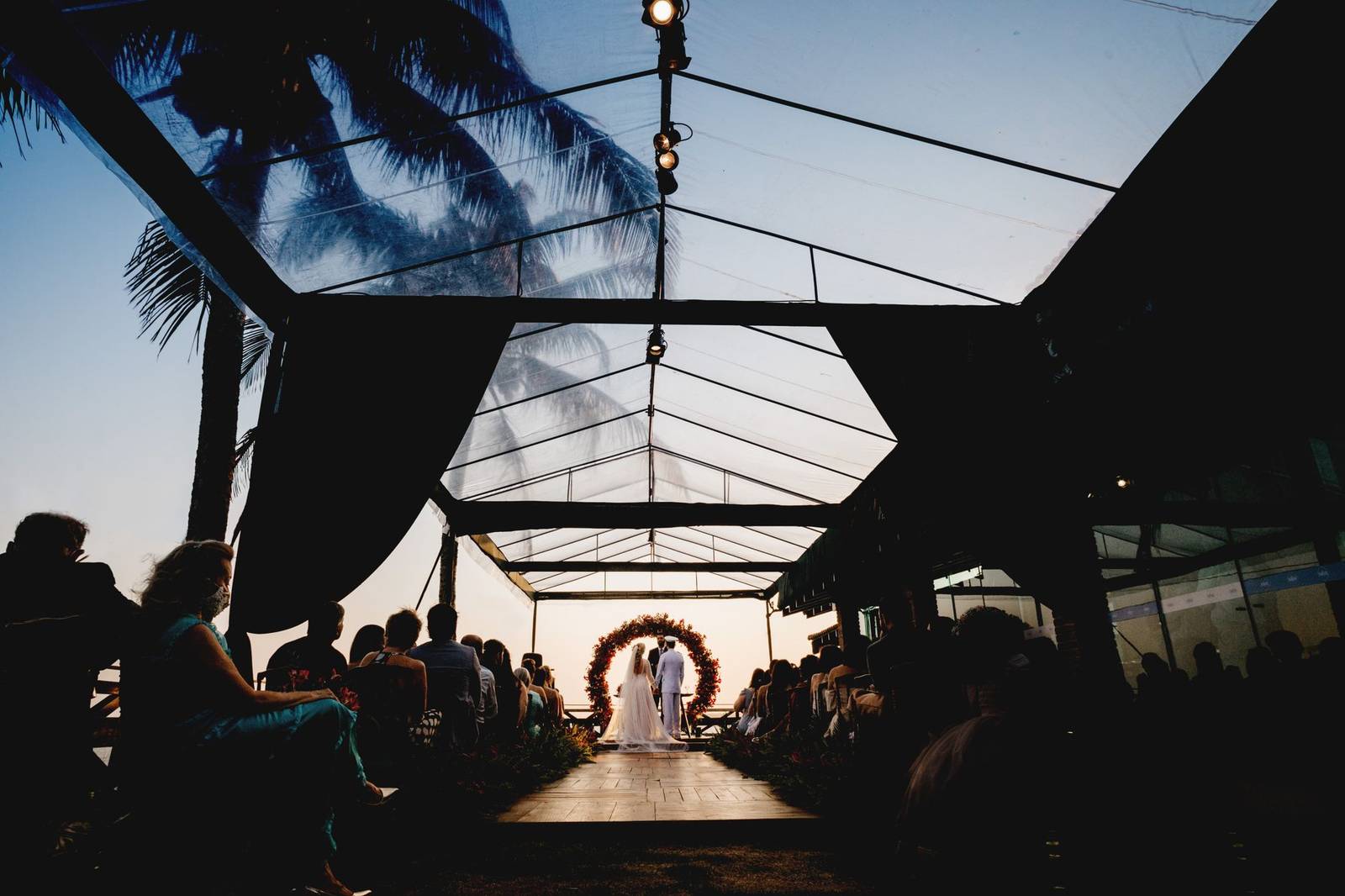
A guest list looks like a social document. It's actually a logistics document wearing a nicer outfit, and every name added or cut moves both jobs at once. Add a guest, and catering cost moves with it: roughly $120 to $200 per head. Add a table, and the room layout shifts. Add a dietary requirement, and someone now has to track it. None of this math runs separately, and treating the guest list as a soft, emotional decision (rather than the first hard number in the whole budget) is the mistake almost every couple makes.
Four guest-count tiers produce four different planning problems, not just bigger versions of the same one.
At the elopement end, up to 15 guests, running $1,500 to $10,000, there's no real seating chart to speak of. One table, maybe two. Dietary needs get sorted in a phone call, not a spreadsheet.
Micro weddings, 15 to 50 guests, $10,000 to $25,000, are where a seating chart starts to earn its keep, but it's still a job done by hand. A simple list still covers dietary needs fine. Venue options stay wide open here, since so few rooms get ruled out on capacity alone.
Classic weddings, 60 to 120 guests, $30,000 to $45,000, are where things actually get complicated, and this is where most Australian couples land: the national average runs $35,000 to $40,000 for around 80 to 100 guests. Multiple tables, mixed dietary needs, real room constraints. Manual tracking cracks here first, and this is the tier where couples most underestimate how hard the chart will fight back.
Premium weddings, 150-plus guests, $45,000 to $80,000-plus, turn table count into a room-layout puzzle with several workable answers and no obvious best one. Dietary tracking stops being a list and turns into a data problem. Day-of coordination needs an actual system, because a spreadsheet someone edits at midnight won't hold.
The tier below never had to solve the problem the tier above runs into. The real difference lies there, not in the bigger number on the invoice.
What venue hire actually costs at each guest count across Australian cities
Guest count is the first wall a couple hits, because venue capacity isn't a suggestion. A room seats 90 people, or it doesn't.
Venue hire averages shift a fair bit by city. Melbourne sits around $17,988. Adelaide runs close behind at $17,433. Perth averages $16,074, Brisbane comes in at $15,849. Sydney runs the other way entirely: total wedding spend there averages $38,566, with metro weddings regularly pushing $40,000 to $45,000, the priciest major market in the country. Melbourne metro isn't far behind, with total wedding spend sitting at $38,000 to $42,000, while Brisbane often delivers a full wedding under $35,000. Sydney couples are effectively paying a tax on the postcode, and no amount of clever seating chart work fixes that gap. If budget is the real constraint, city matters more than almost anything else on this list.
The venue-capacity trap catches more couples than it should, and it's entirely avoidable if anyone thought to check it early. Book a room that seats 80, fall for it, then watch the guest list creep to 95 over the following months. Now there's a mismatch no seating chart software can undo, because the room doesn't have the chairs. Run it backward and the trap still bites: book for 120, only 80 confirm, and the room reads half-empty, with every table plan built on an assumption that never held.
Timing changes the price tag on top of all this. A Saturday in November or December at a popular venue can run substantially more than a midweek booking in the off-peak months. Guest count decides the room size needed. The date decides what that size costs. Sunday and midweek bookings often attract 20 to 30% off venue hire, worth $3,000 to $5,000 back in the budget, real money given how much of total spend sits in venue and catering alone.
How table shape and count ripple out from the number of confirmed guests
Table shape looks like a styling choice. It exists on its own terms. It's a spatial math problem, and guest count sets every term of it.
Round tables are common at Australian receptions, typically seating 8 to 10 guests each. At 80 guests, that's 8 to 10 tables, which most rooms handle without much fuss. At 120, it jumps to 12 to 15 tables, and aisle space starts eating into layout options fast. Push past 150 and the floor plan turns into something closer to an architecture problem. Not every venue can even reconfigure to fit that many tables in comfortably.
Long or banquet tables solve the space problem differently. They seat more people per linear metre, but need a longer room to do it, which is why barns and warehouse venues favour them. They also change how the chart itself gets built: there's no "table 6" anymore, just a spot along a continuous run. Dietary tracking and place cards shift from table-based to positional, and that trips up couples who assumed the old logic would carry over.
The rounding problem goes unmentioned until it's too late to fix cheaply. Take 83 guests, try to fit them into tables of 10, and the math spits out 9 tables, one of them holding just 3 people. That awkward little island at the edge of the room is the kind of thing couples don't notice until they're actually building the chart, weeks after the venue's already locked in.
Lock in a provisional table count the moment the venue is booked. Table count constrains the floor plan, and the venue usually needs that floor plan finalised weeks before the day.
Why dietary requirements become a data problem at scale, and when that threshold hits
At 20 guests, dietary requirements live in someone's memory. At 80, they're a data set. At 150, they're a logistics operation with real failure points.
Manual reconciliation is where it breaks. Dietary responses collected through email or paper RSVPs have to get matched, by hand, to a seating position, and that's exactly where mistakes happen at scale. An error here means a vegan guest gets served lamb on the actual day. A catering team working a 120-person reception needs a dietary-by-seat or dietary-by-table breakdown, not a vague note reading "six vegetarians somewhere."
Australian caterers commonly plan around categories including vegetarian, vegan, gluten-free, nut allergy, halal, kosher, and dairy-free. Several of those need a meal built from scratch, or a separate kitchen protocol, not a swapped side dish.
The risk compounds with every handoff, and there are a lot of handoffs. Dietary data collected at RSVP has to survive the move into the seating chart, then into place cards or table maps, then into the catering team's run sheet. Each manual transfer is a chance for something to drop or get garbled. When dietary responses flow straight from the RSVP system into the seating chart and out to a catering export, nothing gets re-typed, so nothing gets lost in translation. Skip that, and the alternative is a couple at the kitchen table the morning of the wedding, cross-referencing three spreadsheets by hand, hoping they match.
The RSVP deadline problem and why late responses break the seating chart
The seating chart can't get built until the guest list is final. But the venue wants a final floor plan, the caterer wants a final headcount, and the stationery order needs a final list, all landing on roughly the same week.
The typical Australian RSVP timeline sets the deadline 6 to 8 weeks before the day, with most couples aiming to have replies confirmed 3 to 4 weeks out. That leaves a window of just 3 to 4 weeks to build, revise, and lock the chart. Not much room for error.
One late RSVP forces a table group to shift, which nudges the table next to it, which means place cards already printed now need reprinting. Every straggling response carries a seating consequence, and it rarely stays contained to one table.
A few habits cut the damage down. Set the RSVP deadline 2 to 3 weeks ahead of the real catering cutoff, so late responses have somewhere to land without blowing the whole timeline. Use digital RSVPs with live tracking, so a couple can see exactly who hasn't replied and chase them early, instead of discovering a dozen gaps the day the deadline hits. Build the seating chart in draft form as RSVPs trickle in, rather than saving it for one marathon session after the deadline closes: that spreads the work out and catches problems while there's still time to fix them.
One habit makes things worse, not better: pre-assigning seats to guests a couple assumes will attend, before the RSVP is confirmed. Charts built that way need more rebuilding, not less, than charts built strictly from confirmed replies. The assumption costs more time than it saves, every time.
How room layout decisions, aisle width, dance floor size, and table spacing are downstream of confirmed headcount
Many Australian reception venues want a final floor plan several weeks out. Couples underestimate that deadline constantly, usually because they're still waiting on stragglers to reply.
Headcount drives layout in ways that aren't obvious until the room's in front of you. Dance floor space shrinks as guest count rises in a room with a fixed footprint, so at 120 guests in a mid-sized venue, couples often end up choosing between enough tables and enough room to dance, not both. Aisle width matters just as much: accessibility, emergency egress, and the paths catering staff need to move through all need minimum clearances, and once more tables get squeezed in, those paths narrow fast, slowing down how efficiently the venue's own staff can serve dinner. Larger guest counts sometimes push couples toward a cocktail-style format or a partial-seated split instead of a full sit-down, and that changes the whole chart logic, since not every guest needs an assigned seat anymore.
There's the "extras at the back" problem too. Venues running near capacity often seat late-confirmed guests near service doors or structural pillars, purely because the guest list grew after the floor plan was already drafted. Avoidable, but only if someone asks early.
Ask the venue for its capacity breakdown, seated dinner, cocktail, mixed format, before the guest list firms up. And pick a seating chart tool that accounts for actual room dimensions, even a basic one, over a tool that treats the chart as a pure name list. A chart that ignores the room is a chart the venue coordinator sends straight back.
The day-of logistics that scale with guest count: QR finders, place cards, and run sheets
A finished seating chart has to produce several concrete things on the day itself, not just sit there as a nice diagram.
Place cards or escort cards go out one per confirmed guest, name and table number, printed against the final list, never an earlier draft. A table map needs to be visible to arriving guests, printed board or digital screen. The catering team needs a dietary run sheet organised by seat or table, in a format the kitchen can act on mid-service. The MC or coordinator needs a master list of who sits where, for passing the microphone and fielding the inevitable "where's Auntie Jan sitting."
At larger guest counts, a scannable digital seating lookup lets guests find their own table without a single physical board turning into a bottleneck at the entrance. That matters even more at outdoor venues or multi-space layouts, where one display board just can't reach everyone.
Late changes are where the whole thing gets fragile. A single guest swap handled by hand on the morning of the wedding risks an outdated dietary list reaching the kitchen before anyone catches it. A system that spits out an updated export on demand beats a static document printed days earlier and never touched again.
Couples who describe their wedding day as calm, almost without exception, locked down seating and dietary logistics well before the week of the wedding. That upstream work is what buys the room to actually be present on the day, instead of running numbers in a back office.
Where to build and manage the list-to-seating-chart pipeline as an Australian couple
The cascade from guest list to seating chart moves a lot of data: names, RSVPs, dietary needs, table assignments. All of it needs to move between steps without getting re-typed by hand at every stage. Most couples end up stitching together disconnected tools that demand exactly that re-entry, which is where the errors from every earlier section actually happen.
A tool stack that covers the whole pipeline needs guest list collection, RSVP tracking, dietary capture, a seating chart builder, automatic dietary-to-chart syncing, and a day-of output, whether that's a place card list, a catering run sheet, or a QR seat finder. Stitching together five separate apps to cover those jobs isn't a system, it's a guarantee that something gets re-typed wrong at 11pm the week of the wedding. Platforms like Wedbuild, a self-serve wedding planning app that keeps guest lists, RSVPs, digital invitations, seating charts, and budgets in a single place so nothing has to be re-entered between steps, exist precisely to close that gap.
For Australian couples, one platform connects that whole chain end to end: guest list, RSVPs, digital invitations, seating chart, automatic dietary sync, and a day-of QR seat finder, inside one system. It's free to start for guest list and RSVP collection, with the seating chart and QR finder sitting behind a paid plan starting at A$99. An Australian couple built it, which shows in how tightly the dietary and seating pieces are wired together. It suits couples who'd rather run the whole pipeline in one place than juggle a spreadsheet, a separate RSVP form, and a seating app that don't talk to each other.
Whatever tool a couple lands on, the point stands regardless. The guest list and the seating chart were always the same job. They're one decision, made early, echoing all the way through to the morning of the wedding.