Best Vendor Management Software for Wedding Professionals
Platform choice hinges on whether you manage events or client relationships.
Wedding professionals don't all need the same thing. That's the gap most software comparison articles miss, and it's the one that ends up costing people money.
There are two fundamentally different software needs sitting side by side in this industry.
Wedding planners and coordinators manage multi-vendor projects on behalf of clients. Their core need is timeline control, cross-vendor communication, and guest logistics. The software has to hold an entire event in memory and surface dependencies the way a project manager would.
Individual wedding vendors (photographers, florists, caterers, DJs) manage their own client relationships. Their core need is CRM, proposals, contracts, and invoicing. They're not running a multi-vendor project. They're running a small service business with a lot of clients.
The problem is that most planners end up cobbling together five to seven separate tools because no single platform handles everything cleanly — like trying to conduct an orchestra where every musician is reading from a different score. Event-specific platforms handle planning tasks but not invoicing. General business tools handle contracts but weren't built for multi-vendor, multi-milestone coordination. So planners spend $99 to $199 a month on tools that don't talk to each other. The cost of switching between them often exceeds the subscription fees themselves.
There's also a third category: venue-side platforms. Venue coordinators occupy a strange middle position. They coordinate external vendors like photographers and bands while also managing their own internal supplier network. They need a different kind of tool entirely, and a lot of them are using the wrong one.
A few broader forces are shaping how this market is moving. The oldest Gen Z couples are now in their late twenties, and their expectations for vendor communication are different. Mobile-friendly, fast, virtual-capable. That's no longer a preference. It's a baseline.
It's also worth noting that more than half of active wedding professionals are solopreneurs. A platform that's too complex to use consistently is not a better choice than a simpler one that actually gets opened on a Tuesday morning when a vendor issue lands in your inbox.
All-in-one planning platforms built for wedding coordinators and full-service planners
This tier is for planners who need to manage the whole event. Not just their own business. The whole event.
Aisle Planner Pro
Aisle Planner is probably the most complete combination of business management and event planning in this category. It covers leads, contracts, and invoicing on the business side. On the planning side, it handles timelines, guest lists, vendor coordination, and floor plans.
One of its more useful features is the client-facing portal. The couple sees a simplified version of the timeline. The full master timeline lives in the back end, and that's what goes to the vendor team. Everyone knows when they need to be where, without the couple getting overwhelmed by what's actually a fairly complex internal document.
The trade-off is the learning curve. This is not a platform you open and figure out in an afternoon. Budget time for onboarding, or you'll end up using about 30 percent of what you're paying for.
Planning Pod
Planning Pod covers a similar range: clients, vendors, budgets, timelines, seating charts, and to-dos. It also has to-scale floor plan layouts where you can assign seats, names, and meal choices directly on the diagram. There's a vision board feature for style collaboration between planner and client.
It works well for planners who want spatial planning tools and project management in one place, without managing two different subscriptions.
That's The One (TTO)
TTO centralises RSVPs, guest lists, seating charts, budgets, and timelines inside a branded client-facing experience. It's available in seven languages and over twenty currencies, which makes it a genuine differentiator for destination wedding specialists or planners who regularly work with international clients.
At $55 a month, it's also priced against the reality that most planners are already spending significantly more than that across multiple specialised tools.
Plutio
Plutio comes in at $19 a month. That makes it the most affordable option that replaces CRM, proposals, contracts, project management, and invoicing in a single platform. When a couple signs a planning proposal, the system creates a project with milestones running from venue booking through reception. All the vendor details, contracts, and payments tie back to one wedding project.
It's better suited to planners who need business management more than advanced event-specific features. If floor plans are central to your workflow, this isn't your tool. If getting the business side organised is the actual bottleneck, it probably is.
Timeline Genius
Timeline Genius does one thing: detailed, customised event timelines. It lets you collaborate with vendors on the order and timing of the day so the whole team is working from the same document.
It's most useful as a complement to a broader platform, or for coordinators whose primary bottleneck is day-of complexity rather than business operations. A specialist tool, not an all-in-one.
Prismm (formerly Allseated)
Prismm differentiates through 3D spatial visualisation. It builds digital copies of venues so planners and couples can see exactly how a space will look before committing to a layout. It has a library of over 10,000 customisable furniture and design elements, and it supports live collaboration so vendors can work through the space together in real time, even remotely.
This goes well beyond a seating chart tool. For planners pitching high-end or destination events, the virtual venue tour is a meaningful selling point during the proposal stage.
CRM platforms built for individual wedding vendors
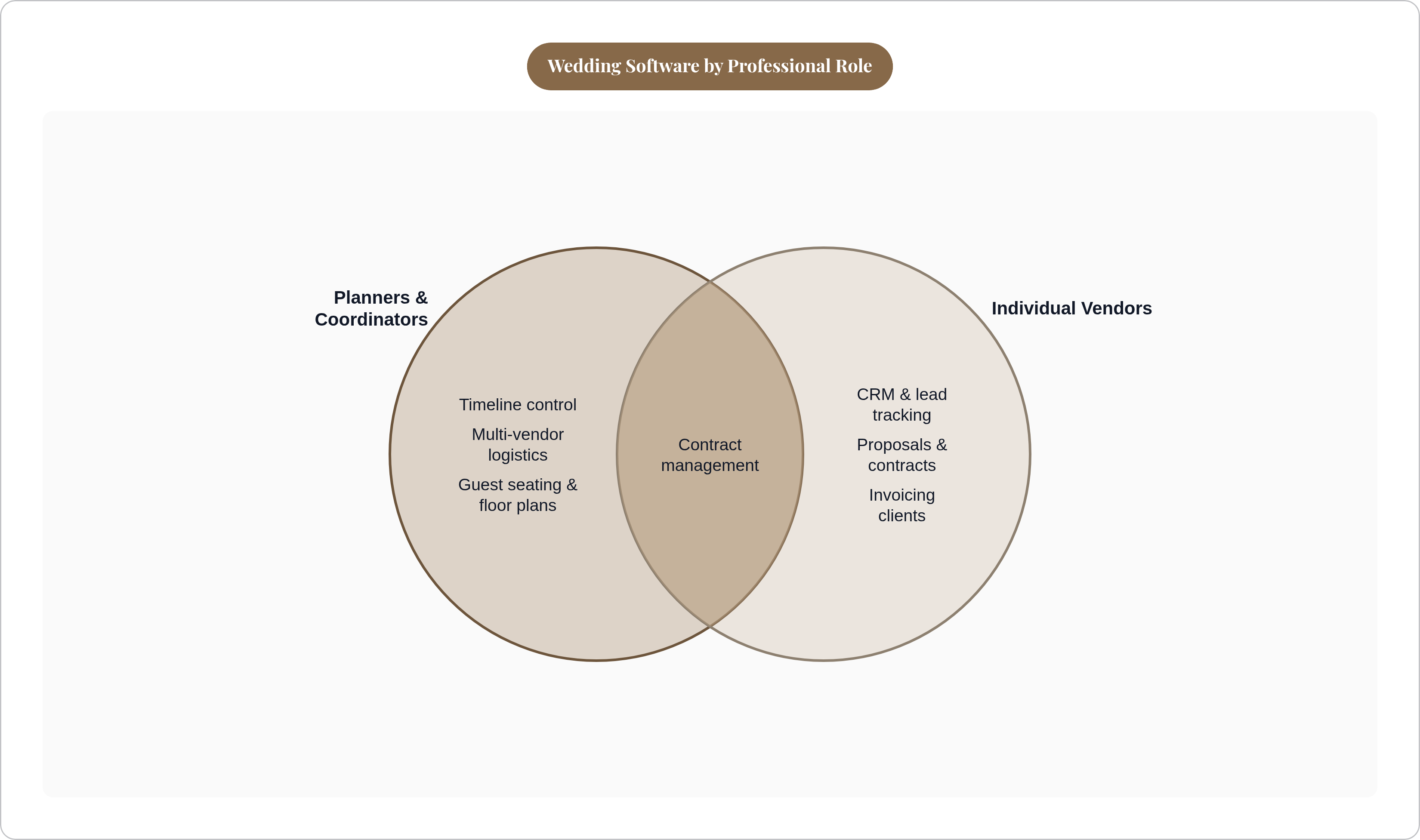
These platforms aren't for planners running multi-vendor projects. They're for the vendors themselves. Photographers, caterers, florists, and DJs running their own small businesses and managing their own client relationships.
HoneyBook
HoneyBook is the most recognisable name in this space. Its Smart Files feature combines proposals, contracts, and invoices into a single interactive document, which genuinely cuts down on the back-and-forth in client-facing workflows.
One thing that has to be mentioned: HoneyBook raised prices significantly in early 2025. The Starter tier went up 89 percent. Essentials rose 51 percent. Premium rose 63 percent. The company framed it as funding AI development. The community response, particularly among photographers and creative professionals, was not warm. Current 2026 pricing runs roughly $29 a month for Starter, $79 for Essentials, and $109 for Premium.
If you're comfortable with the new price point and you prioritise ease of use and polished client-facing touchpoints, HoneyBook still earns its place. Just go in knowing where the cost trajectory has already gone.
Dubsado
Dubsado is the tool that systems-oriented vendors love and everyone else struggles with. It's highly customisable, and it's also a significant time investment to set up — think of it as assembling a custom-built engine: powerful once it's running, but you will absolutely get grease on your hands first. Most vendors need several weeks, or a dedicated setup specialist, before the system is actually functional. That's not a dealbreaker. It's just the honest version of what "highly customisable" means in practice.
A few real limitations:
The scheduler is built for solo use and doesn't work well for teams.
The Dubsado 3.0 update was still rolling out as of late 2025, with some promised features not yet fully available.
The mobile app lags noticeably behind the desktop experience.
None of that disqualifies it. But Dubsado rewards vendors who are willing to invest in setup and maintain the system intentionally. If that's not you, it will frustrate you.
Wedy Pro
At $25 a month, Wedy Pro is the most affordable full-CRM option in this group. It covers contracts, invoicing, automation, and scheduling. What makes it different from a pure CRM tool is a built-in marketplace where couples actively discover vendors.
That distinction matters. Competitors like The Knot charge between $200 and $1,200 a month for ad placements that deliver shared leads, meaning the same lead goes to multiple vendors simultaneously. Wedy Pro offers a discovery channel without that separate marketing spend.
For vendors who want CRM plus visibility without a dedicated marketing budget, that's a real value proposition.
Rock Paper Coin
Rock Paper Coin was built around something most CRM tools ignore: the three-way relationship between planner, vendor, and client. All three parties live on the same platform.
The standout feature is that planners can view and approve vendor contracts on behalf of their clients. For full-service planners who manage vendor relationships directly, that shared visibility eliminates a whole category of back-and-forth. For vendors who work frequently with planners, it means the relationship is collaborative rather than siloed.
It's the most workflow-specific tool in this tier. Whether that's a strength or a limitation depends entirely on how you actually work.
Vendor management tools built specifically for wedding venues
Venues are a different animal. A full-service planner manages one event deeply over many months. A venue coordinator manages multiple events per week across a fixed physical space, often with shared staff, shared suppliers, and very little margin for scheduling errors.
The coordination challenges are different too. Venue coordinators sit at an unusual intersection. They're coordinating external vendors like bands, florists, and photographers. At the same time, they're managing their own internal supplier network for catering, AV, and cleaning. That's both a planner's job and a vendor's job, running simultaneously, for multiple events at once.
What a venue-specific platform has to handle:
Multi-event calendar management. Preventing double-bookings, tracking setup and breakdown windows between events.
Supplier and preferred vendor list management. Approved vendors, contact details, insurance certificates, event history.
Integrated function sheets. Event details, food and beverage requirements, and room configurations communicated cleanly to internal staff.
Client-facing booking and enquiry management. Converting leads into confirmed bookings without a separate CRM layer sitting outside the system.
Platforms like Planning Pod and Aisle Planner do serve venues, but dedicated venue management platforms like EventPro, Tripleseat, and FullyBooked are optimised for multi-event operations rather than single-event depth. The features are oriented toward throughput and scheduling efficiency, not toward the 400-hour arc of a single planning engagement.
The venue use case is also where digital guest experience tools deliver the most operational value. Things like QR seat-finders, or table assignments delivered as Apple or Google Wallet passes directly to guests. For venues running back-to-back events, a chaotic guest seating process at one event bleeds directly into setup time for the next. Anything that streamlines guest arrival has real downstream effects on the whole operation.
How to match a platform to your actual workflow before buying
The most common mistake in this purchase is buying up to an enterprise platform because it feels more professional, or because the sales demo was impressive. A platform the team finds too complex to use consistently is worse than a simpler one they actually open.
Before evaluating any platform, four questions cut through most of the noise:
Are you primarily a planner, a vendor, or a venue? Managing vendors for clients is a different job than managing your own client relationships, which is a different job than managing multiple concurrent events in a physical space.
Do you need to manage guest logistics and seating, or does your coordination happen upstream of the guest experience? A caterer does not need floor plan tools. A full-service planner who handles seating charts does.
Are you a solopreneur or do you have a team? Some platforms have schedulers and permission models that simply don't support team workflows. Dubsado is a clear example.
What is the one coordination failure that has cost you the most time or caused the most client friction? Does the platform actually solve that specific problem, or does it add features that sit next to it without touching it?
That last question is the one most people skip. They evaluate platforms on feature count. The better question is whether any of those features fix the thing that actually broke last season.
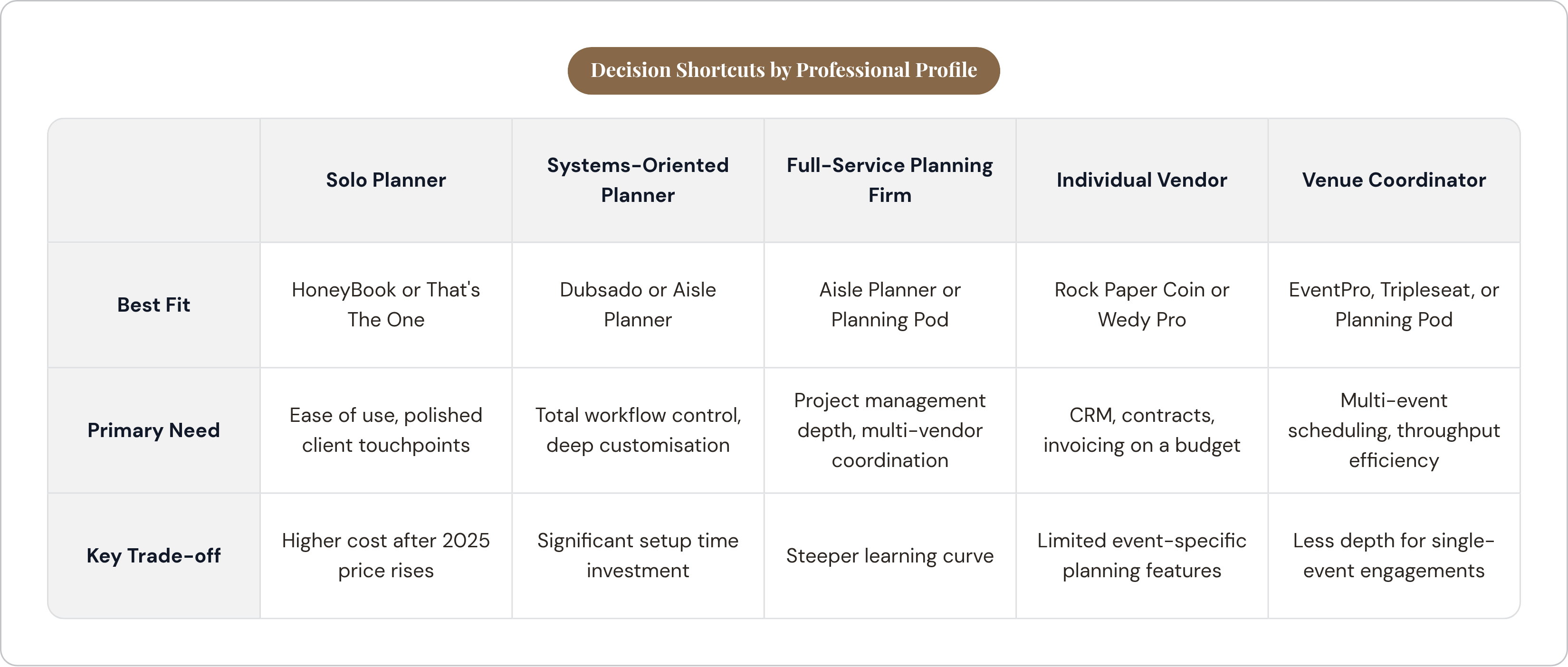
Decision shortcuts by profile:
Solo planner wanting ease of use and polished client touchpoints. HoneyBook or That's The One.
Systems-oriented planner wanting total workflow control. Dubsado or Aisle Planner.
Full-service planning firm needing project management depth. Aisle Planner or Planning Pod.
Individual vendor on a tight budget. Rock Paper Coin or Wedy Pro.
Venue coordinator managing multiple events per week. A dedicated venue platform (EventPro, Tripleseat) or Planning Pod.
According to The Knot's 2026 Planner Survey, 78% of professionals using dedicated software report higher client satisfaction and fewer logistical issues. That number argues for adoption at any level, not just upgrading to the most feature-rich option available.
Free trials exist across most of these platforms. The right test is simple: does the tool get used consistently in the first two weeks? Whether the demo looked polished matters less than whether you actually opened it on a Tuesday morning when you had a vendor issue to resolve.
One more practical note. HoneyBook's 2025 price increase should function as a standing reminder that SaaS costs can shift significantly mid-engagement. When comparing platforms, look at total cost over a typical engagement length of twelve to eighteen months, not just the monthly rate on the pricing page today.
What the right platform actually changes about how a wedding professional works
The operational shift isn't just "less admin." That framing undersells what's actually happening.
The average wedding involves 14 vendors, each with their own timeline, their own contact preferences, their own moving parts, all pointed at a deadline that cannot move. Full-service planners routinely put in 200 to 400 hours per event, and the majority of that time isn't creative work. It's traffic management. Vendor updates, client check-ins, and timeline adjustments can eat roughly five hours per week per active wedding. That overhead compounds quietly across every active event, every week.
The place where time actually disappears is manual reconciliation. A planner gets an update from one vendor and spends the next thirty minutes updating four other documents, hoping nothing propagates incorrectly. It's not glamorous work. It's not billable. And it's the kind of thing that, across a full season, quietly hollows out your capacity without ever showing up on an invoice.
When vendor data, timelines, guest logistics, and client communication live in one connected system, that step disappears. The planner's role shifts from information traffic controller to event director. The work becomes proactive rather than reactive.
For individual vendors, the shift is similar in structure if different in scale. When proposals, contracts, invoices, and scheduling all flow through one system, fewer bookings fall through the cracks. Fewer client relationships require damage control after something was miscommunicated or missed entirely.
The market context matters here. A survey of more than 500 active wedding professionals found that average booking levels for 2025 sat around 66 percent. That points to a competitive market. The professionals converting the most inquiries tend to be the ones whose client experience feels seamless from first contact through day-of. That seamlessness is downstream of whether the back-end tools are actually connected.
More than two million newly engaged couples join major wedding platforms each year. Wedbuild, a self-serve wedding planning app for couples that handles RSVPs, guest lists, seating charts, and budgets in one place, sits on the couple's side of that equation, giving pairs an organised foundation before they ever hand anything off to a professional. The volume of potential clients is not the constraint. The constraint is a planner's or vendor's capacity to serve them without coordination overhead quietly eroding the margin.
The right software doesn't make a planner more creative or a photographer more talented. What it does is stop the operational friction from quietly undercutting the skills they already have.