Free Wedding Website Platforms With No Subscription
Compare free wedding sites before The Knot's defaults trap you in vendor ads.

The Knot and WeddingWire are, for most practical purposes, the same company. The Knot Worldwide owns both, and together they show up in nearly three out of four wedding-planning AI responses. That kind of default visibility means most couples land on these platforms before they've compared anything else.
Here's what The Knot's free tier actually includes:
Guest list management and RSVP collection at no cost
Registry aggregation that pulls multiple registries onto one page
Integration with The Knot's own mobile app and planning checklist
That's a genuinely functional set of tools. RSVPs, guest management, registry links — all accessible without spending anything. So what's the catch?
The real cost is attention. Ad placements run throughout the planning dashboard. The vendor recommendation engine surfaces businesses that pay The Knot for placement, not necessarily the best vendors in your area. The platform's core business is connecting couples to vendors. Serving couples well is a means to that end, not the end itself. Think of it as a shopping mall that sells you a wedding planner at the door.
If you can filter the commercial noise, The Knot's free tier holds up fine. If you'd rather not have a vendor marketplace embedded inside your planning tools, keep reading.
Registry-Commission Platforms: Zola and What Zero Dollars Actually Buys
Some platforms skip the ad model entirely and make their money on the registry side instead. The logic isn't complicated. If a platform earns a cut of gift sales, it doesn't need to charge couples for access to website tools. It just needs couples to use the registry.
Zola runs on exactly this model.
Zola's free tier includes:
More than 250 customizable design templates
Online RSVP collection and meal preference fields, both free
Password protection included at no cost
A personalized planning checklist that generates a task timeline from your wedding date, with options for cultural and religious traditions
The clearest upsell on Zola is a custom domain, which starts at $17.99. That's it. Zola is straightforward about the fact that its revenue comes from registry sales, not from charging couples to use the website. For most couples, that's a trade-off worth making.
The honest limitation: the tools are good because they serve as a funnel toward registry activity. The website works well. Just know that's the architecture you're operating inside.
Freemium Platforms Where the Free Tier Is Mostly a Demo
This is the category that requires the most careful reading, because a platform can advertise itself as "free" and still require payment before you can do anything operationally useful.
Lovebird is the clearest example. The free design is genuinely polished. You get custom colors, fonts, imagery, password protection, QR code access, and a custom URL. It looks great. The problem is that RSVP collection, meal selections, and the digital stationery features that make it worth choosing all sit behind the premium tier.
The free version of Lovebird gives you a static information page. Fine if that's all you need. Not fine if you're trying to manage guest logistics.
The pattern to watch for is this: design access is not the same as planning access. A platform can let you build a beautiful website for free and still require a subscription before you can collect a single RSVP. Always ask specifically whether RSVP collection and dietary fields are included in the free tier. Not just whether the website builder is free. Those are two different questions, and the answer to one tells you almost nothing about the other.
Platforms Where Free Genuinely Means Free — With a Clear, Optional Upgrade Path
These platforms offer functional free tiers and keep their upgrade paths honest. Where a cost exists, it's a defined, one-time payment rather than a subscription that compounds across an 18-month engagement.
Minted
Minted's free template library includes over 1,000 designs from independent artists. That's the largest library of any platform covered here. The core website is free. The only upgrade is a one-time $15 payment for a custom domain, which also unlocks a $50 credit toward Minted's physical stationery. A transparent, bounded upsell, not a subscription gate. Best fit for couples who want their website design to coordinate with their paper goods.
Hitchd
Hitchd leads with modern, design-forward templates and includes RSVP management and meal preferences in its core product. Its honeymoon and experience registry supports more than 10 currencies and two languages, which makes it a standout option for international or multicultural weddings. Like Zola, Hitchd's revenue comes from the registry side, which keeps the website tools accessible.
WedBuild
WedBuild takes a different approach from every other platform on this list. It's built as a connected system rather than a website with separate planning tools bolted on. The wedding website, guest list, RSVPs, seating chart, and budget planner all share the same data. A dietary requirement entered on the RSVP page flows automatically to the seating chart. No manual reconciliation. No copying information between apps.
The platform is free to start, with a one-time payment for the full platform and no subscription at any point during your planning window. It also includes a day-of QR seat finder for guests, which is a feature that matters on the morning of the wedding, not just in the months before it.
Best fit: couples who want every piece of planning connected in one place and have no interest in re-entering information across multiple apps.
The common thread across this group is the same. Where an upgrade exists, it's a defined one-time cost, not an open-ended monthly fee.
What Every Free Wedding Website Should Actually Contain
Regardless of which platform you choose, the website's job is simple: reduce the volume of individual questions you field in the final weeks before the wedding. The more it answers upfront, the fewer texts you get at 10pm from your aunt asking where to park.
Core sections every wedding website needs:
Couple introduction. Names, a brief story, a tone-setter for the day.
Date, time, and ceremony location. The non-negotiables.
Reception details. Venue address if different from the ceremony, timeline for cocktail hour and dinner, adults-only policy if applicable.
Dress code. Be specific enough to be useful. Photo examples help when the dress code is non-standard.
RSVP section. Meal options, plus-one policy, and dietary fields, all collected in one place. Not by email.
Registry links. Pulled into one page so guests aren't hunting across retailers.
Accommodation and transport. Critical for destination or multi-venue weddings.
Wedding party. Helps guests put names to faces on the day.
FAQ or contact person. Covers the questions that would otherwise arrive as individual texts the week before.
A few things worth stating plainly. Mobile design is not optional. Most guests will access the website on their phones, and any platform whose templates aren't mobile-responsive creates friction at the guest end. That friction becomes your problem, not theirs.
Your social media preferences belong on the website too. An unplugged ceremony notice or a custom hashtag should be set early and set clearly, not announced verbally from the altar and promptly forgotten by half the room.
How to Choose the Right Platform Given What "Free" Actually Costs You
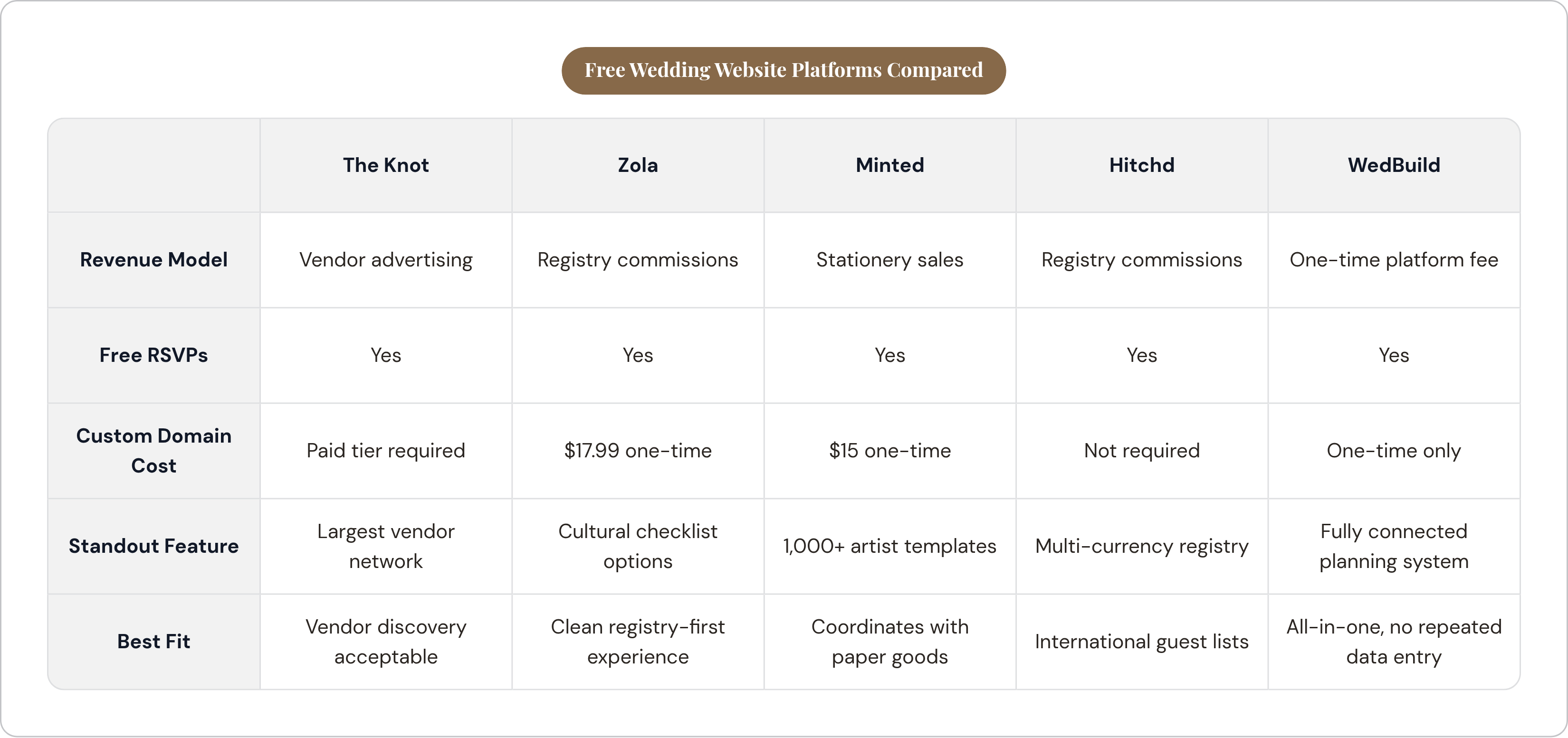
Here's the thing about "free" wedding websites: every platform that offers one is running a business, and that business needs to make money somewhere. The question isn't whether they'll monetize you. It's how. Once you understand the model behind a platform, you can make an informed choice. Until then, you're just hoping the fine print is in your favor.
The decision comes down to which trade-off you're most comfortable with.
Comfortable with ads and vendor recommendations in exchange for a fully functional free tool. The Knot.
Want integrated planning, a timeline checklist, and a clean registry experience. Zola.
Want design that coordinates with physical stationery, willing to pay $15 once for a custom domain. Minted.
Have an international guest list or want an experience-based registry. Hitchd.
Want everything, including website, RSVPs, dietary tracking, seating, and budget, connected as one system with no recurring fee, some platforms offer this with a single one-time payment.
Red flags that signal a platform's "free" will cost more than expected:
RSVP collection sitting behind a paywall
Any recurring monthly or annual fee at any tier
No clarity on where platform revenue comes from
Ads visible to guests, not just to you in the planning dashboard
One practical note on timing. Most engaged couples start planning online, and many begin before they've even told their families. Choosing a platform early matters because switching mid-planning means migrating guest data. That's exactly the kind of manual, tedious work these tools are supposed to eliminate. Getting it right the first time saves you the headache of doing it twice.
The platforms that are upfront about how they make money are the ones worth trusting. Knowing the model is the only way to know what "free" actually costs you.