Vendor Relationship Management in the Wedding Industry
Clear systems prevent the chaos that turns wedding planning into last-minute scrambling.

Managing vendors for a wedding is, at its core, a project management problem. You have somewhere between eight and twelve separate businesses, each running on their own timeline, their own contract format, and their own preferred way of communicating. Nobody is coordinating them except you. And if you don't build a system to manage that, the system defaults to your inbox. Which is not a system — it's like trying to conduct an orchestra where every musician has a different score, and you're the only one who knows the concert starts at six.
Here's the thesis: vendor relationship management is not something only professional planners do. It's a discipline any couple can apply, with the right structure in place from the start. The couples who feel in control during wedding planning aren't necessarily more organised people. They just set up the infrastructure early and let it do the work.
The failure mode is almost always the same. A contract is buried in an email thread from six months ago. Dietary requirements were collected in a Google Form nobody exported. The photographer's run sheet is a different document from the venue's. Nothing connects. And the week before the wedding, someone is manually reconciling all of it. That reconciliation is what makes wedding planning feel overwhelming. It doesn't have to.
According to The Knot's 2024 survey, 78% of couples used online tools to help plan their weddings, citing organisation and time-saving as the main reasons. And yet the fragmentation problem persists, because the tools don't talk to each other. A checklist app here, a budgeting spreadsheet there, contracts in email, a seating chart on someone's laptop. The problem isn't a lack of tools. It's a lack of integration.
The cost of disorganisation is concrete. A missed payment deadline can void a contract. A head count sent to the caterer without dietary data means the kitchen is guessing. A photographer who hasn't seen the run sheet shows up without knowing when the first dance is. Every one of those is a downstream consequence of something that wasn't tracked upstream.
What vendor relationship management actually means for couples
The term "vendor relationship management" comes from procurement and business operations. Most couples haven't heard it applied to wedding planning. That's exactly why it's worth borrowing. It names something that matters but rarely gets treated as a discipline.
For couples, it comes down to four things working together:
- Clear communication. Every vendor knows the brief, the timeline, and who to contact.
- Tracked contracts. Every agreement is stored somewhere both partners can access.
- Compared quotes. Decisions are made on structured criteria, not gut feel from a crowded inbox.
- Coordinated logistics. Every vendor knows how their role fits with everyone else's on the day.
That's it. Four things. But here's the catch: most couples only do one or two of them, and they do those reactively rather than proactively.
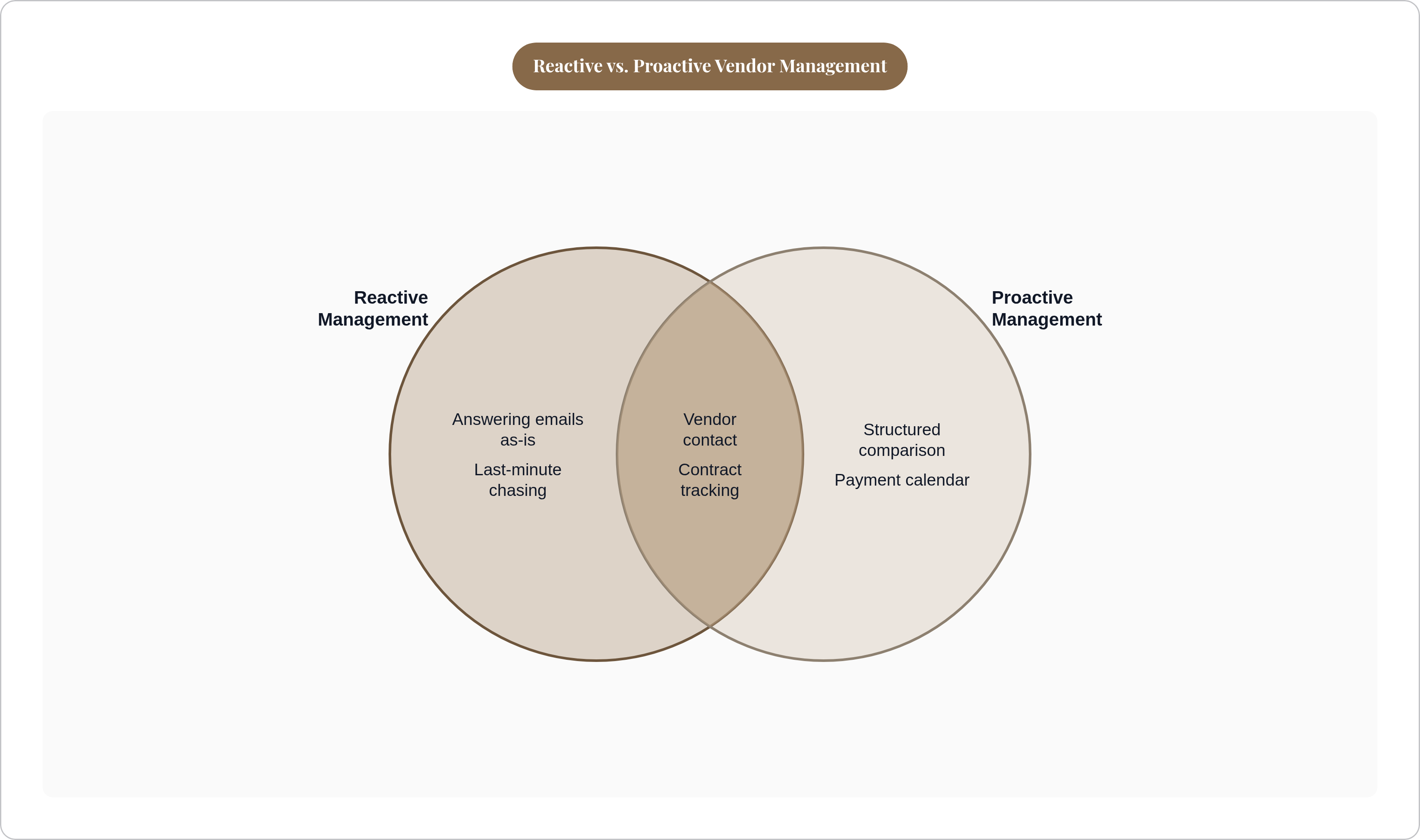
Reactive management looks like answering emails as they arrive, chasing confirmations the week before the wedding, and scrambling to reconcile information that was never centralised. Proactive management looks like setting up systems at the start that make the scrambling unnecessary. The goal of this article is the second one.
The best weddings aren't the ones with the most vendors, or the most expensive ones. They're the ones where every vendor understood the brief, respected the timeline, and delivered their part with confidence. That outcome doesn't happen by accident. It's the result of a management layer that sits above each individual vendor relationship. Build that layer, and everything downstream gets easier.
Building a single source of truth for all vendor information
The core idea is simple: one place where every vendor's contact details, contract status, payment schedule, and key deliverable lives. Accessible to both partners. At all times.
You have two practical options.
The first is an all-in-one wedding planning platform. The upside is low setup friction. Pre-built structure, vendor directory integrations, checklists keyed to your wedding date. The downside is less flexibility, and you're working within someone else's template.
The second is a custom build. A master spreadsheet or a Notion database, with one row per vendor and columns for contact, contract status, deposit paid, balance due, and key delivery date. More flexible. Requires more discipline to maintain.
Neither is wrong. The right choice is the one you'll actually update.
Alongside either option, consider setting up a shared email address used exclusively for wedding vendors. It keeps contracts out of work inboxes, gives both partners full visibility, and creates a searchable archive that's genuinely useful when you need to dig up a specific email three months later. Pair that with a cloud storage folder structure (one folder per vendor, named consistently) where contracts and invoices are filed immediately rather than left as email attachments.
Research consistently shows that couples who start planning early get more value out of their systems, simply because there's more planning period for the infrastructure to work across. The earlier you build this, the more it returns.
Here's the minimum of what to track per vendor:
- Full legal business name and registration number
- Primary contact name and preferred communication channel
- Contract signed date, plus key terms (cancellation and substitution clauses)
- Deposit amount, balance due, and payment due date
- What they're delivering, and what time they need to arrive on the day
This is the infrastructure. Without it, everything else in this article has nowhere to live.
Comparing and selecting vendors on structured criteria rather than vibes
Here's what actually happens. You email four photographers. Two respond immediately, one takes four days, one sends a PDF price list with no personal note. You compare the quotes loosely, the prices feel similar-ish, and you book the one whose Instagram you liked most.
That's not comparison shopping. That's pattern matching on incomplete information.
Structured comparison means deciding in advance what you're evaluating, then applying those criteria consistently across every vendor in a category. Here's what that list looks like:
- Total cost. Not just the headline figure. What's included versus charged separately.
- Availability on your date. Obvious, but worth confirming in writing.
- Experience and style fit. Do their previous weddings look like what you're planning?
- Responsiveness during quoting. A vendor who takes five days to return a quote is showing you something about how they'll communicate during planning.
- Contract terms. Cancellation policy, substitution clause, what happens if they're sick.
- Reviews and references. Look for patterns across multiple reviews, not outliers in either direction.
The practical tool is a comparison tab in your vendor master spreadsheet. One row per shortlisted vendor in a category, columns for each criterion. When it comes time to decide, you're looking at a document, not trying to reconstruct a feeling.
The budget context matters here. According to The Knot's 2026 Real Weddings Study (which surveyed more than 10,000 couples), the average U.S. wedding costs $34,200. Venue and food together typically consume nearly half of that total. That's where your comparison shopping has the most leverage. The major categories reward structured evaluation most.
Photography is worth flagging separately. The average U.S. wedding photography package costs around $5,800, but couples spend an average of roughly $2,900. That gap suggests a lot of couples are selecting on price without fully understanding what a lower package excludes. Hours of coverage, second shooters, album inclusions, printing rights. Read the scope carefully before the price.
Setting communication expectations at the point of booking
Most vendor communication problems aren't really communication problems. They're expectation problems. Neither side was explicit at the start about how they'd communicate or how quickly they'd respond. Everything that follows flows from that ambiguity.
At the point of booking, establish four things:
- Preferred channel. Email for anything that needs a record. Phone for urgent issues.
- Expected response time. Both ways. How quickly will the vendor respond to you, and how quickly will you respond to them.
- Single point of contact. One person on your side, one named contact on theirs.
- Check-in schedule. When you'll next be in touch and why.
The single point of contact rule is more important than it sounds. Vendors who receive instructions from two different people, especially if those instructions occasionally contradict each other, get confused. That confusion compounds as the wedding approaches. Pick one of you to be the primary contact for each vendor category, and stick to it.
After any significant conversation (a scope change, a timing update, a decision about extras), send a brief confirmation email. "Just confirming we've agreed to add a second photographer for the ceremony, included in the original package price." This creates a paper trail. It protects both parties. And it matters because contracts are signed months before the wedding, and memories diverge.
Not every vendor needs monthly check-ins. But every vendor needs at least three structured touchpoints: at booking, at roughly the three-month mark, and at the final confirmation two to three weeks out. Build those into your calendar at the start, not as ad-hoc follow-ups when you remember.
One last point on tone. Vendors who feel clearly briefed and genuinely respected perform better. Not because of sentiment, but because clarity removes the friction that causes errors. Being organised is also being a good client.
Managing contracts and payments without letting anything slip
A wedding contract is not a formality. It's the specification document for the relationship. It defines what's being delivered, when, for how much, and what happens if something changes. Treat it accordingly.
Before signing anything, verify:
- Exactly what's included. And what costs extra.
- Cancellation and postponement terms. Both theirs and yours.
- The substitution clause. What happens if the photographer you met, or the celebrant you interviewed, can't attend and sends someone else?
- The payment schedule. Deposit amount, balance due date, accepted payment methods.
- Force majeure language. This became relevant to a lot of couples in ways nobody anticipated. Check what it covers.
Payment tracking is where couples most commonly fall behind. With eight to twelve vendors each on different schedules, a missed balance payment can void a contract or trigger a penalty. The fix is a payment calendar: a tab in your master spreadsheet, or a shared calendar, with reminders set 14 days before each balance is due. Not the day of. 14 days before, so you have time to arrange a transfer.
According to data from one wedding platform, nearly three-quarters of couples who married recently spent more than their original budget. Untracked vendor extras and scope creep on individual contracts are a primary driver of that. The contract review process is the intervention point. If it isn't in the contract, it isn't a commitment.
The standard advice is to hold back roughly 5% of your total budget as a contingency. That advice only works if you know precisely what you've already committed to in contracts. The contingency fund is your buffer against the unexpected. It's not a fund for scope creep you could have controlled.
Building the master run sheet vendors actually use on the day
The master run sheet is the operational output of all the planning work that came before it. Every vendor's arrival time, setup window, service moment, and departure. On one document.
This matters because vendors don't sequence themselves. If the tent rental crew needs two hours for setup before the florist can start arranging, that slot has to be confirmed before anyone shows up. Sequencing errors between vendors are among the most common day-of problems, and they're almost entirely preventable.
The run sheet must include:
- Vendor name and on-the-day contact number. Not the office number from the contract. The mobile number of the person physically showing up.
- Arrival time and access requirements. Loading dock, parking, venue entry point.
- Setup window with buffer built in.
- Key service moment. First course service, ceremony music start, cake cutting.
- Pack-down time and departure.
Buffer windows are not padding. They're risk management. A 20-minute buffer between one vendor's setup completion and the next vendor's arrival absorbs the most common delays without cascading into something bigger.
Send the run sheet to all vendors at least two weeks out. Not the day before. Two weeks out, so vendors have time to flag a conflict or ask a question while there's still time to resolve it.
Designate one person as the on-the-day point of contact for all vendors. A wedding coordinator if you have one, a trusted and capable family member if you don't. The point is that vendors need somewhere to direct logistics questions that isn't you during cocktail hour.
Handling dietary requirements and seating logistics as one connected problem
Catering is the vendor category most dependent on accurate guest data. It's also the one most likely to go wrong when RSVPs, dietary requirements, and seating are managed as three separate tasks.
Here's what your caterer actually needs, and when:
- Final guest count. Typically required four to six weeks out for ordering. Confirm this deadline at booking.
- Dietary breakdown. Total numbers per requirement: vegetarian, vegan, gluten-free, specific allergies.
- Seat-level dietary data. Which guest at which table has which requirement, so service staff can deliver correctly without asking guests to identify themselves mid-service.
That last one is where most couples fall short. They send a total dietary count but not a seat map. The kitchen knows to prepare twelve gluten-free meals. The service staff doesn't know who gets them.
The fragmentation problem shows up here in miniature. RSVP data lives in one place, dietary notes in another, and the seating chart in a third. Reconciling them manually is a known stress point. It doesn't have to be.
The minimum data structure for your seating chart is five columns: Guest Name, Table Number, RSVP Status, Dietary Needs, Group or Relationship. If you maintain this consistently from the moment RSVPs start coming in, the caterer handoff is an export, not a morning of reconciliation.
Research from seating tools suggests that couples using digital methods with CSV import and drag-and-drop functionality seat a hundred guests in thirty to sixty minutes. Paper-based methods take several hours longer. That's time, and it's stress, both of which compound the week before the wedding.
QR-code seat finders and digital seat passes (delivered via Apple or Google Wallet) reduce day-of confusion for guests and take pressure off the front-of-house team. They're a small thing with a disproportionate effect on how smooth the room arrival feels.
What to do after the wedding to close the vendor loop
Most couples mentally close out on their vendors the moment they leave the reception. There's a short list of things worth doing before you do.
- Confirm all final payments are cleared and save the receipts.
- Chase any outstanding deliverables. Final photo gallery. Video edit. Florist item returns. Venue bond refund. These have a habit of slipping if you don't follow up.
- Write and publish your reviews while the detail is fresh. Specific, honest, useful to other couples.
On that last point: for small wedding vendors (photographers, florists, celebrants, musicians), a detailed and honest review is genuinely among the most valuable things a client can give them. It costs you ten minutes. For them, it's how the next couple finds them. Write the one you'd have wanted to read when you were choosing.
A brief mental debrief per vendor is also worth capturing. Did they deliver on what they promised? What fell short? Would you recommend them? Add a note to the vendor row in your master spreadsheet. Not a formal performance review. A five-minute note that's immediately useful the next time a friend asks if you'd recommend your florist.
Here's the through-line: couples who set up the system at the start — the central hub, the structured comparison process, the communication expectations, the run sheet — find that the post-wedding close-out is genuinely light work. Because nothing was left untracked. There's no reconciliation to do. There's no contract to dig up. There's no vendor to chase who you'd forgotten about.
Getting organised about vendor relationships doesn't remove the emotion from a wedding. It removes the noise. And when the noise is gone, the emotion has room.