Vendor Management Strategies When Coordinating Multi-Vendor Weddings
Coordinate your vendors with a shared timeline and single information source.

The problem isn't finding good vendors. Most couples figure that part out. The problem is that a dozen independently excellent vendors, each with their own plan, their own timeline, and their own assumptions, do not automatically become a coordinated team just because they're all booked for the same Saturday. Nobody told them to be a team. Nobody gave them the same sheet of music.
The core failure is fragmentation. And it's boring. It's not dramatic. It's just information living in the wrong places.
The contract is in your email. The updated quote is a PDF buried in your downloads folder. The revised arrival time is in a WhatsApp thread from eight weeks ago. When something needs checking fast, you spend more time finding the information than using it.
The gaps that actually sink a wedding day are pretty predictable:
Vendor A assumes Vendor B knows something nobody told Vendor B. The caterer assumes the rental company is handling table setup. The rental company assumes someone else is on it. Nobody is on it.
Revised quotes and changed arrival times never make it into the master plan. The florist moved their arrival up by an hour. You updated it in your notes app. Nobody else knows.
No designated contact on the day. So vendors call the couple. During cocktail hour. While the couple is actively trying to hold a drink and talk to their grandmother.
Vendor meals aren't arranged. Your photographer and band are there for ten-plus hours. Most vendor contracts expect a meal. If you haven't flagged this with the caterer, you'll find out about it at the worst possible moment.
The cake arrives before the table it's sitting on is dressed. Small. Fixable. Completely avoidable.
None of these are disasters on their own. It's the accumulation. There's also a financial version of this. A big part of why couples go over budget is that revised quotes, added delivery fees, and per-head price increases never get reconciled against a running total. The money drifts because the information is scattered.
Building a Single Source of Truth Before Booking the Second Vendor
One document. One place. Everything lives there.
This isn't about which platform you use. A dedicated wedding planning app, a well-built Notion database, a detailed spreadsheet. The tool matters less than the discipline. What matters is that there is exactly one place where every piece of vendor information lives, and that everyone working the day is pulling from it.
Here's what your master vendor brief needs to contain:
Event date, venue address, ceremony start time, dinner service time, last song time
Guest count and any dietary requirements relevant to vendor scope
Every vendor's contact name, mobile number, and email
Contracted arrival time and setup window for each vendor
Payment schedule: deposit paid, balance due, due date
Venue-specific constraints: noise curfew, loading dock access, candle policy, bump-out time
Interdependencies (florist must finish centrepieces before the photographer arrives for detail shots, for example)
The reason this has to exist before you book the second vendor is simple. Every new vendor you add either fits into the existing plan or complicates it. You need the plan to exist first so you can tell which one is happening.
Most couples use planning tools as a checklist. Something to tick rather than something to actually manage the day against. The brief isn't a to-do list. It's the single version of truth that every decision gets checked against, all the way to the morning of the wedding. When guest information, dietary requirements, vendor notes, and payment status all live in one place, you never have to reconcile two separate systems at 7 AM.
The Reverse Timeline: Working Backwards from the Ceremony to Set Every Vendor's Window
Most couples build their vendor timeline by asking each vendor when they want to arrive. That's backwards.
Vendor arrival times are not about vendor convenience. They're about what the space needs to look like at a specific moment, and working backwards from that moment to figure out who needs to be there when.
Start with your ceremony time. Then ask: what does the room need to look like when guests walk in, and what has to happen, in what order, for it to look that way?
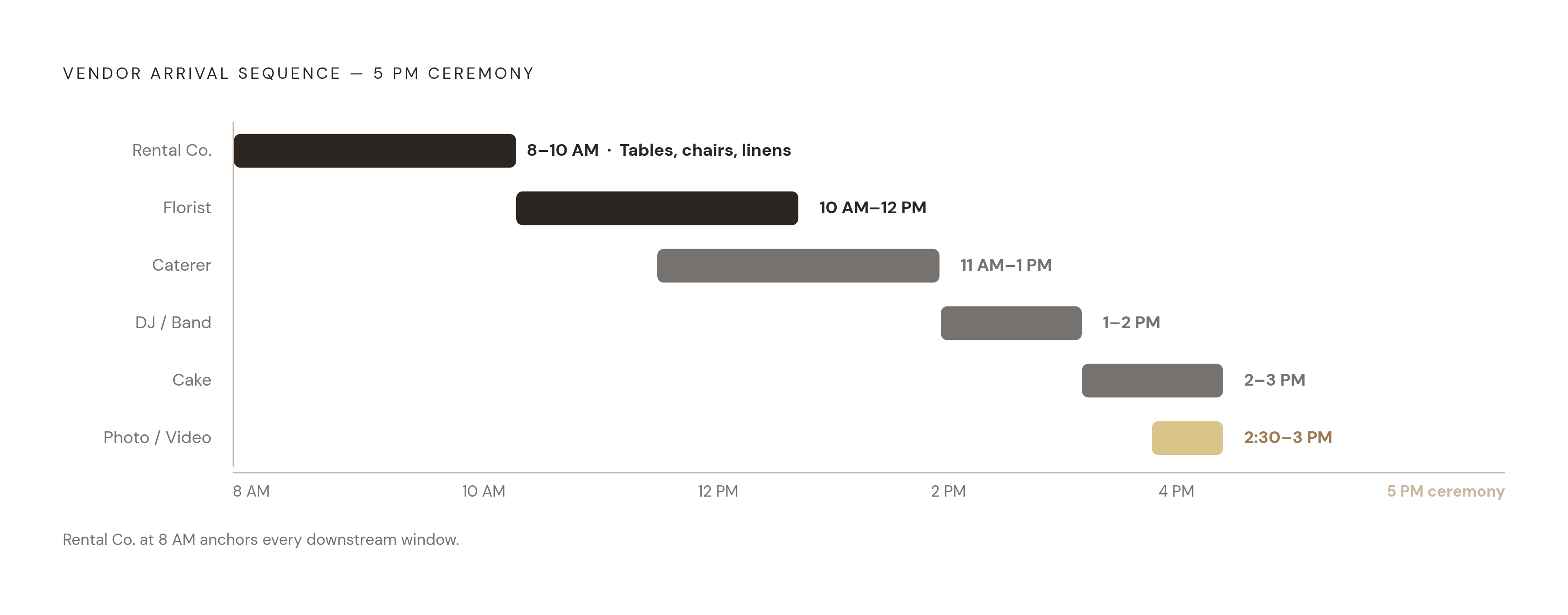
Here's a concrete example for a 5 PM ceremony:
8 to 10 AM: Rental company. Tables, chairs, linens, large equipment. They go first because everyone else needs the furniture to exist before they can do their job.
10 AM to noon: Florist. The most time-intensive setup. They need a clear floor before other vendors crowd the space.
11 AM to 1 PM: Caterer. Kitchen setup starts, but nothing goes on tables until florals are done.
1 to 2 PM: DJ or band. Sound check must finish before guests arrive. One thing people consistently miss: the lighting rig affects where the photographer can actually shoot. These two vendors need to talk before setup locks in.
2 to 3 PM: Cake delivery. After the table it's sitting on exists and is dressed.
2:30 to 3 PM: Photographer and videographer. They arrive to shoot the fully styled venue before anyone touches it.
A few other interdependencies worth naming explicitly:
Floral centrepiece height affects sightlines for speeches. The florist and venue manager need to agree on this before arrangements are placed.
Catering timing dictates when speeches and entertainment can realistically start. The caterer and the MC need the same timeline. Not similar timelines. The same one.
The reverse timeline is also your conflict-detection tool. Two vendors who need the same loading doorway at the same time. A setup window that's tighter than a vendor's contract allows. You find these things now, not at 9 AM on the day when the florist and the rental company are staring at each other in a parking lot.
Each vendor gets their specific arrival window in writing. Not just the ceremony time. Their window.
What to Send Every Vendor Before the Day, and When to Send It
About two weeks before the wedding, every vendor gets a pre-wedding pack. Late enough that the timeline is final. Early enough that vendors can raise conflicts before it's too late to fix them.
What goes in it:
Their specific arrival window and how long their setup is expected to take
The name and mobile number of the day-of point person (not the couple)
Venue address, parking instructions, and load-in access details
Any venue constraints that affect them directly: the noise curfew for the DJ, refrigeration access for the caterer, where the florist can dispose of flower water
Contact details for the two or three vendors they'll need to coordinate with directly. Florist and caterer. DJ and photographer.
After you send it, ask every vendor to confirm receipt and flag any conflicts. Explicitly. Don't assume silence means agreement. Silence usually just means they haven't read it yet.
Then, in the final week, a brief check-in. Keep it short — a full review is unnecessary. Just: has anything changed on your end? Truck issues, staff changes, revised delivery windows. A five-minute call or a quick message thread is enough.
The goal is that every vendor arrives on the day already knowing where to go, who to call, and what happens before and after their window. The couple answers zero operational questions on the day. Zero.
Who Runs the Day: The Difference Between a Venue Coordinator and Someone Who Manages All Your Vendors
The couple cannot be the point of contact on the wedding day. This is not a preference. It's the rule that makes everything else work.
Here's the distinction most couples don't know until it's too late.
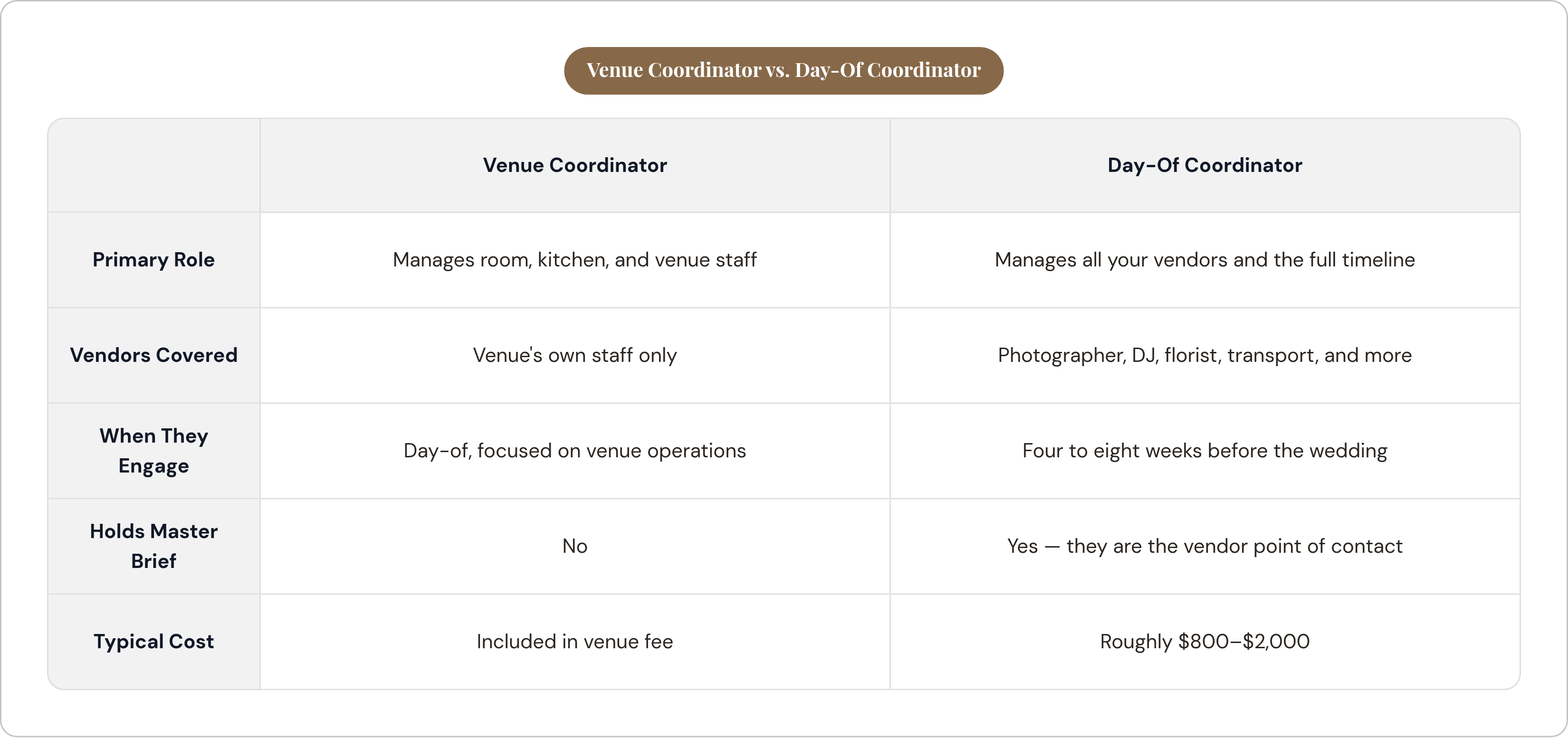
A venue coordinator manages the room, the kitchen timing, the noise curfew, and the venue's own staff. They do not manage your photographer, your DJ, your florist, or your transport. That's not their job, and expecting it of them is the single most common source of "the venue coordinator was useless" complaints. They weren't useless. They were doing a completely different job than the one you needed filled.
A day-of coordinator (sometimes called a month-of coordinator) steps in four to eight weeks before the wedding, learns your full plan, reviews all your contracts, builds or refines the timeline, and then manages every vendor on the day. They hold the master brief. They're the one vendors call. They're the one who puts out fires before you ever hear about them.
Cost-wise, day-of coordination typically runs less than full planning. The range you'll see quoted is $800 to $2,000 for day-of, versus $3,000 to $8,000 or more for full planning. For most multi-vendor weddings, day-of is sufficient.
If a professional coordinator genuinely isn't in the budget, a trusted friend or family member can fill this role. But they need the full master brief, all vendor contacts, and a real briefing beforehand. Every vendor must be told in advance that this person is their contact on the day. Not you.
Introduce them to key vendors before the wedding. A group email is enough. On the day itself, there are no introductions. Everyone already knows who to call.
Tracking Vendor Costs Against a Live Budget So Revised Quotes Don't Become Surprises
Most couples who go over budget didn't blow it on one reckless decision. It was drift. The florist's revised quote came in higher. The rental company added a delivery fee. The caterer's per-head cost went up. None of it got checked against a running total, because no running total existed. With a dozen vendors, modest price increases across several contracts add up fast, and quietly.
Pricing pressure in 2025 and 2026 is real in ways that are specific and worth knowing. A significant portion of vendors raised their rates due to higher operational costs. More than half of couples in one survey attributed vendor price increases to tariffs, which tracks given that roughly 80% of cut flowers sold in the US are imported. Caterers are facing meaningful per-guest cost increases too. These aren't abstract market forces. They show up in your revised quotes.
A static budget set at booking is not a budget tracker. Here's what you actually need to capture per vendor:
Original quoted price
Current agreed amount (if it changed)
Deposit paid
Balance due
Due date
Any outstanding items not yet priced
The Knot recommends a 5% contingency reserve. Treat that as a real line item, not a vague buffer. Set it aside before you start booking and consider it unavailable for anything other than genuine overruns.
Payment tracking belongs in the same master document as arrival windows and contact details. Chasing an unpaid balance and confirming a delivery time should happen in the same place. Separate systems are where information goes to disappear.
Contingency Planning as a Coordination Discipline, Not a Worst-Case Afterthought
Something will change on the day. That's not pessimism. That's just what happens when you have a dozen vendors, hundreds of moving parts, and a timeline with no tolerance for delays. The question is whether your plan can absorb those changes without them ever reaching the couple.
The failure modes worth pre-solving:
A vendor runs late. Who covers the gap? Who contacts the next vendor in the sequence? Does the timeline shift or compress? Decide this now, not at 11 AM when the florist texts that they're stuck in traffic.
Equipment fails. Does the DJ have a backup audio source? Does the venue have a PA the ceremony can use if something goes wrong with the main setup?
Weather affects outdoor elements. There should be a pre-agreed trigger point for moving indoors. Which vendors need to know first? Who makes the call?
A vendor cancels in the final week. Have you identified backup contacts? Not after the cancellation. At booking.
Contingency planning is also a vendor communication task, not just internal planning. Your photographer needs to know the backup ceremony location if the outdoor plan shifts. Your florist needs to know if the outdoor arch is moving inside. These are details to sort out well before the morning of the wedding.
The contingency plan lives in the master brief. It gets shared with the day-of point person and included in the pre-wedding vendor packs for anyone it directly affects. Couples who have pre-solved their failure modes don't have emergencies on the day. They have situations their plan already has an answer for.
Applying the Framework: What to Set Up First, and in What Order
Here's the sequence, and the order matters:
First: Create the master vendor brief before you book the second vendor. The structure comes first. You need the container before you have much to put in it.
Second: Build the reverse timeline as each vendor is confirmed. Assign arrival windows and flag interdependencies as you go, not all at once three weeks before the wedding when you've forgotten half the conversations you had.
Third: Add payment tracking to the same document. Original quote, current amount, deposit, balance, due date. One place. Not a separate spreadsheet that you'll forget to update.
Fourth: Designate your day-of point person early. They need enough lead time to actually learn the plan. Handing someone a 12-page document the night before is not a briefing.
Fifth: Send the vendor pre-wedding pack about two weeks out. Timeline, point-of-contact details, venue logistics, and a clear ask to confirm receipt or raise conflicts.
Sixth: Run a brief check-in in the final week. No surprises, no changes needed. If there are changes, you still have time to adapt.
Seventh: On the day, the couple's job is to be present. Not operational. Present.
The couples who feel calm on their wedding day aren't the ones who got lucky. They're the ones who made every decision about information, communication, and responsibility before the day started. By the time they're getting ready, there's genuinely nothing left for them to manage. That's not an accident. That's what this whole framework is for.