Vendor Risk Management Tools for Wedding Events
Scattered vendor tools create invisible gaps that surface on wedding day, not before.

When a florist changes their delivery window, that shift doesn't stay contained. It pushes setup back. Setup being pushed back affects when the photographer can arrive. The photographer's arrival time affects what the coordinator has scheduled. One change, four manual updates across four separate documents. Miss one, and you have a conflict nobody catches until the morning of the wedding.
This is what's called a coordination cascade. It's the structural reason scattered tools aren't just inconvenient. They're genuinely risky.
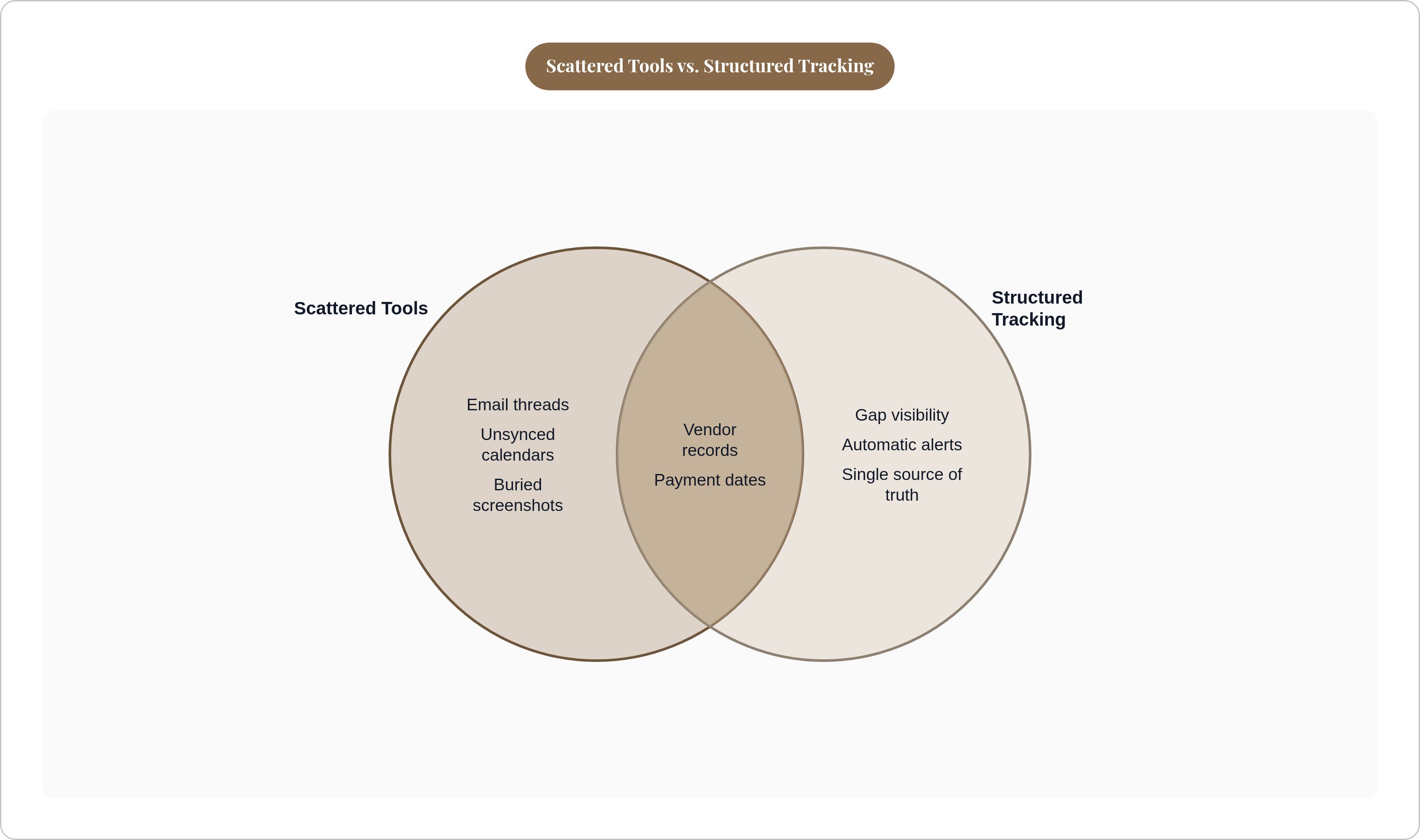
Professional wedding planners often work across five or more tools that don't share data. For couples doing this on their own, the setup is usually worse. Email threads. A shared spreadsheet of unclear origin. Screenshots of contracts buried in a camera roll. Calendar reminders scattered across two phones that don't sync.
What gets missed in that environment:
A vendor who has gone quiet for two months
A contract clause that directly conflicts with a verbal promise made at the tasting
A payment due date that passed while you were busy with something else
Dietary information collected from guests that was never forwarded to the caterer
The couples working in that environment often work harder, not less. The problem isn't laziness. It's that the system has no mechanism to surface what's missing. Nobody flags the blank cell. Nobody sends the alert. The gaps sit there, invisible, until the day they're not.
This scales badly. With a small number of vendors, informal tracking mostly works. As the count climbs toward 14, manual coordination becomes the single biggest bottleneck in the whole operation.
What Structured Vendor Tracking Looks Like Before a Contract Is Signed
The goal at this stage is systematic comparison. Not a chaotic inbox of quotes and scattered notes you'll dig through at midnight trying to remember what the caterer said about the vegan option.
For every vendor you're evaluating, before you sign anything, record:
Name, category, contact details, price quoted
What is explicitly included in the quote. And what is not.
Payment schedule and cancellation terms
Insurance and backup arrangements (does the photographer have a second shooter if something happens?)
References checked, and what you actually asked them
Any verbal promises made, noted with the date and who said it
That last one is the one people skip. And it's the one that hurts later. A promise not captured before signing is almost impossible to enforce after. "But you said the centerpieces would include orchids" is a weak argument when the contract reads "seasonal florals." You're left with a he-said-she-said situation and no bouquet to show for it.
Some questions worth asking every vendor before you sign:
What happens if you're sick or unavailable on the day?
Have you worked at this venue before?
Who exactly will be there on the day — you, or a staff member?
What's the latest you need final guest numbers, dietary requirements, and timing?
The pre-contract comparison phase also catches a specific budget problem that trips people up. When vendors are evaluated one at a time, each individual cost can seem reasonable. Approved individually, they collectively blow the allocation. Venue, catering, and photography alone account for the large majority of a typical wedding budget. Seeing them on the same page at the same time isn't just organizational. It's financial self-protection.
Contract Checkpoints That Surface Problems Couples Typically Miss
Most couples review a contract once, at signing. That's better than skipping it entirely, but it's not enough. The far more useful habit is a second review three to four months before the wedding, when the details are no longer hypothetical and the stakes are starting to feel very real.
When you do that second read, here's what to actually flag:
Force majeure clause. Does it cover what you think it covers?
Substitution rights. Can the vendor send someone else without notifying you?
Final payment deadline. Many require full payment 30 days before the wedding.
What constitutes a breach. And what the remedy actually is.
Cancellation terms in both directions. What happens if you cancel. What happens if they cancel.
Verbal promises and email confirmations deserve special attention here. Any commitment made outside the written contract should be appended to it in writing, or at minimum confirmed via email with an explicit reply from the vendor. A trail of unanswered emails you sent them is not a binding agreement. It's just evidence of your optimism.
Contracts also have a habit of hiding costs. Service charges, taxes, gratuity expectations, overtime rates, travel fees. These regularly contribute to the kind of budget shortfall couples discover when they tally up the real totals after signing.
A contract log helps. One document. Vendor name, signed date, payment schedule, key deadlines, and a note on what to re-read before the final confirmation call. Something that doesn't require hunting through email to find the relevant clause.
The Payment Schedule as a Risk Signal
Each payment milestone is not just a financial transaction. It's a scheduled contact point with a vendor, and a natural moment to confirm that everything is still on track. Treat it that way.
When a payment is due, use it as a prompt to:
Confirm the vendor's contact details are current
Confirm the person attending is still the person contracted
Flag any open questions since your last conversation
Ask whether anything has changed on their end. Staffing, suppliers, venue access.
A vendor who's slow to confirm receipt of payment, or who goes quiet at a payment milestone, is a meaningful signal. Not necessarily a problem. But worth a phone call, not just another email.
A typical deposit structure runs 25 to 50 percent at signing, with the balance due around 30 days before the wedding. That means by the time you make the final large payment, you're already inside the window where finding a replacement vendor is extremely difficult.
This is why the 60-day mark matters. That's realistically the last safe window to identify a vendor concern and act on it. Use the payment milestone just before that window as your prompt to do a full vendor review. Budget tracking and vendor risk tracking are essentially the same motion at this stage. Knowing when money leaves the account, and to whom, is both financial hygiene and a risk check at the same time.
How Dietary and Logistics Information Flows from Guests to Vendors. And Where It Breaks Down.
A significant portion of wedding guests arrive with at least one dietary preference, restriction, or allergy. At a guest count in the low-to-mid hundreds, that's not a rounding error. It's a logistical reality that requires an actual plan.
Here's the scenario that plays out more often than it should. The caterer asks for final meal counts two weeks before the wedding. The couple realizes the dietary information was collected at RSVP but never transmitted anywhere useful. What follows is a frantic round of individual outreach to guests, some of whom have already forgotten what they submitted.
The breakdown usually has a structural cause. Dietary information was collected in one place. Caterer communication lives somewhere else entirely. The two were never connected.
What connected information flow actually looks like:
Dietary questions built directly into the RSVP process, not sent as a separate follow-up email most guests ignore
Responses stored in a single guest record, not buried in a form submission email that nobody re-reads
A summary organized by table, so servers can locate guests with restrictions without checking individual cards at service time
One practical note: grouping guests with dietary needs together at a small number of tables, rather than scattering them across the room, makes day-of service significantly more manageable for catering staff. It sounds minor. It genuinely is not.
The same information flow problem applies to vendor access logistics. Venue arrival times, parking instructions, load-in sequences, freight elevator codes. These are details couples hold that vendors need, and they are often communicated too late, or communicated differently to different vendors, which creates its own cascade.
Building a Day-of Vendor Contact and Timeline Reference That Actually Gets Used
The day-of vendor sheet is the output of good pre-wedding tracking. If vendor details, timelines, and contacts have been maintained in one place across the planning period, producing this document takes minutes. If they haven't, it takes a frantic evening pulling information from three email accounts and a phone that's running out of storage.
What the document should include for each vendor:
Name, role, mobile number, and arrival window
Who they report to on arrival (coordinator, venue contact, or a named person from the couple's side)
Departure time and any post-event obligations (equipment pickup, rental returns)
A one-line note on anything that changed from the original contract
Who gets a copy matters. The couple, yes. But also whoever is acting as the on-the-day point of contact, the venue coordinator, and the officiant or MC if they're managing transitions. Not everyone needs the full document. Everyone needs their relevant slice of it.
Send the final seating chart and vendor timeline to the venue at least a week before the wedding. Not the morning of. The morning of is too late to fix anything that's wrong.
The timeline coordination problem gets worse when vendors don't know each other's schedules. The photographer doesn't know when the caterer finishes setup. The caterer doesn't know the ceremony ran long. A shared timeline distributed in advance is the lowest-cost intervention available, and it prevents more day-of collisions than almost anything else.
One more practical note: the day-of document needs to be reachable on a phone. Not locked in a laptop at the rental house. Keep it somewhere you can actually get to it.
What Backup Planning Looks Like in Practice for High-Risk Vendor Categories
Not all vendor categories carry equal risk. Some are replaceable with a phone call and a budget adjustment. Others are effectively irreplaceable within days or weeks of the wedding.
The ones worth explicit backup thinking:
Celebrant or officiant. Confirm at contract stage whether a backup person or agency can step in. Check whether a legal substitute can be arranged if the named person is genuinely unavailable. This is one of those details that feels overly cautious until it suddenly isn't.
Photographer. Ask at contract stage whether a second shooter is included, and whether the studio can supply a replacement. Not just a different camera operator. An actual photographer with a similar style and the technical skill to run the job.
Catering. Understand what happens if the head chef is unavailable. Ask whether the quoted menu is locked or subject to supplier substitution. More relevant than most couples expect.
Florist. Smaller operators carry higher risk for closures and supply chain failures. Ask whether arrangements can be sourced from a wholesale supplier if the florist can't deliver.
Music or DJ. Equipment failure is as common a risk as personal unavailability. Confirm backup equipment exists and confirm who is responsible for sourcing it if the primary fails.
Wedding insurance covers some vendor failure scenarios. Read what it actually covers before assuming it functions as a vendor replacement service. It usually does not work that way.
The 60-day review is the last realistic window for backup activation. Identify alternatives before they're needed. Scrambling after a problem surfaces is not the time to start a search.
One more thing worth accepting in advance: a backup is not always a full replacement. Sometimes it's a modified plan. Fewer flowers. A simplified menu. A local DJ instead of the one you booked from out of town. Knowing what an acceptable, scaled-back version of each vendor's contribution looks like takes real pressure off the day. Because you already had the conversation. You already made the call.
How to Build a Simple Vendor Risk Tracker Without Specialist Software
A spreadsheet. One row per vendor. That's the whole thing.
Columns worth including:
Vendor name and category
Signed contract: yes or no, plus date
Deposit paid: amount and date
Final payment due date
Last confirmed contact date
Second contract review completed: yes or no
Dietary and logistics information forwarded: yes or no, plus date
Backup option identified: yes or no
Day-of contact and arrival time confirmed: yes or no
The tracker's value isn't data storage. It's gap visibility. Any row with a blank cell in a field that should be complete by now is an open risk. You look at the spreadsheet. You see the blanks. You fix them before they become surprises.
Three natural review points to build into the planning calendar:
At contract signing. Complete the core columns.
60 days before the wedding. Second contract review, backup check, dietary information status.
14 days before. Final confirmation of arrival times, payment cleared, day-of sheet distributed.
Couples using an integrated platform where guest data, vendor records, budget tracking, and timelines share the same source get much of this automatically. The tracker above is the manual equivalent. And knowing what it needs to capture helps you evaluate whether any platform you're considering actually provides it, or just looks like it does.
With 14 vendors, two families, and a catering deadline, no system is going to be perfect. What a good tracker does is make the right questions visible at the right time. That's the whole job.