Digital Wedding Budgeting Tools for Couples Under Pressure
Regional costs and rising vendor rates make wedding budgets fail before couples even start.

Wedding budgets don't fail because couples are irresponsible. They fail because the whole setup is designed to go sideways. The numbers are moving targets, the costs are geographically specific, and most couples are walking in completely blind — like trying to hit a bullseye on a dartboard that keeps sliding down the wall. The right digital budgeting tool doesn't just give you a place to log expenses. It connects every spending decision to the rest of your planning so you can see the full picture before you commit, not after. Here is what to look for, and why it matters more than most planning advice lets on.
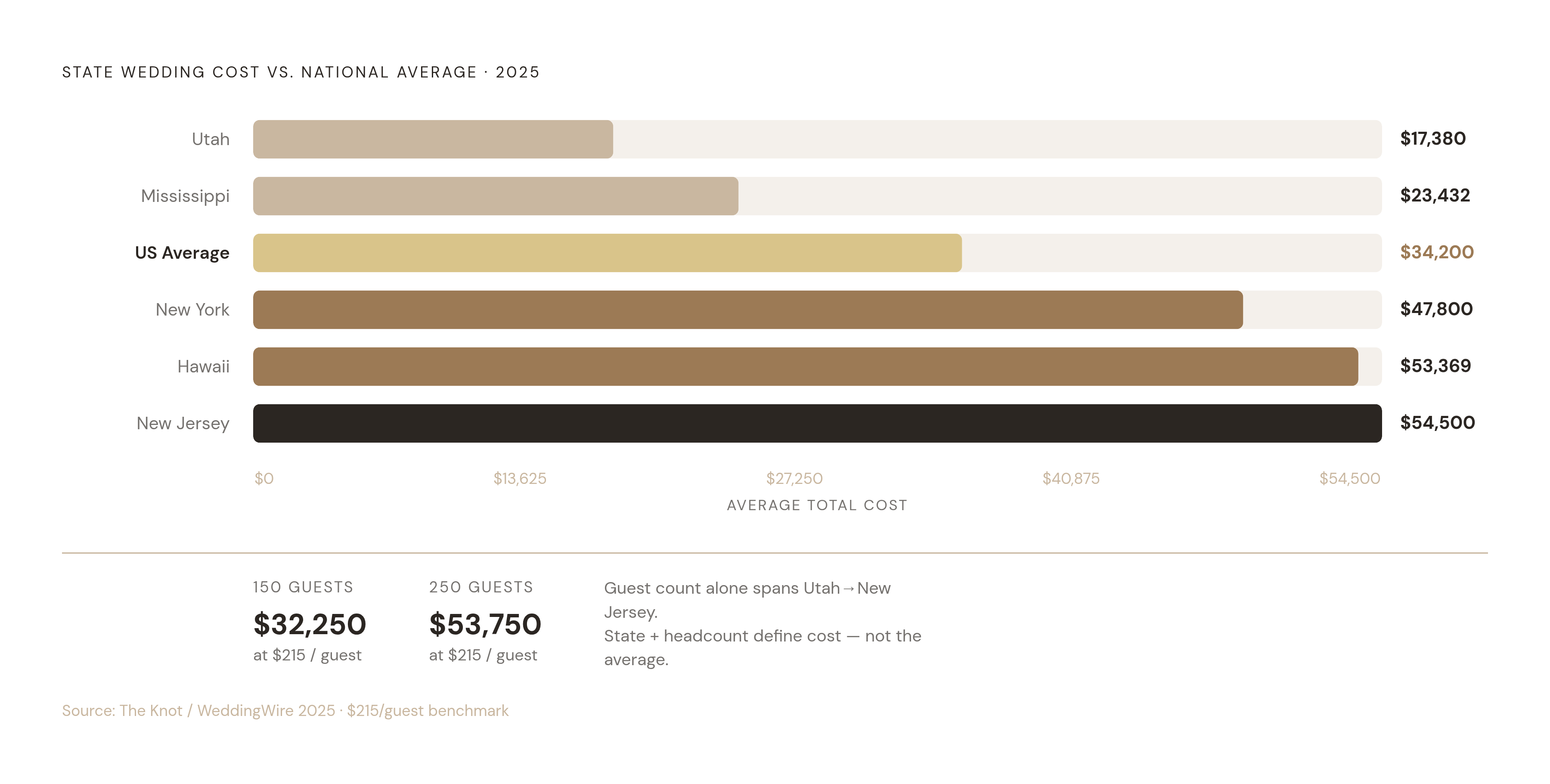
The national average for a US wedding in 2025 was $34,200, according to The Knot's 2026 Real Weddings Study of over 10,000 couples. Sounds useful until you see where you actually live. New Jersey averaged $54,500. Hawaii came in at $53,369. New York sat at $47,800. Meanwhile, Utah averaged $17,380 and Mississippi $23,432. A couple in New Jersey planning to a national average isn't being optimistic. They are structurally underfunded from the moment they write down their first number. And costs are still climbing. In 2025, 83% of vendors reported higher operational costs, and 77% raised their rates as a result. Basic wedding elements cost roughly 20% more than four years prior. Labor rates are up 30% to 50% since 2020. Florals are especially volatile because roughly 80% of US cut flowers are imported, and current tariffs have pushed floral design costs up 15% to 25%.
A more useful anchor than any national average is this: roughly $215 per guest. That figure from WeddingWire reframes the conversation entirely. Your guest count isn't a social decision with a side effect on the budget. It IS the budget decision. Most couples don't realize that until they're already three vendor quotes deep.
How the Overspending Happens (and Why It's Not Your Fault)
Let's start with a number that should make everyone feel a little better and a lot more alarmed. In a 2025 LendingTree survey of over 1,000 US newlyweds, 67% went into debt for their wedding. Nearly 60% increased their initial budget. Roughly half exceeded their original estimate. This is not a story about a few couples who got carried away. This is the norm.
Three structural traps cause most of the damage.
Micro-spending. The small ribbon order. The modest calligraphy addition. The $120 last-minute rehearsal dinner detail. None of these feel significant on their own. Together, they routinely become meaningful overruns that never got flagged because they were never tracked individually.
Hidden fees. Three out of four couples hit at least one surprise fee during planning. Service charges, delivery minimums, venue add-ons, cake-cutting fees. These aren't surprises in hindsight. They're structural features of the wedding industry. A good tool anticipates this category before you encounter it.
The reality gap. 91% of couples get inspiration from social media. About 48% struggle with the gap between what they see online and what their budget can actually support. And 68% of couples vet vendors via Instagram and TikTok, which surfaces premium options disproportionately. You're not browsing a representative sample. You're browsing the most beautiful and expensive examples in the world.
Now layer in the context. Only 13% of couples have wedding savings set aside when they start planning. 91% are getting married for the first time. They have no prior experience to calibrate against. At the same time, 76% receive a fixed dollar amount from family regardless of what the wedding ends up costing. 75% are also saving for a honeymoon. 62% are saving for a house. 51% are paying off student loans. The wedding budget isn't just competing with itself. It's competing with everything.
52% of newlyweds wish they had spent differently. And here's the genuinely interesting part: that regret splits almost evenly between people who wish they'd spent more and people who wish they'd spent less. The problem isn't usually the total number. It's the allocation. The right tool doesn't just help you spend less. It helps you spend in the right places.
What a Spreadsheet Can and Cannot Do
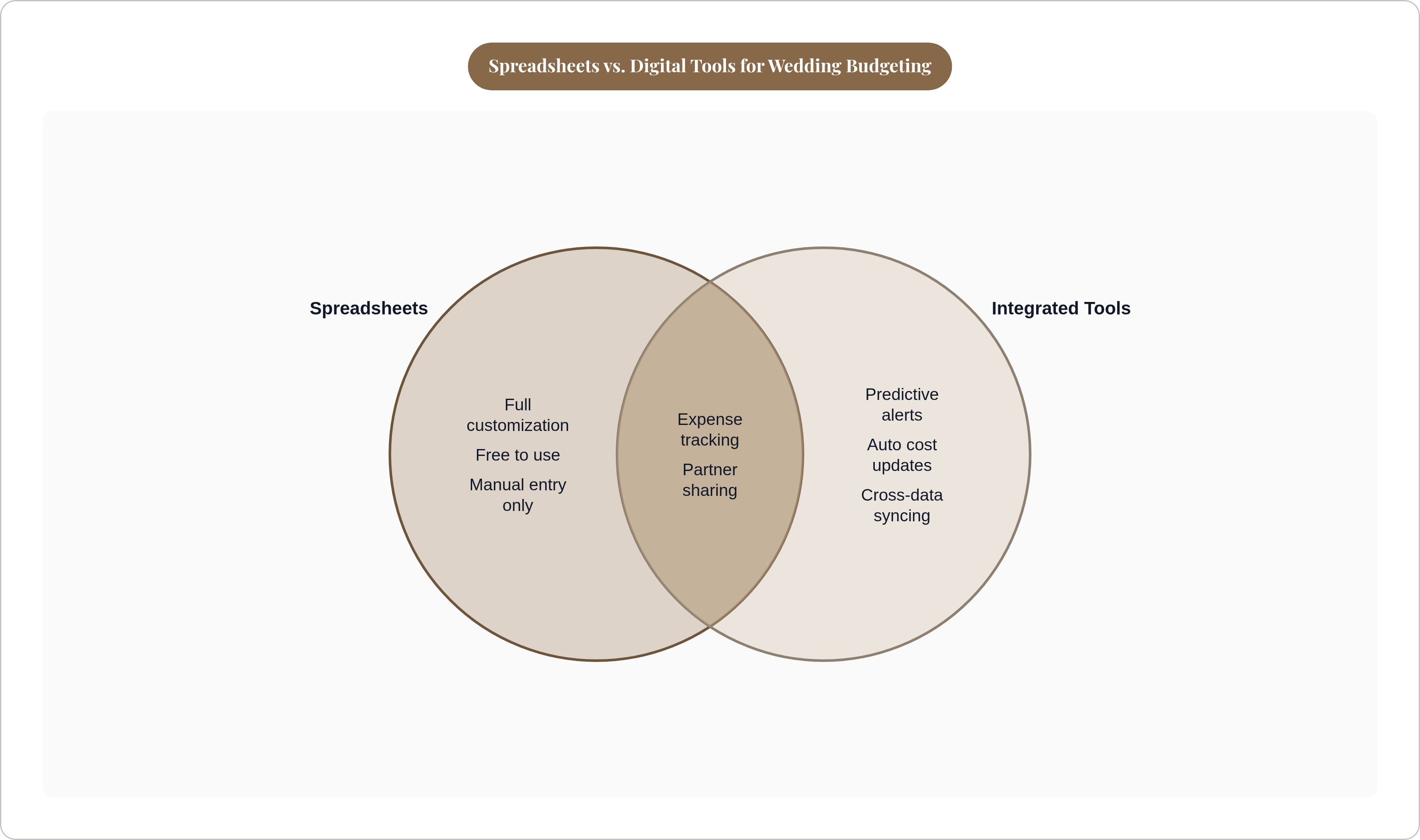
A spreadsheet does several things genuinely well. It gives you full visibility. You can customize every category. It's free. You can share it with your partner. For some couples, especially those who are methodical and manually disciplined, it works fine.
But wedding planning is a roughly 20-month process. And a spreadsheet is static. It only knows what you manually enter into it.
Here's where that breaks down in practice. Picture Sarah and Tom, eight months into planning their wedding. They'd been meticulous — or so they thought. Every vendor quote was dutifully entered, every deposit logged. Then they added twelve guests to the list, bumped up from the next lower catering tier, and quietly unlocked an entirely new cost bracket at the venue. The spreadsheet sat there, unchanged and cheerful, showing a total that had nothing to do with reality anymore. By the time they noticed, they were already committed to the new headcount and three vendors had been booked at the old pricing logic:
Your guest count changes. The per-head cost estimate doesn't update automatically.
A vendor sends a quote to your inbox. The spreadsheet doesn't know.
A payment clears your bank account. The spreadsheet still doesn't know unless you go update it.
A category starts trending over. There's no alert. You have to remember to check.
Dietary requirements are in one document. The seating chart is in another. RSVPs are in a third. Reconciling them happens manually, usually the week before the wedding.
14% of couples say they were too stressed to fully enjoy their wedding day. A spreadsheet doesn't reduce that stress. In most cases, it quietly creates the conditions for it, because the overhead of maintaining it perfectly is enormous and grows with every new variable you add.
The question isn't really "spreadsheet versus tool." The question is: what does the tool need to do that a spreadsheet structurally cannot?
The Features That Actually Reduce Pressure Versus the Ones That Just Look Good
There's a clean way to divide wedding budgeting features into two categories. Recording features capture what already happened. Anticipatory features warn you before something goes wrong.
Most tools are heavy on recording and light on anticipatory. That's not useless, but it's not where the real value is under pressure.
Recording features worth having:
Estimated versus actual tracking per category. If your florist comes in under budget, that savings should be visible and reallocatable immediately.
Payment status tracking. Deposits, due dates, outstanding balances. In a 20-month planning window, something will slip if this isn't surfaced automatically.
Category breakdowns that match how weddings actually cost. Venue and catering. Photography. Florals. Entertainment. Not generic expense buckets that make you do translation work.
Anticipatory features that separate real tools from decorated spreadsheets:
Real-time spend tracking against allocations. Couples who track actual costs in real time are 30% more likely to stay under budget than those who check totals monthly, according to an analysis by ourvows.app. That gap is not small.
Predictive alerts. The better 2025 apps are now surfacing warnings like "based on your current decor spending, you're projected to exceed your total budget significantly." That is the kind of information that changes a decision. A spreadsheet never tells you this.
Guest-count-to-cost linkage. When five guests are added, the per-head costs should update. Automatically. Without you remembering to do the math.
There's also a simple integration test you can apply to any tool: does it reduce the number of times you have to re-enter the same information? If the answer is no, it's a digital spreadsheet with nicer formatting.
How the Main Digital Budgeting Tools Compare on What Actually Matters
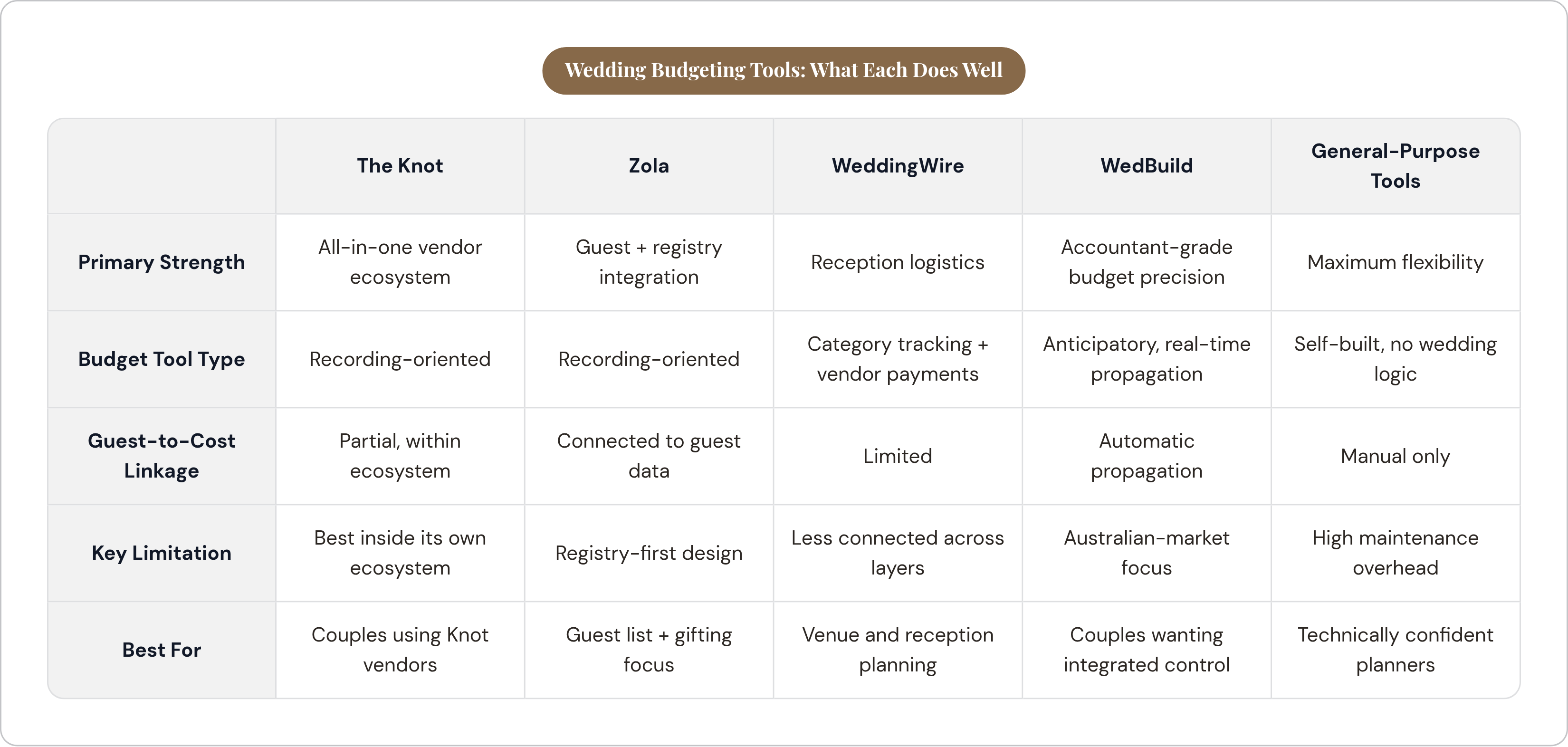
This isn't a ranking. It's an honest look at what each platform does well and where it stops.
The Knot is a strong all-in-one platform. It has a customizable checklist, a budget advisor, and a guest list manager that tracks RSVPs and meal choices. The vendor discovery and AI style tools are integrated. Its budget tool is sophisticated, but it's primarily recording-oriented. It works best for couples already deep in The Knot's vendor ecosystem, where the connections between tools are most meaningful.
WeddingWire offers a free budget planner with category adjustment, vendor payment tracking, and spend breakdown. The seating chart uses drag-and-drop and mirrors actual floor plans, which coordinators can export directly. It's particularly strong on reception logistics, and its vendor directory is useful for gathering quotes. Less tightly connected across all planning layers, but solid on the tools it does offer.
General-purpose tools like Notion, Trello, and Google Workspace offer maximum flexibility. You can link vendor contracts directly to budget line items and timeline blocks. But there's no wedding-specific logic. Guest count doesn't propagate to cost estimates automatically. You build and maintain every connection yourself. High ceiling for technically confident couples. High overhead for everyone else.
Why Integration Is the Actual Budget Control Mechanism
The common thread in how wedding budgets fall apart is not carelessness. It's that information lives in disconnected places, so a change in one area doesn't register anywhere else until it's too late.
The guest list chain is the clearest example. Adding five guests doesn't just change a headcount. It changes per-head catering costs, seating layout, stationery quantities, and potentially your venue capacity tier. In a siloed setup, each of these requires a separate manual update. In an integrated platform, one input change propagates to all of them.
The vendor chain works the same way. Quotes collected through a structured comparison tool should create budget line items directly, rather than require a copy-paste step from your inbox. Payment milestones should live next to the budget allocation, not buried in an email thread from eight months ago.
The dietary-to-seating chain is a planning failure that happens at almost every wedding using disconnected tools. The dietary requirements were collected at RSVP. Nobody connected them to the seating chart. The morning of the wedding, someone is manually cross-referencing two separate documents under time pressure. That information was always there. It was just never linked.
The planning window is long. Decisions made early, like venue and guest count, have cost effects that show up months later. A connected platform makes those downstream effects visible at the time of the decision, not when the invoice arrives.
A large majority of wedding professionals using dedicated software report happier clients and fewer logistical problems, per The Knot's 2025 Planner Survey. The professional side of the industry figured this out already. The consumer tools are catching up.
How to Set a Wedding Budget That Stays Realistic From the First Number You Write Down
Start with geography and guest count. Not a total.
Look up average costs for your state or region before you settle on any number. The gap between Utah and New Jersey makes the national average almost useless as a planning anchor. If you're in a high-cost market and plan to a low-cost average, you will be underfunded before you talk to a single vendor.
Then set your guest count before your total budget. At roughly $215 per guest, the headcount decision is effectively the budget decision. Nail that number down before anything else.
Allocate by category before you approach vendors. The standard benchmark puts venue and catering at roughly half of total spend. Photography and videography together represent a substantial second allocation. Everything else divides the remainder. Having category allocations before you collect quotes means every quote lands in a context. It either fits, or it forces an explicit trade-off rather than a slow drift into overspending.
A few practical rules that hold up across almost every budget:
Build in a meaningful buffer. Three out of four couples hit at least one unexpected fee. This isn't pessimism. It's planning.
Make guest count changes formal decisions. Every addition is a budget decision. Treat it like one.
Track spending in real time, not at the end of the month. The 30% difference in budget adherence between real-time trackers and monthly reviewers is not a small number.
Use a tool that reduces re-entry. Every time you copy information from one place to another, you're creating a version-control problem and an opportunity for something to fall through.
The couples who finish planning without financial regret aren't the ones who had the most money. They're the ones who made allocation decisions deliberately, saw the downstream effects before they committed, and used tools that helped them do both. That is a solvable problem. The tools exist. You just have to pick the one that's actually connected.